Showing posts with label Church and Culture. Show all posts

Wednesday, April 20, 2011

Should progressive churches accommodate? Or should they challenge the culture? (Keith Watkins)

Keith Watkins, whose postings have appeared here before, has written an interesting engagement with the book In Search of Paul, by John Dominic Crossan and Jonathan Reed.  It comes as part of a larger conversation about adaptive change that Keith has been having at his blog, and the question raised here concerns whether or not the church should accommodate with or challenge the culture.  Crossan and Reed suggest how Paul would answer the question, and and Keith uses their analysis to ask the question of to what extent it is appropriate for the contemporary church to accommodate and to what extent it should seek change.  It is an important question, and I invite you to read and respond -- and of course visit Keith's blog.  Keith is Professor Emeritus at Christian Theological Seminary.  This essay is reposted with Keith's permission. 


*****************************

The central thesis of adaptive change is that in order to thrive in a new environment churches and other institutions need to change their patterns. Accommodation to the culture therefore seems to be the key to vitality and growth. Three books that I have reviewed in recent columns support this thesis: Leadership Without Easy Answers; God Is Back; Finding a Spiritual Home.

A contrarian’s point of view, however, is presented by Paul, the church’s first theologian. Not accommodation but radical challenge was his prescriptive counsel to the churches, or so John Dominic Crossan and Jonathan L. Reed assert in their book

“The Roman Empire,” they claim, “was based on the common principle of peace through victory or, more fully, on a faith in the sequence of piety, war, victory, and peace.” Paul, however, a Jewish visionary inspired by Jesus, “opposed the mantras of Roman normalcy with a vision of peace through justice or, more fully, with a faith in the sequence of covenant, nonviolence, justice, and peace.”

Crossan and Reed believe that Paul’s challenge is as great today as it was then. “Paul opposed Rome with Christ against Caesar, not because that empire was particularly unjust or oppressive, but because he questioned the normalcy of civilization itself, since civilization has always been imperial, that is, unjust and oppressive.”

At the heart of Roman civilization was an “imperial theology” which was persuasively expressed wherever Roman military power held sway by two elements.

The imperial cult (or patterns of public religious activity) “which housed deified emperors in temples from Thessalonica to Ephesus,” and which was able to include the gods of conquered peoples in the galaxy of Roman deities.

The cult of luxury, “which brought urban amenities in the form of aqueducts, baths, and entertainments to cities from Asia to Syria.”

Central to Paul’s alternative vision of life in the world was his presentation of Christ as the alternative to Caesar. Since the Caesars were elevated to divine status, as gods in this world and the next, Paul also emphasized strands of the Christian tradition that interpreted Jesus as Son of God, as the embodiment in human form of the very God whom Jews had proclaimed from ancient times.

Among the major characteristics of Roman civilization were a significantly unequal distribution of the basic commodities of life and a distribution of power and privilege that was radically hierarchical. Paul’s vision of the world God intended, a world that Paul believed was already present, included an equally radical redistribution of resources and power. At every point, he could point to Jesus as exemplar of this alternative view of life in the world.

Both of these elements of Paul’s social vision were to be expressed uncompromisingly in the life of the church.

For Crossan and Reed, the most illuminating and decision biblical text is Galatians 3:27-28, in which Paul asserts that because they had been “clothed with Christ” there could no longer be divisions of race, gender, or social status “for all of you are one in Christ Jesus.”

Paul recognized that Christians lived in Caesar’s world and reluctantly acknowledged that they might need to accommodate themselves to patterns of behavior in that world. With great force, however, he insisted that these accommodations should never be tolerated in the church itself.

The imperial cult in contemporary American life is not as explicitly religious as it was in Paul’s Roman world. The statue of our sixteenth president in Washington’s Lincoln Memorial, for example, inspires deep feelings of respect rather than the reverence that was expected when gazing upon statues of the divinized emperors in temples all around the Roman world. Yet to read some of the literature about Lincoln long ago, and perhaps even more about Ronald Reagan of recent date, one could believe that the line between honor and reverence is easily (and often) crossed.

Furthermore, there is a tendency in many churches today to link material gain—the amenities of life made possible by the American version of capitalism—with the gospel. In some strange way, following Jesus, who had no place to lay his head, becomes the way to enjoy a prosperous and comfortable life.

Even as they work at adaptive change, therefore, church leaders need to be thoughtful in their efforts to transform the culture of Christian worship.

Perhaps the central question is this: what accommodations are legitimate as we deal with the need to live effectively in our world? Stated in contrasting fashion: What should we seek to change? And what must ever be the same?

Thursday, April 14, 2011

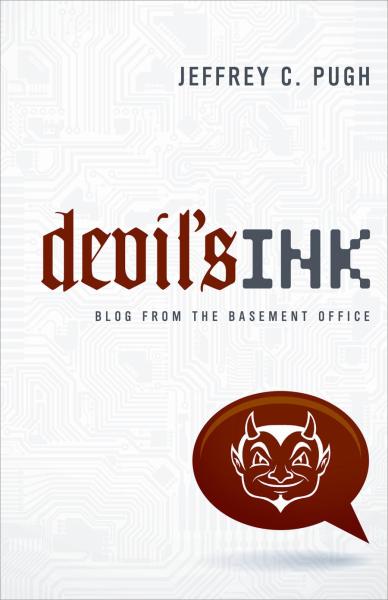
Devil's Ink -- Review

DEVIL’S INK: Blog from the Basement Office. By Jeffrey C. Pugh. Minneapolis: Fortress Press, 2011. Xiv +193 pages.

Many years ago C.S. Lewis wrote a book entitled The Screwtape Letters, which was supposedly a collection of letters written by the Devil to his minions offering guidance on how to deal with the “enemy.” One of the most famous quotations from the Lewis book warns against two opposing errors:

There are two equal and opposite errors into which our race can fall about the devils. One is to disbelieve in their existence. The other is to believe, and to feel an excessive and unhealthy interest in them. They themselves are equally pleased by both errors and hail a materialist or a magician with the same delight.

Nearly seventy years after Lewis wrote The Screwtape Letters, Jeffrey Pugh has written Devil’s Ink, which takes inspiration from Lewis even if the format and theology might be different. Whereas Lewis used the letter as the basis of his exploration of the problem of evil in the world, Pugh makes use of the blog, a more modern form of communication.

The author of this book is ostensibly the Devil, but you might say that the Devil has a ghost writer in Jeffrey Pugh, a professor of religious studies at Elon University in North Carolina and author of several books, including one on Dietrich Bonhoeffer. The Devil’s posts offer advice and direction to the Devil’s minions as they work to undermine the efforts of the Enemy – God – and the Body (Christ).

As for the author’s purpose, Pugh takes up this particular form of communication to help contemporary Christians wrestle with the problem of evil, especially as evil seeks to co-opt the church and its people. Although Lewis is an influence on this book, Pugh has done more than simply change the format. His picture of the Devil has had to change, because our understanding of evil has changed over the past seven decades. The starting point for this book is revealed in a rather succinct way in a sentence found in the opening paragraphs of the book: “Devil’s Ink explores how evil arises in stealthy ways in popular culture” (p. xi). But, not only does he want to shine a light on the presence of evil within popular culture, he wants to raise the specter of evil gaining access to the church through popular culture – and we’re not just talking about going to movies and listening to Rock & Roll. No, we’re talking about the way that, for instance, American culture can impact the way the church sees itself and acts in the world.

In the opening blog post “the Devil” reveals that he has chosen this format because it’s important to be “flexible and innovative or we risk losing influence.” Then he goes on to say that “if there is one thing that I fear, it is losing influence” (p. 1). As we hear this word, it’s important to remember that the audience of this book is the church, not the minions of Satan. Thus, right off the bat we’re challenged to consider how easy it is for evil to get a foothold in the church, not to mention the nation in which we live. Thus, in this “introductory post” we’re warned about the dangers of seeking influence over others, for that is the “Devil’s” game. He notes he could have used Facebook or Twitter, but the blog seemed to be the best forum, and as you read the book you will agree that the blog makes the most sense for this kind of work. The postings are, for the most part, relatively long – often covering two or more pages. There is depth here that other forms of communication can’t offer. As an aid to understand the meaning of the posting, the author provides tags, which are then explained in a glossary at the end of the book. These are revealing in and of themselves.

As to how to read the book, Pugh notes that it’s best not to try to read this all at once. Remember you’re reading posts from the Devil, so take it in small bites. And as a further reminder about how this book is to be read, the Devil notes that the Minions of Hell must make sure not to let this information leak out to the enemy – “So none of you better go all Julian Assange on me or I will have you for lunch –literally” (p. 3).

The Devil begins with several postings on desire, which he says is “truly one of the best instruments in our toolbox,” (p. 5) and then moves on to such issues as suffering, the desire for control over one’s life and the lives of others, the dangers of religion and government becoming intertwined, for as the title of one blog post puts it – “Play in Caesar’s Ballpark, Play by Caesar’s Rules" – suffering and theodicy, allegiances, money, fear, terrorism, spirituality, grace and justice, torture and science, and more. There are really very few issues that don’t warrant some comment.

As for point of view – the one that lies behind the Devil’s words of advice – Jeffrey Pugh seems to be of a Hauerwasian perspective. There is a strong sense of the importance of community, and as with Hauerwas a strong suspicion of the effects of government/political entanglements. Thus, he writes that “it works best for us when they confuse the need for order with the existence of the state” (p. 86). A few paragraphs later he writes, revealingly:

The citizens of the state invest it with the power to regulate persons so they might be secure. But in order to protect them from one another, the state must assume increasing control of their lives. What starts out as something that seems so innocent will eventually end up just where we hope – in absolute control and dominance of their bodies, and if all goes well, their souls (p. 87).

But, while government ultimately is useful to control the soul of the person, it is not alone in its ability to use violence for its own purposes – religions have shown themselves quite able and willing to resort to violence to pursue their own purposes.

In each post, the Devil reminds us that we are susceptible to influences that are cunning and resourceful. One needn’t fear the presence of a demon hiding out under every rock, but one should be and discerning and perceptive. As Jesus said, you should be as innocent as doves and wise as serpents. In the end, however, the point of contention is not the presence of the Devil, but our perception of God’s absence. The “truth of this story” concerns the reality that what drives our modern world is the fact that humanity lives as if God is absent. And thus, this means that humanity falls into the waiting hands of the Devil. He writes:

What is even better, from our perspective, is that the gods they do create in their religions to justify their orders are locked in violent struggle with one another. Many of them think that the other’s deity is a threat to their worlds. They may be right (p. 168).

Thus, whether we live as if God doesn’t exist or use our religions to justify violence, either way the Devil wins!

As Lewis noted, we need to stay away from the two extremes – one in which we focus all our attention on finding the demons under the rocks and on the other hand living as if evil is not even present. The truth is, evil is present and it does on too many occasions find its way into the life of the church. Thus, even if one doesn’t find every posting to be of relevance or in accord with one’s own perspectives, most readers will find much of value in these relatively brief postings.

The author has taken great pains to root these postings in a cogent and coherent theological foundation, and as for the Devil, whether or not you believe in a spiritual-physical being known as Satan (the Devil), I believe that you will find this to be a worthwhile read. That issue is rather beside the point, because in this particular book, the Devil serves as a personification of the kinds of evil that we face in our daily lives. In fact, by focusing on the “physicality” of the Devil, would likely lead us astray and keep us from hearing a word directed to ourselves. Thus, if you choose to read this book, you will experience something that is entertaining and innovative, while be exceedingly serious as well. If Lewis provided the church with a classic text in the 1940s, perhaps this will be a new classic for decades to come.

Article first published as Review: Devil's Ink: Blog from the Basement Office by Jeffrey C. Pugh. on Blogcritics.