Showing posts with label Paul. Show all posts

Wednesday, April 20, 2011

Should progressive churches accommodate? Or should they challenge the culture? (Keith Watkins)

Keith Watkins, whose postings have appeared here before, has written an interesting engagement with the book In Search of Paul, by John Dominic Crossan and Jonathan Reed.  It comes as part of a larger conversation about adaptive change that Keith has been having at his blog, and the question raised here concerns whether or not the church should accommodate with or challenge the culture.  Crossan and Reed suggest how Paul would answer the question, and and Keith uses their analysis to ask the question of to what extent it is appropriate for the contemporary church to accommodate and to what extent it should seek change.  It is an important question, and I invite you to read and respond -- and of course visit Keith's blog.  Keith is Professor Emeritus at Christian Theological Seminary.  This essay is reposted with Keith's permission. 


*****************************

The central thesis of adaptive change is that in order to thrive in a new environment churches and other institutions need to change their patterns. Accommodation to the culture therefore seems to be the key to vitality and growth. Three books that I have reviewed in recent columns support this thesis: Leadership Without Easy Answers; God Is Back; Finding a Spiritual Home.

A contrarian’s point of view, however, is presented by Paul, the church’s first theologian. Not accommodation but radical challenge was his prescriptive counsel to the churches, or so John Dominic Crossan and Jonathan L. Reed assert in their book

“The Roman Empire,” they claim, “was based on the common principle of peace through victory or, more fully, on a faith in the sequence of piety, war, victory, and peace.” Paul, however, a Jewish visionary inspired by Jesus, “opposed the mantras of Roman normalcy with a vision of peace through justice or, more fully, with a faith in the sequence of covenant, nonviolence, justice, and peace.”

Crossan and Reed believe that Paul’s challenge is as great today as it was then. “Paul opposed Rome with Christ against Caesar, not because that empire was particularly unjust or oppressive, but because he questioned the normalcy of civilization itself, since civilization has always been imperial, that is, unjust and oppressive.”

At the heart of Roman civilization was an “imperial theology” which was persuasively expressed wherever Roman military power held sway by two elements.

The imperial cult (or patterns of public religious activity) “which housed deified emperors in temples from Thessalonica to Ephesus,” and which was able to include the gods of conquered peoples in the galaxy of Roman deities.

The cult of luxury, “which brought urban amenities in the form of aqueducts, baths, and entertainments to cities from Asia to Syria.”

Central to Paul’s alternative vision of life in the world was his presentation of Christ as the alternative to Caesar. Since the Caesars were elevated to divine status, as gods in this world and the next, Paul also emphasized strands of the Christian tradition that interpreted Jesus as Son of God, as the embodiment in human form of the very God whom Jews had proclaimed from ancient times.

Among the major characteristics of Roman civilization were a significantly unequal distribution of the basic commodities of life and a distribution of power and privilege that was radically hierarchical. Paul’s vision of the world God intended, a world that Paul believed was already present, included an equally radical redistribution of resources and power. At every point, he could point to Jesus as exemplar of this alternative view of life in the world.

Both of these elements of Paul’s social vision were to be expressed uncompromisingly in the life of the church.

For Crossan and Reed, the most illuminating and decision biblical text is Galatians 3:27-28, in which Paul asserts that because they had been “clothed with Christ” there could no longer be divisions of race, gender, or social status “for all of you are one in Christ Jesus.”

Paul recognized that Christians lived in Caesar’s world and reluctantly acknowledged that they might need to accommodate themselves to patterns of behavior in that world. With great force, however, he insisted that these accommodations should never be tolerated in the church itself.

The imperial cult in contemporary American life is not as explicitly religious as it was in Paul’s Roman world. The statue of our sixteenth president in Washington’s Lincoln Memorial, for example, inspires deep feelings of respect rather than the reverence that was expected when gazing upon statues of the divinized emperors in temples all around the Roman world. Yet to read some of the literature about Lincoln long ago, and perhaps even more about Ronald Reagan of recent date, one could believe that the line between honor and reverence is easily (and often) crossed.

Furthermore, there is a tendency in many churches today to link material gain—the amenities of life made possible by the American version of capitalism—with the gospel. In some strange way, following Jesus, who had no place to lay his head, becomes the way to enjoy a prosperous and comfortable life.

Even as they work at adaptive change, therefore, church leaders need to be thoughtful in their efforts to transform the culture of Christian worship.

Perhaps the central question is this: what accommodations are legitimate as we deal with the need to live effectively in our world? Stated in contrasting fashion: What should we seek to change? And what must ever be the same?

Thursday, March 24, 2011

I'm Thirsty -- A Lectionary Meditation

Exodus 17:1-7


Romans 5:1-11


John 4:5-42


I’m Thirsty

Water is essential to life. The human body is somewhere between 55% and 78% water, and water covers about 70% of the earth’s surface. Although we can go a while without water, eventually we’ll die without water. Water and life – they go hand in hand.

Two of the texts for this Third Sunday of Lent focus on water. Moses has to deal with a people who complain vociferously because they don’t have water to drink, while Jesus finds himself tired and thirsty and sitting next to Jacob’s well. He doesn’t complain, but he does ask for water! As we think about water and thirst we might want to look ahead for a moment to Jesus’s cry from the cross – I Thirst (John 19:28). Paul’s not quite ready to get to the water (Baptism appears in Romans 6), but he deals with the issue of suffering and hope, ideas that are present in the other two texts. Each of these scriptures remind us that no matter how difficult the journey, God is present and faithful.

In the Exodus story, the people have again grown cantankerous. Although God provided food for the journey – not that they enjoyed the menu – now they’re thirsty. This leads to quarreling and complaining to Moses – why, they ask, have you led us out here into the wilderness so that we might die of thirst. You would have thought that they preferred slavery in Egypt, and perhaps they did. We often prefer the misery we know to the potential misery that might face us in the unknown. With all the harping and complaining, Moses grows frustrated with this people God had entrusted to his care. They were never satisfied, no matter what God did – whether it was the rescue from the clutches of Pharaoh’s army or the manna from heaven – they weren’t satisfied. Wanting water they begin to quarrel amongst themselves, and Moses cries to God – “What am I to do with this people? They’re ready to stone me.” As I read this, I’m reminded of political leaders, especially Presidents, who find that they can never satisfy the populace, no matter what they do. It’s never enough!

But God is gracious and hears Moses, telling him to gather the Elders and then go out ahead of the people. God tells Moses to meet at the Rock at Horeb, and there in front of the Elders, Moses does as God commanded. He strikes the rock with the staff he had used to strike the Nile, and from that rock sprang water to quench the thirst of the people. God had provided, but in a bit of frustration, Moses calls this place Masseh and Meribah, because the Israelites “quarreled and tested the Lord saying - “is the Lord among us.” I sense that the word we need to hear in this story concerns typical human behavior – even in the church – in spite of our complaining and insolence, God is faithful. So instead of complaining, let us give thanks to God.

Before we turn to story of Jesus’ encounter with the woman at the well, we must heed Paul’s discourse in Romans 5. The chapter begins familiarly – “Since we are justified we have peace with God through the Lord Jesus Christ, through whom we have obtained access to the grace in which we stand.” In Christ we’re justified, saved, and reconciled. I’m afraid it’s easy to read this passage in a very transactional way. We’re sinners who face the wrath of God, and Jesus’ blood substitutes for our blood. For centuries theologians have interpreted the cross in a quid pro quo fashion – the life of Jesus for my life. But why does God need blood to be satisfied? What is it that I have done that requires the death of another, especially one who is innocent of all changes? I struggle with the idea of divine wrath. I don’t have space to delve into this question here in this place, but perhaps there is another way of reading this text. Maybe the issue is one of separation between Jew and Gentile – in the cross a way has been created that brings the two together. I don’t know, but what I do hear in this text is a promise that no matter what happens there is hope. Suffering, which we all experience, produces endurance, and endurance leads to character, and character builds hope, and as Paul says – this hope doesn’t disappoint. That is because God’s love has been poured into our hearts through the Holy Spirit. That is the message we need to hear – not that we’re miserable sinners who need someone to suffer our due punishment so that God will accept us. No the word we should hear in this text is that God’s love will transform our lives in ways that lead to hope. That is a word of salvation.

Finally we come to the story Jesus’ encounter with the Samaritan woman at Jacob’s Well. According to John, Jesus is sitting by the well because he’s tired. He’s on his way to Jerusalem, where he will taste suffering The disciples have gone into town to get some food. It’s about noon when a woman comes to the well to draw water, and so Jesus asks her to draw him some water to drink, because he’s thirsty. This woman is caught off guard because Jesus is a Jew and she’s a Samaritan (and a woman) so why is he asking her for water? My guess is that he’s thirsty and she has the means to get him a cup of water, but that’s too simple an explanation. The point isn’t the physical thirst, but the spiritual thirst that lies within. The request for water leads to a theological discussion, but first Jesus has to overcome the woman’s literalist mind set, just as he had to do in John 3 with regard to Nicodemus. That’s just the way we are – we think literally first and only later are we able to move onto something more spiritual in nature.

Having asked the woman for a cup of water, Jesus in turn offers the woman living water. At first she can’t comprehend what he’s saying. How can Jesus offer her living water when he doesn’t have a bucket to draw water with. But, when Jesus says that once she drinks this living water she’ll never thirst again, she becomes intrigued. How does this happen? But, besides that, this well belonged to Jacob. How could any other water exceed it in value? Still, water that fulfilled thirst eternally, that was worth pursuing. Having such water would eliminate the need to come to the well. As she’s contemplating this reality, Jesus tells her to go and get her husband. Of course, she’s not married, but apparently he already knows this. In fact, although she’s been married five times, the man she’s with whom she now lives isn’t her husband. Not only is she a woman and a Samaritan, but it would appear that she’s also a sinner, but Jesus doesn’t make anything of that. He seems to understand that she has lived a life of suffering – probably at the hands of the men who have been in her life. Perhaps she has become ostracized, which is why she was at the well at the height of the noon day sun. I don’t know any of this for sure, but it does appear that Jesus has pricked her heart. His revelation of her life causes her to move from her focus on getting water to understanding whom Jesus is.

How do you know this about me? You must be a prophet of God, but then there’s this theological problem. We worship here on this mountain, and you worship in Jerusalem. We’re divided, separated from each other by our theologies of worship. We think God is present here in this place, you think God is some place else. And yet he has spoken truth to her and so she’s intrigued. But Jesus has a surprise for her – place doesn’t matter. It doesn’t matter if it’s Sychar or Jerusalem, Wittenberg or Rome, the point is that God is Spirit and those who would worship God must worship in Spirit and truth. What a freeing thing this word must be, though still she’s not ready to receive it. How often do we resist a word of liberation and freedom? We stay locked within the box that we’ve built for ourselves. The box may have its use once, but now its time to move on, to grasp that God is bigger than the box. The woman who is now a theologian says to Jesus, well when the Messiah comes, then we’ll know what to do. Yes, when the prophet comes who we’re expecting, that person will make this all clear. And Jesus says – “I am he.” I’m the one you’ve been waiting for.

As Jesus makes this claim, the Disciples return to find him deep in conversation with this woman. They’re surprised at all of this. I’m not sure whether this is because the conversation partner is a woman or a Samaritan, but they’re not prepared. This interruption gives the woman an opportunity to return to the village, where she spreads the news about the one who revealed her life to her, and her testimony draws out the people to the well. While she’s doing her evangelistic effort, the Disciples talk to Jesus about the food they’ve procured, but Jesus says – “I have food you know nothing about.” Yes, once again it’s a question of literal versus spiritual. And the Disciples are confused – where did he get the food, but the food he has to offer is spiritual food. As they discuss what to eat, the Samaritans gather around Jesus and invite him to stay a few days and teach them. Afterwards they say to the woman: We no longer have to rely on your testimony, we’ve heard enough to know that he is the savior of the world.

Our thirst is physical, even as our hunger is physical. We are physical beings and we need food and water – whether we’re in the desert of Sinai or at Jacob’s Well. But we’re more than physical beings who need food and water. We’re spiritual beings, who need spiritual food and spiritual drink. Each week, at least in my tradition, we gather at the table of the Lord and take bread and cup. It’s not enough to stave off our physical hunger and thirst, but it is a reminder that our hope is found in the one whom we worship in spirit and in truth, the one who is faithful and who provides what we need, so that we might grow into people of hope.

Wednesday, March 16, 2011

Moving on Up -- a Lectionary Reflection for the Second Sunday of Lent

Genesis 12:1-4a


Romans 4:1-5, 13-17


John 3:1-17


Moving on Up . . .

You can’t see the Kingdom of God without being “born from above.” So says Jesus to Nicodemus (John 3:3). That phrase “born from above” might be a key to understanding the journey of faith. We are by nature physical beings, but by grace we become spiritual beings. By faith we are enabled, as we allow the Spirit, who like the wind, blows where it likes, without us being able to control it. If we’re willing to allow grace to bless us, then our lives might be transformed so that we can participate in God’s work of transforming the world that God loves. If being part of the realm of God means being “born from above,” then most assuredly the path of faith is an upward track. While this path may lead upward, it needs to be said that most often it first goes into the valley.

In approaching these three lectionary texts for the second Sunday of Lent, my thoughts are being pushed in interesting directions from my concurrent readings in Richard Rohr’s Falling Upward: A Spirituality for the Two Halves of Life (Jossey Bass, advanced proof). Rohr speaks of the reality that faces us all – that we will fall before we rise.

So we must stumble and fall, I am sorry to say. And that does not mean reading about falling, as you are doing here. We must actually be out of the driver’s seat for a while, or we’ll never learn how to give up control to the Real Guide. It is the necessary pattern. (P. 66).
The journey we are taking, should we chose the way of the Spirit of God, won’t be an easy one. Consider the journey of Abraham and Sarah, after God calls him. Yes, he receives a promise and a purpose, but it’s not all smooth sailing. God calls Paul on the Damascus Road, he’s blinded and then healed, but it’s not all smooth sailing for him either. As for Jesus, he hears the call and takes up the mantle of God, but his path leads to a cross before it leads to resurrection. Suffering is part of the course of life. We must go down, in order to move up. The cross comes before resurrection. If we’re to experience the fullness of God’s promises we must understand this reality.

Our journey starts with a promise to Abram. God says – go to a new country and I’ll make for you many descendants and you we’ll be blessed so that you might be a blessing to the nations. That’s pretty good news, but it demands a sacrifice. Abram must leave behind his home and his family in order to receive the blessings. But Abram went by faith. But, he doesn’t go alone. In this particular set of verses, we don’t read Sarai’s name, but this is a partnership. There will be no descendants without her. The promise made to Abram and Sarai is really one of the most important statements in scripture, because it sets the context for the rest of the story. Christians come into the story as heirs of the promise to Abraham by grace, for we are not direct descendants of Abraham and Sarah. But then again, as we’ll see, even Abraham and Sarah and their descendants don’t earn this promise, but instead receive it by grace. It is grace that enables them to receive the call of righteousness by faith.

In many ways Romans 4 is a commentary on the Genesis 12 passage. According to Paul, the call of Abraham is not something that has been earned. Abraham is our ancestor, not because of works, but simply because Abraham believed God. Now what does this mean? “Abraham believed God.” Does that mean that God gave Abraham some kind of ordination exam with a set of questions that needed proper answers lest he be rejected? That doesn’t seem to be the case. Abraham isn’t justified – made right before God – because of the Law. Remember the Law doesn’t come until later. No, it’s a matter of faith, and again faith isn’t assent to a set of doctrines, but is simply trust. Abraham heard the call to leave behind family and friends and security so that he could follow God’s lead into Canaan.

It’s important that as we hear Paul place the Law behind Faith, we don’t hear him denigrate the value of Law. For Paul the Law its place, but it’s not the end game. Again, turning to Richard Rohr, who speaks of life’s two halves, the first half has to do with identity formation and security. It’s a question of ordering one’s life, and most assuredly the Law helps with this task. In the second half of life, we can begin to take risks and journeys beyond secure boundaries, but as Rohr suggest, “maybe they cannot answer a second call because they have not yet completed the first task.” He then goes on to write:

Unless you build your first house well, you will never leave it. To build your house well is, ironically, to be nudged beyond its doors (p. 23).
We have to fulfill at least a large part of the first half tasks before we’re ready to move on. Apparently Abraham was ready to take the next step. So was Paul. The point is, that if adherence to the Law is all that is required, then faith is of little value. If Law is the end, then what we have is a rather risk-averse life. The Law has its place, for as Rohr writes, “without law in some form, and also without butting up against the law, we cannot move forward easily and naturally” (p. 25). To live by faith is to take that step outside the doors, to butt up against the walls that try to keep us inside, and being to fly, to test the waters, and live by the Spirit.

This brings us to the gospel lesson from John. The text itself doesn’t speak to the Abraham paradigm that is present in the two texts from Genesis and Romans, but John pushes us to think outside the box. Nicodemus comes to Jesus, seeking wisdom (we would assume), but Jesus throws him for a loop with his talk of being born from above if he should want to see God’s kingdom. Like most of us, Nicodemus is thinking in very material terms. How can I be reborn from my mother’s womb? But, Jesus is speaking in spiritual not material terms. He’s moving beyond the first half concerns of rules and boundaries and identities to the life in the Spirit, where we test boundaries and allow God to move in and through us so we might reach our full potential as God’s children. Jesus first says – if you want to see the realm of God you have to be born from above – that is, born from heaven. Then he ups the ante, and says – if you want to enter the Kingdom then you will have to be “born of water and Spirit.” Traditionally, this phrase has been taken to refer to baptism, but I’m convinced that in context the point isn’t baptism, but rather a contrast between physical birth (water) and spiritual birth. Both are necessary, for we are born of the flesh, but if we’re open then we can also be born of the Spirit as well. To enter the kingdom we must experience this spiritual birth, and when it comes to the Spirit, the wind blows where it will. We don’t control it, and it will push us outside the box.

In this conversation, as John tells the story, Jesus moves onto a discussion of what it means to fall upward. No one has ascended to heaven, he says, except the one who has descended from heaven – the Son of Man. But the one who has descended must be lifted up, even as Moses lifted up the serpent, so that whoever would believe might have eternal life. And what does it mean to believe? Again, I don’t think it means signing on the dotted doctrinal line, but rather trusting in the one who seeks to take us on a journey of faith – the Spirit of God. Our hope lies then in the one sent by God who loves the world, so that whoever trusts in the one God has sent might not perish but have eternal life, which as Richard Beck notes, may have less to do with quantity of time as it does with quality of life in God.

The question that these texts raise concerns whether we’re ready to move on up into the heavenly realm? Are we ready to follow the Spirit and live outside the box? Have we formed/been formed in such a way that our identities are secure enough that we can leave the nest and follow the Spirit into new opportunities to be in partnership with God in loving the world? And we do so by faith, knowing that the wind of the Spirit blows where ever it wills!


Friday, March 11, 2011

Temptation -- a Lectionary Meditation

Genesis 2:15-17, 3:1-7


Romans 5:12-19


Matthew 4:1-11


Temptation

“There are several good protections against temptation, but the surest is cowardice.” (Mark Twain)
Two stories of temptation lead off the Lenten journey, reminding us that temptation is an ever present challenge. Though, as Mark Twain notes, there are ways of dealing with temptation, the most effective being – run for the hills! Or better yet, never take risks, and you’ll not have to deal with problems such as this. But if we want to live fully and put ourselves in a position to grow and mature in our faith, then we must face the prospect of falling prey to temptation. It is, in fact, the central theme of the biblical story. Richard Rohr writes:

It is not that suffering or failure might happen, or that it will only happen to you if you are bad (which is what religious people often think), or that it will happen to the unfortunate, or to a few in other places, or that you can somehow by cleverness or righteousness avoid it. No, it will happen, and to you! Losing, failing, falling, sin, and the suffering that comes those experiences – all of this is a necessary and even good part of the human journey. [Richard Rohr, Falling Upward, (Jossey Bass, proof copy), p. xxii]
It is important that as we take in these stories that we not forget that falling down is part of the journey, but growth comes as we get up and move forward in the presence of God. In this week’s lectionary readings there are two stories of temptation – one referring to Adam and Eve and the other to Jesus. In the middle we come across Paul’s meditation on sin and redemption – through one man sin comes into the world, through the second man its effects are overcome. In Genesis God puts a tree into the middle of the garden and says – don’t eat or you’ll die. In Matthew, Jesus is baptized by John and then is immediately driven into the Wilderness by the Spirit so that he might be tested. Are we ready to be tested? That is the question.

In the first story God puts a man in the garden and tells him to till it and tend to it. He can eat of all the trees in the garden, except one, and if he eats of this Tree of Knowledge he’ll most assuredly die – though Genesis doesn’t tell us how this will occur (Gen. 2:15-17). But, as you read this warning, you have to know that something untoward is going to happen. You can’t put a tree in the middle of the garden that has really good looking fruit on it and then say – don’t eat. You know he’ll eventually bite into the fruit. With this warning in place, the lectionary guides have us skip over the section where God creates the woman as the man’s companion, and takes us to the encounter between the woman and the Serpent, who according to the writer of this text is the craftiest of God’s creations. Note here that the reference isn’t to the devil, though later interpretive tradition will make this connection. The Serpent says to the woman: “Did God say, ‘You shall not eat from any tree in the garden?” Of course, God didn’t say anything of the sort. God said you have all that you need, so stay away from that tree in the middle of the garden. If you eat it, you will die. The woman knows the truth and responds accordingly. But the key to the discussion is the suggestion by the Serpent that the reason God doesn’t want them to eat of the fruit is that upon eating it they will be like God, knowing both good and evil. The Serpent promised wisdom, but God asked for trust, trust that was quickly broken. And upon eating the fruit, the eyes of both are opened and they discover that they are naked, and so they cover themselves with fig leaves. Yes, shame enters the picture and the two whom God created to be companions are now alienated from each other. And as the story goes on, they hide even from God, suggesting that alienation from God had also crept into the picture. While we talk about sin here, the real issue is one of broken trust. But, as Rohr points out – that is part of life. The question is – how will we respond to the realities. Will we get back up and seek reconciliation? Will we allow that original trust to be restored?

Before we turn to Matthew’s temptation story, we turn to Romans 5, where Paul talks about the consequences of the man’s transgressions. Although the woman is often blamed for the Fall, Paul is of the mind (maybe it’s his chauvinism) that the man is responsible. Of course, Paul is also concerned about creating a parallel situation. Adam is seen as the one who breaks trust with God, and therefore allows for sin and death to enter the picture. The passage opens with one of the most pregnant verses in the New Testament. Taken literally it seems to give support to the doctrine of original sin. Paul writes that it was through a man (Adam) that death came into the world because of sin, and death spread to all humanity because all sinned. Paul is reaching back to Genesis 2-3, and offers his explanation as to why sin is so prevalent and why death is experienced by all. Because of Adam we all die, and the culprit has traditionally been seen as original sin. We sin because of Adam and we die because of him. It seems so genetic, but not so fast. Note that Paul says that death spread to all because all sinned, not because the man sinned. Sin was present since the beginning of human history – that is the implication of the text, and it has had devastating effects. It is also clear that sin is not simply disobedience of the Law, because sin and death existed prior to Moses.

The key point in all of this is the role that Adam (the man) plays in the story. Paul says that Adam is the type of the one to come. And while sin and death was introduced into the world through the actions of the first man, through the work of the second Adam (Christ) comes grace. Thus, if many die because of the first man’s sin (setting the world in motion toward disobedience), so in the second Adam’s obedience this is turned around. In a statement that almost sounds universalist in intent, Paul says that “because of the one man’s trespass, death exercised dominion through that one, much more surely will those who receive the abundance of grace and the free gift of righteousness exercise dominion in life through one man, Jesus Christ (Rom. 5:17). We must face the reality of sin – however it may have come into the world – but the good news is that in Christ its effects have been overturned. Forgiveness is ours.

When we read Matthew’s Temptation story, it’s easy for us to discount the threat to Jesus’ identity. We just assume, or at least many assume, that Jesus is divine and therefore there’s really nothing to be concerned about. It’s all just a test, to which all the answers have already been given. There’s really no chance that Jesus would actually have failed or fallen. But if we take such a view. If there’s nothing really at risk in the incarnation, then what’s the point? Is it a mere exercise for our enjoyment? Is the devil too stupid to know that Jesus couldn’t fall, so God was having a good laugh? If these tests are real and God’s purpose could have been thwarted, then Jesus is – in Paul’s terms – the Second Adam. In his obedience he shows us the way to rebuild trust; how to walk in righteousness. But as the story goes, the devil gave it his best shot, but it wasn’t good enough. The temptations were truly seductive. Bread to end hunger; a spectacle to draw followers; rule over the world in exchange for a small bow. And yet in each case, Jesus stood strong in the Spirit. Jesus chooses to live by the words that come from the mouth of God; chooses not to put God to the test; and Jesus chose to worship God and not the devil. In the end the devil goes away, and the famished savior is tended to by the angels. It is in the obedience of the Second Adam that the disobedience of the First Adam is reversed. But obedience is more than playing it safe. Obedience involves taking necessary risks so that one might grow in faith and practice.

Temptation is part of life. We will fall, lest we believe that perfection is something to be guarded to such an extent that we’re not willing to live life in the presence of God. That is not, I believe, what God calls for us to do. It is in reality the way of death and not life. Let us then pursue God’s purpose for our lives, by living boldly in the world.

Tuesday, March 1, 2011

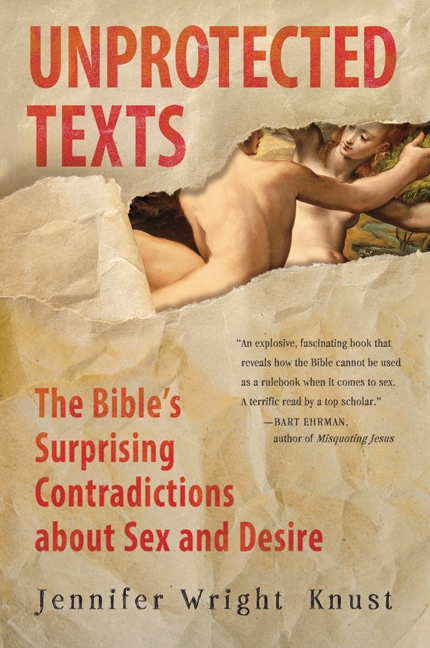
Unprotected Texts -- Review


“Family values” has long been a rallying cry of politically inclined religious conservatives, especially as the sexual mores of the American people have “loosened” since the 1960s. In the face of increasing acceptance of homosexuality, premarital sex, and divorce, “family values” push for the adoption of a “biblically based” sexual morality that includes a definition of marriage limited to one man and one woman along with sexual abstinence outside of marriage. The problem with these proposals is that it’s difficult to nail down a consistent biblically based sexual ethic. First century families, Christian or otherwise, look a lot different from contemporary family structures – even among conservative Christians, not to mention variety of family groupings and guidelines found in the Hebrew Bible/Christian Old Testament. So, whose family values should we embrace? Abraham’s, Jacob’s, David’s, Jesus’, or may be Paul’s? Once you start digging deeper into the biblical text the possibility of finding such a consistent ethic is difficult to find.

Jennifer Wright Knust has taken up the question of the bible and sexuality in her provocatively titled book Unprotected Texts: The Bible’s Surprising Contradictions about Sex and Desire. While the “contradictions” might not be all that surprising to those of us who have read the Scriptures with a critical eye, for many lay readers the questions raised by Knust might prove challenging at the very least. Since this is a book written with the educated but curious general reader in mind, one can imagine the conversations that will take place around the “new books” table at the local bookstore (if such a thing still exists in your community). That the author is not only a biblical scholar (Knust is an assistant professor of religion at Boston University), but an ordained American Baptist minister might be even more provocative to some. How does a person called to serve the church write such a book?

The answer might be found in common concern among religious leaders, including clergy and religious scholars – how do we respond to the questions being asked of us concerning religion and sexuality? For some the answer is simple – stick to “traditional values” – but for others this simply doesn’t work. As we learn more about homosexuality, for instance, it’s much harder to see same-gender relationships as sinful or unnatural. And as young adults postpone marriage, it’s harder to enforce prohibitions against pre-marital sex and living together outside marriage. It is in response to these dilemmas that Knust writes, hoping that by uncovering the complexity of understandings of sexuality in Scripture Christians and Jews might find answers to festering questions. The basic purpose in writing the book, according to the author, is to present “a detailed analysis of biblical attitudes and assumptions while exploring the reception of biblical narratives by later Christian and Jewish interpreters” (p. 16).

In taking up her quest to understand the various ways sexuality is understood in scripture, she makes it clear that in her estimation the Scriptures present conflicting perspectives on sexual morality, even though all of this is done in the name of God. As we take this trip through the Bible’s discussions of sexuality we deal with such issues as whether Jonathan and David’s relationship was homoerotic and whether the Song of Solomon envisions a premarital erotic sexual relationship. The reader will also look at the variety of ways that marriage is envisioned, from the polygamous marriages of David and Solomon, to the rather negative portrayals of marriage offered by Jesus and Paul. Then, of course there are the household codes that we find in Ephesians and Colossians. Sections of the book deal with body parts and fluids – looking into questions of menstruation, circumcision, and masturbation. Another chapter deals with the “evil impulse,” that is the sexual drive, which needed to be controlled. In this particular chapter Knust responds to the suggestion by Southern Baptist megachurch pastor Ed Young that marriages can be strengthened if partners have sex every day. Knust notes that such advice would run quite contrary to the teachings of Paul and his own interpreters, who sought to control their sexuality not free it up – whether within marriage or not.

Knust’s book is an interesting and intriguing read. She covers a lot of territory and does so provocatively. As I noted earlier for many readers much of this won’t be new, though personally I found the discussion in the chapter on “Strange Flesh” illuminating. In this chapter she deals with a number of issues that range from the Sodom Gomorrah story to the suggestion that the giants and “warriors of renown” were the children of unions between angels and human women. The latter isn’t all that new or controversial, but the suggestion that the issue in Sodom centered not on either homosexuality or hospitality, but the Sodomite’s yearning to mate with angels (that is strange flesh) was new to me and intriguing. She also deals with the question of the angels whom Paul is concerned about in 1 Corinthians 11. Paul suggests that women should be veiled “on account of the angels.” Could the issue be that the angels are watching and desiring these women? Remember too that the Corinthians were engaging in angelic speech.  Another topic that many will find intriguing and challenging is her comparison of the Jezebel and Esther stories.  One is condemned for being a foreign woman who leads her husband astray (Jezebel), while the other is a Jewish woman (Esther) who leads her foreign husband to do what is right.  Both play similar roles, but one is commended and the other is not.  It is, therefore, a matter of perspective!

The book is, as noted earlier, intriguing and at times illuminating, but it is also frustrating. At times it seems as if we’re being given only two choices when it comes to reading scripture. You have to choose between either biblical literalism or biblical minimalism. As is often true of the broadsides written by folks like John Spong and Bart Ehrman (his blurb graces the front cover) there doesn’t seem to be any middle ground. Thus, although I find the “strange flesh” explanation for the Sodom story to be intriguing, I’m not sure I’m ready to jettison the idea that the problem is one of breaking the code of hospitality. Another conversation point has to do with Paul’s attitude toward sex (pp. 81ff). Although Paul prefers celibacy, I’m not convinced that this makes him anti-sex or that marriage is the second best option for controlling sexual desire. In addition, while I’m in agreement that there isn’t a consistent sexual ethic present, I wish there was more attention given to how we might make use of the biblical story/stories to construct appropriate sexual ethics in the present age. The author herself affirms that while the Bible is not perfect it is beautiful, “particularly when we do not try to force it to mean just one thing” (p. 247).

My conclusion is that Knust’s book is far from perfect.  First, I'm not always clear who the intended audience is.  There are points at which she gives some rather remedial directives as to the context of a story, while at other points going into rather deep detail in topics that require more background.  While she raises lots of important questions about the role of sexuality and family in the biblical story, often in provocative ways, I wish she had given more guidance as to how we might make sense of this diversity in creating a sexual ethic that is appropriate for this age.  Yes, there is great variety in the text, which seems to offer permission for variety of expressions in the modern age.  But, how does one discern what is appropriate and what is not when it comes to sexuality?  Although, the book is a helpful conversation starter that may serve as necessary antidote to the proof-texting methods of the "family values" crowd, but I was left wanting more. 

Offered as part of the TLC Book Tour.