Showing posts with label Mainline Protestantism. Show all posts

Tuesday, April 26, 2011

The Jesus Creed for Students -- Review

THE JESUS CREED FOR STUDENTS: Loving God, Loving Others. By Scot McKnight with Chris Folmsbee and Syler Thomas. Brewster, MA: Paraclete Press, 2011. 107 pages.

What defines the Christian faith? Historically, councils, denominations, bishops, congregations, and theologians have attempted to answer that question with creeds, systemic theologies, credos, and other statements of faith. Some have been relatively brief and others have been extensive, and what’s essential to one might not be essential to another. History also shows that not everyone follows the dictum of Rupert Meldenius that in “essentials unity, in nonessentials, liberty, and in all things charity.”

An evangelical college professor (North Park University), biblical scholar, author (The Blue Parakeet, among others), and blogger (Jesus Creed), Scot McKnight has proposed an answer to this question, which he calls the Jesus Creed. That creed can be simply stated as “loving God, loving others,” which briefly restates the two great commandments established in the Pentateuch and reaffirmed by Jesus (Mk. 12:29-31). The Jesus Creed for Students takes this concept, which McKnight first developed in The Jesus Creed (Paraclete, 2004), and applies it to the needs of high school students – with the assistance of Chris Folmsbee and Syler Thomas. Folmsbee, director of a youth ministry training organization called Barefoot Ministries, and Thomas, a youth pastor in Lake Forest, IL, are credited with helping McKnight focus the book toward a younger audience than he’s probably used to working with. Thus, the concepts and basic framework are McKnight’s but the style is somewhat different from what I’ve become accustomed to as I’ve read his other work.

Being that it’s been a while since I was either a high school student or a youth minister, I decided to read this book from the perspective of a left of center Mainline Protestant pastor who’s been asked to recommend for resources for youth to use in deepening their faith. As I began to read the book, I started with the assumption that the author stands to my theological right (although I didn’t read the original Jesus Creed book, I’ve read enough of his works to get a good sense of his theology). From that standpoint, I decided that this book would be very appropriate for most Mainline Protestants. That’s not to say that it is liberal. It’s just straightforward biblically based wisdom.

The point of the book is to help high school students understand what it means to love God and love others. He does this by not only focusing his attention on the great two commandments, but also the Sermon on the Mount, which stands at the heart of this conversation. In the course of this conversation he discusses the beatitudes, wherein he distinguishes between blessedness and happiness, which he says “describes the person whose central principle is ‘love myself’” (p. 21). The discussion continues on by addressing Jesus’ expectations (Jesus’ expansion of the law) and what he calls spiritual branding, by which he means seeking to impress God and other people with our spirituality. Later chapters explore the Lord’s Prayer, forgiveness, one’s priorities in life, discipleship, and how one understands the person of Jesus. Finally, he invites the reader to be a “boundary breaker.” In this final chapter McKnight he invites the reader to consider what it means to follow Jesus by taking up a life of ministry (not professional ministry, but ministry in general), a calling that three characteristics: forgiveness, fellowship, and freedom. In the closing sentences of this chapter he suggests that “loving God and loving others is the path we are made to travel, and that when we love others genuinely, forgiveness and fellowship and freedom flow like a river” (p. 100).

Although this book could be used in a bible study, it’s really designed for personal use. McKnight invites the reader to begin each day by reciting the Jesus Creed and then recite the Lord’s Prayer each evening, so that these foundational Christian statements can penetrate the heart and mind. Again, the idea here is to establish habits (reciting the Jesus Creed in the morning and the Lord’s Prayer at bedtime) that will inform the moral vision of the young person.

Although I’m neither a youth nor a youth minister, and so I can’t speak to whether the style is appropriate to the audience, I do believe that this book should prove to be a valuable resource for helping young people develop a moral vision and a deeply rooted Christian faith, whether they’re Evangelical, Catholic, or Mainline Protestant. I might quibble with something that’s said here or there, but there’s nothing that stands out as a barrier to this being used by youth in my church. After all the premise here is to imbibe the vision that we are called to love God and love others!


This book was provided for review by Paraclete Press


Wednesday, April 6, 2011

What's the Least I Can Believe and Still Be a Christian -- Review


I’m an ordained minister in a non-creedal denomination that has from its origins embraced the principles espoused in Rupert Meldinius’ motto – “In essentials unity, in non-essentials liberty, and in all things liberty.” It is also a tradition whose founders embraced the principles John Locke espoused in his books The Reasonableness of Christianity and A Letter Concerning Toleration, wherein he suggested that the church should not make any terms of communion beyond those that “the Holy Spirit has in the holy Scriptures declared in express words to be necessary to salvation” (Locke, Toleration, Prometheus Books, p. 24). Coming as I do from a tradition that has embraced what some might call a simple faith, one that leaves significant room for opinion in matters of faith; I didn’t find the title of Martin Thielen’s book odd or off-putting. In fact, it resonates quite well with my sensibilities, though I have to admit that I’ve heard some in my tradition who have claimed that one can be a member of the Christian Church (Disciples of Christ), and pretty much believe whatever you want. Although that assessment is too minimalist even for Disciples, I expect that a United Methodist pastor would have a more expansive set of necessary doctrines than would a Disciple, and a perusal of this book would bear out this expectation.

The title of the book does leave one with the sense that the author might be espousing a rather minimalist faith, but that would be a misreading of the book. The author is a United Methodist pastor who left the Southern Baptists after the fundamentalist takeover of the Southern Baptist Convention. That decision was brought on by the feeling that he no longer fit within the church in which he had grown up, been educated, and had served as a pastor, educator, and publisher. Ultimately he would find himself serving as pastor of First United Methodist Church of Lebanon, Tennessee.

In a book that is written for a lay/general audience, and that would be very useful for an adult education program (an online leader’s guide is available from the publisher), the author offers what this reviewer would consider a broad, middling, moderate understanding of the Christian faith. Although the book might seem liberal to some, it will seem rather conservative to others, and yet it lifts up for discussion issues that tend to divide and confuse contemporary Christians.

The book is broken into two parts, the first of which lifts up ten issues that “Christians don’t need to believe,” while the second part focuses on eleven items that he believes Christians should believe – what he would consider essentials. At the end of each chapter Thielen places a brief summary statement – what he calls the “bottom line.” So, for instance in the chapter in which he deals with women in the church, his bottom line is: “Women are fully equal with men in marriage, in church, and in society” (p. 23).

The first section of the book focuses on ten “don’ts,” which aren’t merely non-essentials. Instead, for the most part these are perspectives that one would best reject, either because the misrepresent God or they reflect an anti-intellectual perspective that is best left behind by modern Christians. These topics include the suggestion that God causes things like cancer, car wrecks, and catastrophes, as well as the suggestion that real Christians won’t have doubts about their faith, believe in evolution, or think that women can’t be preachers. In a brief opening paragraph to this section, Thielen takes us back to the old gospel song that declared “Gimme That Old-Time Religion.” He suggests that while much of that old time religion might be good or noble, it could also be downright dangerous to the body, to the mind, and to the Spirit. Not only did it give us the Crusades, the Inquisition and religious wars, it also oppressed women, supported slavery, and suppressed science. There are, therefore, aspects of the old form of our religion that we’d be better off casting aside.

The second part of the book focuses on eleven things the author thinks you do need to believe – what he considers essentials or the “least I can believe and still be a Christian.” These are the areas of the faith that he believes matter most. Being that this is written for Christians it should not be surprising that the focus is on Jesus, beginning with what some call the “good confession” (Matthew 16:16), and deals as well with issues such as grace, the presence of God, Jesus’ example, his death and resurrection, the church, the Holy Spirit, and God’s vision of the future. The final “essential” seeks to answer the question as to whether mainline Christians believe in salvation. He insists they do, but he wants to clarify what that means.

This is a good little book that should be of value to many in the church. It might be used as an introduction to the Christian faith for those exploring the faith or who have questions about the Christian faith. It could also provide a foundation to needed conversations about what is important and not important to the life of the church. Although the book is written with Mainline Protestants in mind, at times I felt like Thielen was trying to convince the more conservative elements of his Baptist past of a better way forward. That may explain the moderate and even evangelical tone of the book. This tone is especially present in the final chapter of the book, which seeks to answer the question: “Do Mainline Christians believe in getting saved?” Now the answer to this question is framed in a more progressive fashion – it depends on what you think we’re being saved from or for, but the mere phrasing of the question in this way seems to address concerns among a more conservative audience. This isn’t meant as a criticism; it’s just meant to demonstrate the perspective that’s evidenced in the book.

Ultimately what we have here is a gentle, moderate, Christocentric faith, one that represents the perspective of a large portion of Mainline Protestantism. Thus, the author supports women in ministry, a commitment to social justice, an intellectually engaged faith that embraces evolution, while taking a more middle of the road approach to homosexuality. On this issue he points out that this is an area upon which not all mainliners agree, but suggests that the best description of the current climate is “welcoming but not affirming.” In that chapter, the author doesn’t take a strong position, but you get the sense that he falls into the majority view (though being open to conversation).

While this isn’t a perfect book, and really doesn’t break new ground, I sense that it will prove to be useful to the church.  This is true in large part because Thielen reminds us that we should focus on those things that matter most, rather than focusing on the tangentials that tend to divide and rarely edify.

Thursday, March 10, 2011

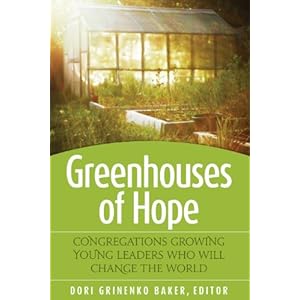
Greenhouses of Hope -- Review


From where will the leaders of the church tomorrow emerge? More specifically, in what context will the gifts and callings to ministry of the church’s future leaders be nurtured? The answers will be found in local congregations, both large and small, where seeds of faith are planted and visions of service are nurtured. Although there are many cases of this happening without intentionality – with young people catch a vision and pursue a calling, even if the local congregation and its clergy are uninvolved and unaware of their callings – there will be greater benefits to the church and to the world at large if congregations intentionally commit themselves to discerning and supporting calls to ministry. These kinds of communities are, as the title of this book suggests, “greenhouses of hope.” These are places where young leaders emerge, desiring to join with God in changing the world.

Dori Baker, the editor of this collection of essays, defines a “greenhouse of hope” as a “Christian congregation freeing itself to experiment with both newly imagined and time-honored ways of following the path of Jesus.” These congregations seek to “embrace the gifts of youth and young adults,” with the view toward young leaders emerging from their midst (p. 2). The book – Greenhouses of Hope – is the culmination of Baker’s quest to discover vital congregations committed to this cause of raising up the next generation of leaders. In the course of her studies of congregations she was looking for the diverse ways in which congregations take up this calling of nurturing a vision of ministry. What results from this work is a series of ethnographic studies, some of which Baker wrote, and some that other scholar/practitioners offered. What we see are “detailed observations of the ways of life of a particular people in order to learn about them, from them, and with them” (p. 3).

Baker is a United Methodist who serves as scholar-in-residence to the Calling Congregations initiative of the Fund for Theological Education. The other contributors to the book are primarily United Methodist, but there are also Presbyterian and AME Zion representatives as well. These other contributors help provide a broader ethnographic picture of congregational practices that nurture faith and visions of service. What we see in these studies is the way in which mission trips, youth mentoring younger children, interfaith engagement, close community that provides a safe place for youth to ask questions and explore vocations, providing a strong sense of empowerment with accompanying opportunities to share in leadership in a particular cultural context (African American), and interestingly enough, even in the midst of conflict. What one finds in common to all of these communities is that they are with some degree of intentionality giving young people opportunities to take leadership, explore their gifts and callings, and affirming them in the process – even if the congregation itself is struggling with conflict.

In laying out this study, according to Dori Baker, the authors sought to keep in balance two seemingly paradoxical perspectives. First, they were interested in young people who were inclined to answer a call to professional ministry, believing that the church has something to offer to the world. She writes:

We want to see bright, creative, innovative young people answering a call to be pastors and preachers who will, in turn, help shape the imaginations and vocations of others. (p. 6).

At the same time the authors of these studies were convinced that “Greenhouses of Hope” could and should nurture callings to purposeful lives among all the young people. That is, through their baptism, all Christians are called to lives of ministry. Therefore, the expectation is that the imaginations and callings of all the people would be stirred and nurtured, even if only some of this number answered the call to professional ministry. The belief is that “People formed by congregations that care about vocation learn to find ways that all of their work in the world can be connected to their call as Christians” (p. 7).

In the opening chapter of the book, Baker explores the image of the greenhouse. The image emerged from a set of abandoned greenhouses that a neighborhood group purchased and renovated. These greenhouses had been built to house roses, but now the new owners pulled out the debris, put in new soil, and planted new flowers, fruits, and vegetables. One of the greenhouses was even renovated to raise a special rose that was found still living within the old greenhouse. What an image that is – something old and now wild was nurtured to health and productivity. There was, however, one greenhouse that didn’t get renovated. Roses still grew there, without fertilizer or care, its only nourishment being water seeping through cracks. These roses continued to grow, bursting through the ceiling of the old greenhouse. But, this happens in spite of many obstacles. And here is the metaphor, the image that drives the conversation. Baker writes that “God will call young lives, with or without the help of congregations.” God will not be left without a witness, but how much better it is when congregations cease being obstacles, and instead commit themselves to being places of nurture and hope, so that young people needn’t be “left to eke out their calling solo, but rather were given the best of their community’s resources of attention, love and nourishment toward their vocational flourishing?” (P. 11). And yes, even “old growth” churches, churches that have been around for generations can and should be places where this nurturing process takes place.

Throughout the book, the authors align their observations around four practices, which carry the acronym CARE. Greenhouses of Hope “Create hospitable space to explore Christian Vocation; Ask self-awakening questions; Reflect theologically on self and community; and Explore, enact, and establish ministry opportunities (p. 30). Each of these practices is important and even essential to the effective nurturing of calls to service.

Each of the chapters offers a look at a specific form of space or action, but one that I found especially intriguing, in large part because it’s culturally different, but maybe very culturally relevant for many of our smaller churches. Sinai Chung writes of a Korean Presbyterian Church that engages in what the author calls mozying. This practice is named after the Korean word for older siblings. The concept that has taken root in this particular congregation is that the older children/youth/young people help care for the younger ones. That is, the older ones mentor the younger ones. The need emerged from the transition from first to second generation Koreans, and the need to help second generation Koreans engage in congregational life. This practice is characterized by a belief in “intensive and genuine sibling love.” It is rooted in an intimacy between the younger and the older. Second, unlike most other mentoring relationships, both benefit. Finally, the practice is “highly contagious.” That is, it leads to chain reactions among all age groups. Although this particular practice has its own cultural roots, it has great potential as a model of making a space for ministry practice and spiritual growth.

In her concluding essay, Melissa Wigington summarizes the various models that had been explored earlier, and offers important reflections. She warns, rightly against the tendency to tokenism – something that occurs in every church. We try to get young people on boards and committees, just to say we’ve done it, without any real thought about the spiritual welfare and development of these young people. She notes as well three common themes that emerge from these ethnographic studies – in each context intergenerational relationships are valued and nurtured, young adults and youth are given authentic roles in the life of the church, and present in each are “embodied spiritual practices that connect lived experience with the holy” (p. 195).

The greenhouse is a safe place to grow and experience life in ministry, but as Wigington points out, eventually these plants have to take root outside the safety of the greenhouse. Issues such as delayed adulthood and the economic realities of the day affect the way in which young adults are able to navigate their world. They face the prospects of burnout, not being able to find themselves, and sometimes having too narrow a vision of the world, and thus feeling trapped by these commitments. What these greenhouses must do is help prepare young adults to be resourceful and open to new opportunities so that they can navigate the world that they inhabit. And their ability to do so will be rooted in those four practices that carry the acronym – CARE.

This is a most helpful and encouraging book, especially for churches that are willing to embrace a call to nurture the ministry gifts of their children and young people. It is a good reminder that congregations can either be obstacles or encouragers. Each of the studies opens vistas that might prove helpful in a particular context. The chapter on churches in conflict allows us to see that even when churches are not healthy, they can still be places where callings are intentionally nurtured, even if difficult to maintain. Dori Baker is to be commended for drawing together a team that can provide Mainline churches seeds of hope for the future.