Showing posts with label Love. Show all posts

Tuesday, April 26, 2011

The Jesus Creed for Students -- Review

THE JESUS CREED FOR STUDENTS: Loving God, Loving Others. By Scot McKnight with Chris Folmsbee and Syler Thomas. Brewster, MA: Paraclete Press, 2011. 107 pages.

What defines the Christian faith? Historically, councils, denominations, bishops, congregations, and theologians have attempted to answer that question with creeds, systemic theologies, credos, and other statements of faith. Some have been relatively brief and others have been extensive, and what’s essential to one might not be essential to another. History also shows that not everyone follows the dictum of Rupert Meldenius that in “essentials unity, in nonessentials, liberty, and in all things charity.”

An evangelical college professor (North Park University), biblical scholar, author (The Blue Parakeet, among others), and blogger (Jesus Creed), Scot McKnight has proposed an answer to this question, which he calls the Jesus Creed. That creed can be simply stated as “loving God, loving others,” which briefly restates the two great commandments established in the Pentateuch and reaffirmed by Jesus (Mk. 12:29-31). The Jesus Creed for Students takes this concept, which McKnight first developed in The Jesus Creed (Paraclete, 2004), and applies it to the needs of high school students – with the assistance of Chris Folmsbee and Syler Thomas. Folmsbee, director of a youth ministry training organization called Barefoot Ministries, and Thomas, a youth pastor in Lake Forest, IL, are credited with helping McKnight focus the book toward a younger audience than he’s probably used to working with. Thus, the concepts and basic framework are McKnight’s but the style is somewhat different from what I’ve become accustomed to as I’ve read his other work.

Being that it’s been a while since I was either a high school student or a youth minister, I decided to read this book from the perspective of a left of center Mainline Protestant pastor who’s been asked to recommend for resources for youth to use in deepening their faith. As I began to read the book, I started with the assumption that the author stands to my theological right (although I didn’t read the original Jesus Creed book, I’ve read enough of his works to get a good sense of his theology). From that standpoint, I decided that this book would be very appropriate for most Mainline Protestants. That’s not to say that it is liberal. It’s just straightforward biblically based wisdom.

The point of the book is to help high school students understand what it means to love God and love others. He does this by not only focusing his attention on the great two commandments, but also the Sermon on the Mount, which stands at the heart of this conversation. In the course of this conversation he discusses the beatitudes, wherein he distinguishes between blessedness and happiness, which he says “describes the person whose central principle is ‘love myself’” (p. 21). The discussion continues on by addressing Jesus’ expectations (Jesus’ expansion of the law) and what he calls spiritual branding, by which he means seeking to impress God and other people with our spirituality. Later chapters explore the Lord’s Prayer, forgiveness, one’s priorities in life, discipleship, and how one understands the person of Jesus. Finally, he invites the reader to be a “boundary breaker.” In this final chapter McKnight he invites the reader to consider what it means to follow Jesus by taking up a life of ministry (not professional ministry, but ministry in general), a calling that three characteristics: forgiveness, fellowship, and freedom. In the closing sentences of this chapter he suggests that “loving God and loving others is the path we are made to travel, and that when we love others genuinely, forgiveness and fellowship and freedom flow like a river” (p. 100).

Although this book could be used in a bible study, it’s really designed for personal use. McKnight invites the reader to begin each day by reciting the Jesus Creed and then recite the Lord’s Prayer each evening, so that these foundational Christian statements can penetrate the heart and mind. Again, the idea here is to establish habits (reciting the Jesus Creed in the morning and the Lord’s Prayer at bedtime) that will inform the moral vision of the young person.

Although I’m neither a youth nor a youth minister, and so I can’t speak to whether the style is appropriate to the audience, I do believe that this book should prove to be a valuable resource for helping young people develop a moral vision and a deeply rooted Christian faith, whether they’re Evangelical, Catholic, or Mainline Protestant. I might quibble with something that’s said here or there, but there’s nothing that stands out as a barrier to this being used by youth in my church. After all the premise here is to imbibe the vision that we are called to love God and love others!


This book was provided for review by Paraclete Press


Saturday, April 23, 2011

Love Wins (Rob Bell) -- A Review


The trailer for Rob Bell’s Love Wins set Twitter afire even before the book was released, but why all the furor? The answer can be found in the responses offered by the defenders of evangelical orthodoxy. Because Bell raised questions as to whether the Hindu Gandhi might not be in hell that was sufficient proof that the young evangelical mega-church pastor had gone off the deep end and embraced the universalism of liberal Christianity. Further proof of the author’s unorthodox ways could be found in the fact that the book was being published by Harper One and not Zondervan (forgetting that Zondervan is a division of Harper-Collins and that by moving the book to Harper One, Bell’s book would get a bigger audience – especially among non-evangelicals).

The problem with Bell’s position was that in affirming the premise that Love Wins, he was somehow undermining the justice of God, not to mention the atonement, evangelism, perhaps even the church. With all the clamor over the book, it’s no surprise that Time Magazine deemed Bell worthy of its annual Holy Week cover story. They even reached back four decades to the famous “God is Dead” cover story for inspiration, entitling the story: “Is Hell Dead?” Over night the relatively obscure pastor from Grand Rapids had become a media sensation.

I’ve read a number of Bell’s other books, all published by Zondervan, including Velvet Elvis and Jesus Wants to Save Christians, and have enjoyed them, so the furor surrounding the book’s merits made me all the more eager to read this volume. I wanted to see why the critics thought he had fallen off the cliff into the abyss of liberalism, and besides that, Bell is a fellow alumnus of Fuller Seminary, and I wanted to see if what he was saying reflected ideas planted at an earlier time (likely back when I was teaching adjunctively at Fuller). As I read the book, I did find signs that his Fuller education did show up in the way he deals with issues, such as the nature of God and eschatology, which are the primary topics of this book.

So why the furor? Besides raising important questions that many are afraid to tackle, Bell is a very talented communicator. He knows how to bring seemingly dense topics alive, inviting the reader into the conversation. He writes with a very light touch – often in short sentences and even sentence-paragraphs. He is more apt to raise questions than resolve them, provocatively offering the reader biblical texts to ponder. He’s a teller of stories, though not in the same way that a Fred Craddock tells them. He’s more urban and GenX, whereas Craddock is rural and speaks from an earlier era. Both styles work powerfully, which is why both men have been successful as preachers.
As for the charges – the critics claim that Bell is a universalist, which means that in the end everyone gets into heaven, and that doesn’t sit well with the guardians of the gateways into heaven. Bell and his universalist friends make it too easy to get in, and that undermines Christian theology and even Christian morality. In fact, if God lets everyone in, why did Jesus need to come to earth? The whole house of cards begins to crumble if “love wins!”

So, what do we make of the evidence? Having read the book, I can say that I didn’t find any signs of universalism, at least not of a pluralistic sense. I did, however, find in this book a strong commitment to the principle that God’s love for the creation is absolute and everlasting. He speaks of a love that feeds God’s desire to reconcile everyone to God’s self, even if that means pursuing them after death’s doors close. What needs to be said here is that for Rob Bell, God’s love compels God to pursue us, but at the same time God doesn’t necessarily get what God wants. We have the freedom to say no.

What is clear is that Bell doesn’t believe in a God who punishes humanity eternally in fire for simply not saying yes to Jesus. We may sin, but these sins, committed in this life, don’t merit such treatment, and besides that, to define God in such terms is to demean God. Although Bell isn’t a universalist, I would say that he’s a Christocentric inclusivist. He allows for God to work through other religions, but in the end God is in Christ reconciling the world to God’s self (2 Cor. 5). Does the death of Jesus matter? Very much so, it’s just that God doesn’t necessarily put the fate of humanity and the creation in the hands of Christians!

The book is full of wisdom, and even though Bell doesn’t resolve all the questions, there is much to chew on. Regarding the questions, although the book’s subtitle lifts up the issues of heaven, hell, and salvation, the real issue under discussion is the nature of God. Who do we believe God to be?

Readers may find different chapters to be of greatest interest – perhaps dwelling on the chapter on heaven or maybe the one on hell, which follows it. Or maybe it will be the one that wrestles with other religions. In light of the critiques, I found his discussion of the Parable of the Prodigal Son most intriguing (ch. 7). In discussing the parable, he focuses on the older brother, who gets angry when his father unexpectedly welcomes the prodigal home with open arms, even throwing a party for him. The older brother doesn’t think that this is fair, after all he’d stayed home, worked hard, did what the father asked, and the father never threw a party for him. The father responds by reminding the older brother that everything that was his belongs to the older son, and that he could have had a party any time he wanted.

The key to this story, as Bell unfolds it, is the charge the older son makes against his father. He accuses the Father of being a slave driver and of being cheap. That is, this older son, had a rather negative view of his father, and that fed his disdain for the way the father received the younger prodigal. The older brother didn’t recognize in the father, any sense of love, grace, or generosity – not because it wasn’t there, but because this son refused to see it, and it affected the way he lived. In the parable, Bell says, the father tells a different story about both sons, and Bell suggests provocatively -- this is the difference between heaven and hell. That is, the older brother is experiencing a hell of his own making, by separating himself from the father’s love. Bell writes:

Hell is being at the party.
That’s what makes it so hellish.
It’s not an image of separation,
by one of integration. (pp. 169-170).
That is, heaven and hell are intertwined, and we decide where we want to stand -- “hell is our refusal to trust God’s retelling of our story” (p. 170). Here is the story of one who just can’t stand it that the other is in a sense getting away with it! And therefore, he has a tantrum.

But back to the nature of God and how God deals with us – Bell notes the biblical story that speaks of God loving the world so much that the Father sends the son into the world so that the world might be saved. It’s a beautiful sight, but what of the other side of the story that so often gets told – and here’s where it gets controversial, at least in some circles. We’ve been taught that there are millions who, for whatever reason, don’t make that choice, perhaps dying before having that chance to say yes to God, and thus God must “punish them forever in conscious torment in hell.” If this is true:

God would, in essence, become a fundamentally different being to them in that moment of death. A different being to them forever. A loving heavenly father who will go to extraordinary lengths to have a relationship with them would, in the blink of an eye, become a cruel, mean, vicious tormenter who would ensure that they had no escape from an endless future of agony (pp. 173-174).
Such a vision doesn’t make sense to Bell and to many others, including me. He’s right, an earthly father that took such a turn would be reported to the authorities. There might be those who find such a vision appropriate, but not many.

So, my take on this book is this: It’s a gentle pastoral response to the kinds of questions that people are asking. He recognizes that many of the answers traditionally offered don’t make sense and turn people away from God. Although they may hear that God loves them, the flip side of this story makes no sense. How can God love us, and then if we spurn that offer, torture us for eternity? Bell suggests that such an image speaks poorly of God and misrepresents the teaching of Scripture. Not everyone will agree with the author’s perspective, but I found it to be appropriate and compelling. Yes, he raises more questions than he answers, but he gives the reader enough guidance that they will, I think, discover that the God of Jesus is a God of grace and love, who will do everything and anything to reconcile them to God’s self. And in my estimation – that’s a winning message!  That makes it the kind of book that I, as a pastor, would share with the person wrestling with God!
 

Thursday, April 21, 2011

Death and Resurrection! -- A Lectionary Meditation for Easter

Jeremiah 31:1-6


Colossians 3:1-4


Matthew 28:1-10


Death and Resurrection!


As we once again experience Holy Week, we’re reminded that life emerges from death. There is no better analogy of this truth than the transition from winter to spring, which is why it seems appropriate that Easter and the coming of spring coincide. With spring’s coming, the long dormant flowers and trees suddenly come back to life as spring’s warmth replaces winter’s cold darkness. Surely, we can see the parallels between this and Good Friday/Easter.

Now, of course, there are questions to be addressed when it comes to the Resurrection. David Hume has had his way with us, and we must face the fact that people just don’t rise from the dead every day. Therefore, we don’t have analogies that can truly help us grapple with this article of faith. Is it a physical event or a metaphor? The Gospels speak of empty tombs and appearances, and we even have defenses of the event against charges that the disciples stole the body. Of course there are the discrepancies between the various stories as to when and where and how Jesus appeared to his disciples. Did he meet them in Jerusalem or in Galilee (or both?). We can speculate, but that gets us nowhere. Whatever the nature of this reality – and I personally find myself somewhere between Marcus Borg and N.T. Wright – and the nature of the debates, what we hear in these texts of Easter is a call to confess our faith in the risen Lord. It is a reminder that we don’t serve a dead hero, but a living Lord, who shares with us the fullness of God’s everlasting love.

Ultimately we must hear each witness on its own, listening for its voice, and in this case, for this meditation (and for Sunday’s sermon) I will limit my thoughts to Matthew’s testimony – together with that of Jeremiah and the author of Colossians.

Jeremiah doesn’t explicitly speak to Easter -- there’s no promise of resurrection here, but there is a promise here concerning God’s intention to be present with us forever, sharing with us the everlasting love of God. Now this word goes first and foremost to Israel, which must endure the suffering of exile, but here in Jeremiah 31 comes the promise that God hasn’t forgotten them. God promises to be the God of all Israel, even as they have endured the wilderness. The word that comes to Israel (and to us) is that God has loved Israel with “everlasting love,” and therefore God continues to be faithful to Israel. This confession of God’s faithfulness leads Jeremiah to invite the people to pull out their tambourines and begin to dance like merrymakers. Having heard the promise that Israel will continue to be God’s people and that exile is ending, they are invited to celebrate something that is equivalent to life out of death. But not only will they dance, but they will also plant. Yes, merrymaking leads to work. And from there, the call goes out: “Come, let us go up to Zion, to the Lord our God. All of this, however, is but a sign of God’s everlasting love. As I reflect on this truth, my thoughts go to the point made by Rob Bell in his new and controversial book, wherein, he speaks of God’s desire that all be saved–or reconciled. He writes:

History is about the kind of love a parent has for a child, the kind of love that pursues, searches, creates, connects, and bonds. The kind of love that moves toward, embraces, and always works to be reconciled with, regardless of the cost. [Bell, Love Wins, p. 99].

Jeremiah understands this truth – God seeks out and restores the people to the land, and therefore they will rejoice with song and dancing, and also by planting, by taking possession of the land that is promised. This is, after all, an act of love.

We hear the resurrection story from Matthew’s perspective in this lectionary season (unless you decide to go with John’s version). In this version of the story, Mary Magdalene and another Mary go to the tomb, though the reason for their visit isn’t mentioned. As they reach the tomb on this first day of the week, with the Sabbath behind them, they discover that an earthquake has rolled the stone away from the tomb. Now, I know something about earthquakes and generally their not as localized as this report would suggest. Whatever the nature of the quake, the stone is rolled away, and an angel of heaven with a countenance like that of lightening, and the clothes, a dazzling white, sits on the stone – having frightened the guards away. The message of this angel is simple: Don’t be afraid (like the guards?). Instead, hear the message he brings – the one they look for isn’t there, but is instead risen from the dead, just as he had said. Remember, God is faithful! They might not have gotten the message, but God remains faithful, due to God’s everlasting love.

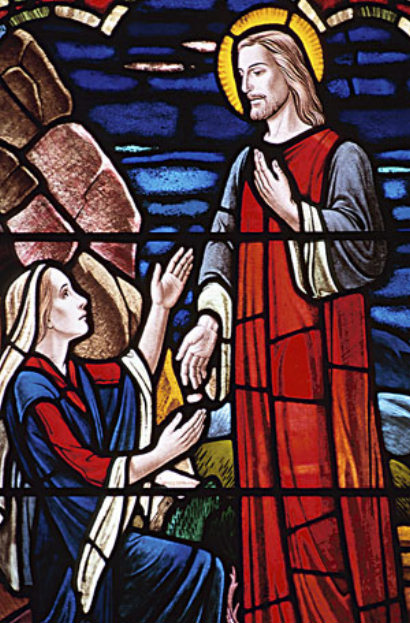
The angel has another message – go tell the disciples to meet Jesus in Galilee. With this command these two women become the first witnesses to the resurrection – at least of the empty tomb. But as they go back to the larger gathering, they receive another visit. This time it’s Jesus himself, and like the angel, he tells them to tell the disciples to meet him in Galilee (where they’ll receive their commissions). It bears repeating here that one of the marks of an apostle is that the apostle is a witness of the resurrection, and thus these two women are to be counted among the apostles of Jesus. Oh, and there’s one other thing about this passage, not only do the women bear witness of the resurrection, but when they meet Jesus they worship him. Matthew says that they grabbed his feet and worshiped him (proskynein). While this could mean an acknowledgment of someone of higher rank, James Dunn notes that in almost every case in the New Testament it’s used in relationship to worship of God or of Jesus (as is the case here) [James Dunn, Did the First Christians Worship Jesus?, p. 10-11].

There’s not enough space here to wrestle with the issue of what it means to say that they worshiped Jesus, but it’s clear that the women are rejoicing at this sign of God’s everlasting love. They can’t help not worshiping this one who was dead and now lives! And is that not the point of Easter – the one who brings God’s everlasting love to us is alive and present with us, so that we need not see ourselves alone in the wilderness?

Finally, our attention goes to this short passage from Colossians 3, where the author (we don’t know if it’s Paul or not), declares that if we’re raised with Christ then we should look for the things that come from above, for that is where Christ is sitting – at the Right Hand of God. The message of resurrection is to consider the things of heaven, rather than the earth. For many of us this command does raise warning flags. We’re all aware of the danger of “being so heavenly minded that we’re of no earthly good.” That is, it sure sounds as if the author of this letter is giving us permission to walk around with our heads in the clouds, but I don’t believe that’s the case. It is, I would suggest a reminder to examine our own sense of allegiance. If you are a follower of Jesus, then you must keep your allegiance with the one who sits at the Right Hand of God. And when he’s revealed then you, having hid your life in Christ, you will be revealed in glory.

Here we are at Easter, being called upon to declare our allegiance to the one whom God has raised to the Right Hand, a God who as Jeremiah reminds us, is faithful to the promise to love with everlasting love. If this is true, if Easter is true, then what is your response? How will you celebrate Easter’s glory?  Will you take out the tambourine and dance for joy?

Friday, April 15, 2011

It May Not Be What It Seems -- A Lectionary Meditation for Palm Sunday

Psalm 118:1-2, 19-29

Matthew 21:1-11


It May Not Be What It Seems


Palm Sunday is a rather odd feast day in the life of the church. We come to church ready to celebrate. We get to wave palms and celebrate with Jesus as he enters the city of Jerusalem in triumph. We get to join with the people who gathered that day for the festal parade and hail Jesus as king of kings and son of David. We sing hymns like “All Glory, Laud and Honor” and “Ride on, Ride on in Majesty.” We wave palm branches as the choir and clergy enter into the sanctuary. We join the crowds of old in shouting Hosanna to the King of Kings. It’s a grand and glorious parade, and yet this grand and glorious hour quickly fades into something else much less triumphant. This is in many ways the picture of an aborted revolution. The powers that be see their foe and crush it before the spark can grow into a fire.

I’m not sure how other preachers feel about Palm Sunday, but I’m rather ambivalent about the day’s events. I enjoy the pageantry, but I don’t want to get caught up in it, because I know that tragedy must come before triumph. If we skip from Palm Sunday to Easter, without stopping to ponder the day of the cross then we will have misunderstood the whole thing. We’ll be lulled into believing that the Christian life is just one triumph after another; not realizing that with triumph often comes suffering and death. But maybe that’s the point of Palm Sunday; if we look at it as only the opening act of the Holy Week story, then we’re reminded of the ease with which we misinterpret the signs, often jumping the gun and failing to see the underlying currents.

Although the lectionary readings for Palm Sunday, at least in this cycle, only provide us with two texts, one from the Psalms and the other from the Gospel, these texts are sufficient. One text, the Gospel of Matthew tells the story of the day, but it’s Psalm 118 that provides us with the lens through which we can truly understand that all might not be as it seems. The Psalmist seems to have caught sight of this undercurrent and names it for us, while at the same time providing us with a word of promise.

We begin with the story of Palm Sunday as it is told in Matthew 21. It’s a well-known, oft-told story. Jesus approaches Jerusalem, and when he comes near the Mount of Olives, he sends two disciples into the village of Bethpage to get a donkey, and with it a colt, and they are to bring these to Jesus. If anyone should ask why they are doing this, they’re to tell them that the Lord sent them. This interchange has led to lots of speculation. Did Jesus have this set up ahead of time? Or did Jesus foresee this happening (after all he is the Son of God and therefore knows all things). And the speculations go on and on, without any real resolution. All of this, however takes place because it fulfills the words of the prophet (Zechariah 9:9), who foresees Jerusalem’s king riding into the city riding on a colt, the foal of a donkey. The gospel writer misses the poetic parallelisms and envisions two animals at interprets Zechariah 9. The other gospels have only one animal.

In any case, this donkey will be the sign of a royal entrance, which Jesus reenacts. Those who see him riding into Jerusalem understand the sign and dutifully hail him king and Messiah (Son of David). They put their cloaks and palm branches out in front of him as a sign of their allegiance, all the while shouting “Hosanna to the Son of David.” And “Blessed is the one who comes in the name of the Lord. As he makes his entrance the city is said to be in turmoil with everyone asking who he was? Those in the know respond: “This is the prophet Jesus from Nazareth in Galilee.”

An act such as this had to be seen as provocative by the authorities. It would have made the Temple authorities, to whom general governance was given by the Romans, nervous, and it would have made the Romans nervous. As the Gospels tell it, this entrance takes place on the eve of the Passover celebration, when the city was filled with pilgrims. And, as Marcus Borg and John Dominic Crossan suggest, Jesus’ “peasant procession” likely was being paralleled by an imperial procession into the city. They envision Pilate entering the city accompanied by his troops who normally were stationed in Caesarea Maritima. As they put it:

Pilate’s procession displayed not only imperial power, but also Roman imperial theology. According to this theology, the emperor was not simply ruler of Rome, but the Son of God. (Borg and Crossan, The Last Week, p. 3).
Two processions each representing rival theologies – one imperial and the other representing the Kingdom of God. Thus, we have a clash of ideologies and theologies, which means that what appears to be a scene of triumph on the surface will likely lead to dangerous encounters as the week progresses. But that is not the story that Matthew is ready to tell just yet. In the meantime we bask in the glory of the day.

The Psalmist helps us put this scene in context. This selection from Psalm 118 begins with a profession of faith in the Lord, who is not only good, but whose “steadfast love endures forever.” From this confession we move down to the Psalmist’s description of a festal parade through the “gates of righteousness.” It is through this gate that the righteous enter so that they might give thanks to the Lord for the salvation that the Lord has brought to them. But salvation has come at a cost, for “the stone that the builders rejected has become the chief cornerstone.” There will be triumph, but there will also be tragedy. This verse stands as a reminder to us that we shouldn’t put too much stock in the exuberant welcome offered to Jesus. Things have a way of souring. People can be fickle.

But in the meantime, let us rejoice and beseech God to “give us success!” With this prayer upon our lips, we join in the parade, crying out: “Blessed is the one who comes in the name of the Lord.” The Lord gives us light so that we can enter the festal parade with branches, and make our way to the “horns of the altar.” There we will offer our sacrifice of praise, giving thanks for God’s provisions. Indeed, we give thanks that God’s “steadfast love endures forever.” Even as the initial triumph is fleeting, so will be our fall. In the end, we can trust in this Love that is God’s. We can take our hope in this promise, because as Tom Oord points out in his book The Nature of Love, when the scriptures speak of God’s everlasting love, it is rooted in the premise that God loves of necessity. That is, when we give thanks this Palm Sunday for God’s chesed (steadfast love) we are talking about God’s essential being that evidences itself in love of God’s creatures (Oord, The Nature of Love, p. 130).

Palm Sunday provides great difficulties for us, because it tempts us to believe that the Christian life runs from one triumph to another. Jesus enters the gates of the city and then jumps to heaven the next Sunday. But that’s not the way it works. We must continue the journey, which leads through betrayal, torture, and death. In Tom Troeger’s hymn for Palm Sunday, “A Cheering, Chanting, Dizzy Crowd,” after speaking of the parade, he offers us these two final stanzas:

Lest we be fooled because our hearts have surged with passing praise,
remind us, God, as this week starts where Christ has fixed his gaze.

Instead of palms a winding sheet will have to be unrolled,
a carpet much more fit to greet the king across will hold. (Chalice Hymnal 193)
The parade of palms will stir our hearts, but it’s not yet time to celebrate the final triumph. Palm Sunday is in many ways a false start. Jesus goes into the city, checks it out, and leaves. No revolution yet! But as the hymn reminds us, the journey has just begun. The triumph that we will celebrate on Easter, must go through Good Friday, and it is in this journey that we see God’s steadfast love truly revealed. In this journey from this triumphant gate to Easter, we discover that God is not only present in the moments of glory, but even more powerfully in our moments of suffering and despair.

Sunday, March 27, 2011

Judge Not, Lest Ye . . . 7th Sermon on the Sermon on the Mount

Matthew 7:1-14

Although many of us enjoy being judge and jury, few of us want to face judgement. We like the words “judge not, lest ye be judged,” and yet it’s almost part of human nature to judge others. Therefore, we find ourselves saying: “Can you believe the way she dresses? It’s embarrassing.” Or, “Did you hear what he said? Well, I just think that’s totally inappropriate!” Or, “Did you hear that Sam went to the casino last week, and he calls himself a Christian?” In case you believe yourself incapable of such words, Jesus has an unflattering word to describe you (and me).

As we continue our journey through the Sermon on the Mount, we come to an invitation to examine closely our lives. Instead of judging others, we hear Jesus calling on us to judge ourselves. Of course, the task of facing our own inner demons isn’t an easy task, which is why very few of us answer this call. But, if we’re going to seek first the kingdom of God, then this is the road we must take.


1. Logs and Splinters

Jesus is a master of language, and his choices in metaphors cut through the noise that surrounds our lives. In this passage from Matthew’s gospel, we hear words about splinters and logs. Although we enjoy sitting in judgment of others – admit it, you like it – we’re really not in the position to render judgment on the lives of our neighbors. That’s because we have logs in our eyes that keep us from seeing the splinter that lies in the eye of our neighbor. You simply can’t pull something out of the eye of another person, when there’s an impediment so large sitting your eye that you can’t even see the face of the other. So, take care of that impediment, before trying to do surgery on someone else.

As we contemplate these metaphors, we might benefit from hearing another story, this one being from the Gospel of John. If you look at most bibles, the story of the woman caught in adultery will be in the margins or in parentheses. That’s because there are questions about whether or not it is original to this gospel, but whether or not it originally was in John’s gospel, it speaks to an important truth.

According to this story, a group of religious leaders brings this women who had been caught in adultery and challenged Jesus to render judgment. That meant casting the first stone. Jesus puts the onus back on them, and says to the accusers – “let the one who is without sin, cast the first stone.” When no one comes forward, Jesus says to the woman, no one comes to condemn you, neither do I, but go and sin no more. If we take the biblical witness to heart, Jesus is in a position to cast that stone, but he chose not to do so. Since he chooses not to render judgement, then perhaps we shouldn’t either.


2. Proper Gifts

Of course Scripture speaks of judgment, and next Sunday’s sermon carries the title “Judgement Day.” Although there is a place for judgment, it is God and not us, to whom this task is entrusted. When we try to take on the role of judge, we’re assuming the prerogative of God. Now, the reason why we should leave the role of judge to God isn’t because God is important and we’re not, but instead it’s because of the character of God.

This is why the words that follow the word about judgment are so important. Jesus tells us that if we ask, we’ll receive; if we seek, we’ll find; and if we knock the door will be opened. This is because God is faithful to God’s promises. When it comes to the promises of God, there will be no bait and switch.

Of course, we need to understand that the promises of God are related to the kingdom of God. The promise is made to those who seek first the kingdom and place their treasure in heaven. Although, there are those who would say otherwise, Jesus isn’t promising us a Lexus or a mansion, or even a check for a million dollars, not even if you promise to donate 10% to the church. But because God, who is the giver of every good and perfect gift and who will not do evil, then we can trust God. Yes, as Jesus says, God is like a loving parent, who when a child asks for bread doesn’t give a stone instead, or when a child asks for a fish, gives a snake instead. Indeed, if you, who are evil, don’t treat your children that way, then surely God, who is righteous and loving won’t either. The reason why we should leave the task of judgment to God, is that God isn’t just good, but because God’s essence is love in all of love’s dimensions.

God is love, which doesn’t mean that God is a sentimental chap, but rather, to borrow from Tom Oord’s definition of love, God acts “intentionally in sympathetic/empathetic response to others, to promote overall well-being” (Oord, The Nature of Love, p. 17). This definition of love defines the nature of God, and it also provides the context in which God acts in judgment of the world.

3. Do unto others . . .

Instead of rendering judgments that neither you nor I are prepared to offer, “treat people in the same way that you want people to treat you; this is the Law and the Prophets.” (Mt. 7:12 CEB). These words form what we call the Golden Rule, and this rule is simply a paraphrase of the second great commandment – “love our neighbors as you love yourself.” As you consider this golden rule, remember that Jesus defined neighbor to include one’s enemies, and agape love, as Tom Oord suggests, means intentionally promoting the overall well-being of those who mean to do us evil. This is, of course, no easy task, which is why few of us heed the call to love the world as God loves the world.

But, if you love in this way, then you fulfill the Law and the Prophets. You may have thought that Jesus renders the Law and the prophets null and void, but that isn’t true. Jesus never abandons either the Law or the Prophets, because without them we won’t know how to act toward others. As Stanley Hauerwas, who is known to be a rather radical sort of character, puts it: “love is the fulfillment of the Law.” And, having said that, he goes on to say that love is “a radical politics that challenges the world’s misappropriation of God’s good gift.” Indeed, if Christ embodies God’s love, then we can’t “know love apart from loving one’s enemies.” (Mt. 22:37-40). [Stanley Hauerwas, Matthew, Brazos Press, 2006, p. 89].

If we’re going to take the journey that Jesus outlines in the Sermon on the Mount, then we’ll have to give up trying to be judge and jury. Instead, of trying to be judges of others, we can begin loving our friends and our enemies as God loves them. If we’re going to join God in the work of transforming this world in which we live, then we’ll have to take the narrow pathway, which is the road less traveled.

So how do we know which path to take? Dietrich Bonhoeffer writes in his book on discipleship that we’ll know the way if we keep our eyes focused on Jesus, who walks in front of us, leading the way. Bonhoeffer writes:

He is the narrow road and the narrow gate. The only thing that matters is finding him. If we know that, then we will walk the narrow way to life through the narrow gate of the cross of Jesus Christ, then the narrowness of the way will reassure us. [Bonhoeffer, Discipleship, (Fortress, 2001), p. 4:176].

This narrow path doesn’t take the form of legalism, with a lot of senseless rules and regulations that tell us not to do this or do that or we’ll be excluded. It’s not a matter of dress codes and good manners, or even having all the right beliefs. What it does involve is living life in a way that honors God and seeks to promote the well-being of others. That’s not an easy path to take, but this is the path way that leads from what Richard Rohr calls the first half of life to the second half of life.

If we’re going to take this path then we’ll have to “let go of our own smaller kingdoms,” which we’re not always eager to do, and instead choose union with God. That means letting God lead the way. If we choose this path, and let God both guide us and judge us, then we’ll begin to think in a way that leaves plenty of room for others to join us in communion with God. As Fr. Rohr writes: “Everyone is in heaven when he or she has plenty of room for communion and no need for exclusion. The more room you have to include, the bigger your heaven will be” (Richard Rohr, Falling Upward, p. 101).

It is my prayer that each of us will let go of the need to judge others, but instead as we recognize our own need of forgiveness and restoration, that we will commit ourselves to the way of the kingdom, and in doing so, we will promote the well-being of all those who share this world with us. In this we will know the fullness of God’s presence, and that is what it means to be in heaven!
 
Preached by:
Dr. Robert D. Cornwall
Pastor, Central Woodward Christian Church (Disciples of Christ)
Troy, Michigan
3rd Sunday in Lent
March 27, 2011

Thursday, March 24, 2011

Tom Oord's "Defining Love" and "The Nature of Love" -- A Review

DEFINING LOVE: A Philosophical, Scientific, and Theological Engagement. By Thomas Jay Oord. Grand Rapids: Brazos Press, 2010. Xiii +225 pages. THE NATURE OF LOVE: A Theology. St. Louis: Chalice Press, 2010. Xii +195 pages.

Christians talk a lot about love. We affirm that God is love. We say that God loves the world enough to send into the world his Son. We treasure the words of 1 Corinthians 13, with its suggestion that while faith and hope will abide, the greatest is love. We even sing, perhaps with an uneasy conscience, “They’ll Know We Are Christians by Our Love.” But, what do we mean when we talk about love? What is our definition? How do we know to discern whether someone is acting in love? In fact, where does love come from? All of these questions are raised and addressed in these two similar, but different, books authored by Nazarene theologian Thomas Jay Oord.

Tom Oord, who is Professor of Theology and Philosophy at Northwest Nazarene University and a Ph.D. graduate of Claremont Graduate University, has an agenda. He wants to move beyond simply putting love on the theological discussion table to placing love at the very center of theology. If God not only loves, but is love, then love should be “organizing principle” of theology. Unfortunately, in Oord’s mind, this has not happened. Too often it remains behind Oz’s curtain, but “only when placed at the center can the logic of love explicitly extend to all aspects of Christian theology” (Nature, p. 4).

Oord’s agenda, it would seem, requires too very different but related books. Defining Love is in many ways the foundational text. It provides the broader outlines for placing love at the center of theological reflection, but looking at love from philosophical and scientific angles as well as theological ones. In this challenging and at times dense book Oord lays out a new field of scholarship, what he calls the “love, science, and theology symbiosis” (Defining, p. 5). In this context Oord is advocating a program of “love research,” that has at its core the belief that it is possible for the world and individuals can get better. He wants to find ways in which we can discern the virtues and practices that will enable this to happen. In other words, love just doesn’t’ happen. It requires nurture and promotion and development. This requires research into the nature of love and how it is best expressed. With this in mind, Oord lays out his understandings of science and theology, trying to clearly define where they are different and where they relate to each other.

Essential to this program is to have a firm definition of love, one that can provide a foundation for research and theological reflection. The definition that he formulates provides the basis for discussion in both of these books. That basic definition reads as follows:

To love is to act intentionally, in sympathetic response to others (including God), to promote overall well-being (Defining, p. 15).
With this basic definition in mind, Oord proceeds to explore the diverse forms of love, for not all forms of love are alike, even if they have at their base the same purpose – “promotion of overall well-being.” Thus, he looks at agape, philia, and eros. While making use of theology here, he is more intent on exploring the input of philosophy to the discussion.

Moving from definitions, Oord brings to bear the “qualitative and quantitative” insights of the social sciences, including both psychology and sociology. Key to this discussion are concepts such as altruism and empathy, along with personality types and motives. He concludes that from examining research there is a clear move away from the idea that humans are by nature “inevitably and invariably egoistic” (Defining, p. 96). If the social sciences provide one vantage point, what about biology. Assuming that evolution is true, the question concerns how evolutionary development provides the conditions for love. Again the focus is on altruism, and whether there is evidence from the study of nature of self-sacrificial action. Although the explorations are still at their early stages, the key question, concerns the evidence that nonhuman creatures express love. This may still be speculative, but there is interesting evidence to pursue. Turning from biology to cosmology, with its discussions of the formation of the universe, including the principle of creatio ex nihilo, the issue here in part concerns the possibilities of divine engagement with the universe. This is a key question for we must wrestle with the way in which God might engage us. Does God have either the power or the will to change or affect in dramatic ways nature? Or does God work in a very different fashion? Here Oord, who can be considered part of the Open Theism movement, interacts with a variety of theological and biblical perspectives, including Process Theology, which he respects but doesn’t embrace completely. The point of the chapter isn’t to provide a final understanding but to lay out the parameters and possibilities for study. Finally, he reaches theology, where he expresses his hope for a partnership between the sciences and theology so that love can find its place at the center of theology.

If Defining Love has a scientific/philosophical focus, The Nature of Love focuses on theology itself. Of the two books, this is probably the easier read and may be for many the most appropriate place to start. Although no mention is made of Defining Love many of the ideas and foundations transfer from one book to the other (I’m not sure which book was written first, though from the reader's perspective Defining Love could be considered the foundational book).

In Nature of Love Oord begins with the same definition of love as in the first book, with a focus on intentionality and end result – promotion of well-being. Whereas in the first book his conversation partners are the sciences and philosophy, here they are theologians. He wrestles with Anders Nygren over agape, St. Augustine over eros, and Clark Pinnock over philia. He finds something of value in each of these theologians and their particular definitions and perspectives on love, but he also finds them to be deficient at important points. Of the three foci, I found the engagements with Nygren and Augustine the most pertinent. In both cases, Oord redefines in important ways how we understand love.

In regard to Nygren and Nygren’s claim that agape is the definitive form of Christian love, to the exclusion of other forms, Oord challenges the idea that we are simply conduits of a love that comes from God alone without any human engagement. In his view, agape should be understood as “in spite of love.” That is, agape is that form of love that intentionally seeks to promote the well-being of the other despite the fact that the other means us harm or evil. God is definitely involved, but that doesn’t mean that we have not part to play. With regard to eros, which Augustine saw as a deficient form of love, for Augustine believed that only God could truly love, and that the object of love has no value in and of itself. Oord defines eros as being “because of love,” by which God and we seek to promote overall well-being by affirming and promoting the value that is inherent in the other. This is, I believe an important step, for too often theology starts with the premise that we are some how “totally depraved” and thus having no inherent worth or value. If Oord is correct, then we must think differently, and that means that we act differently with regard to the other. Finally, he deals with philia, and in this regard looks to his late colleague Clark Pinnock with whom he has much in common, but with whom he has what might seem to be minor differences, but which have important implications. Philia is by definition the promotion of well-being by “coming alongside.” It is that friendship, community oriented form of love, which reminds us that we need each other. It speaks of cooperation with God and with one another. Where he differs from Pinnock is in Pinnock’s concern to protect God’s reputation.

In the final chapter of The Nature of Love, Oord offers his own theological program, which he calls “essential kenosis.” This program serves as the context in which love can be brought into the center. There are similarities to Process Theology, though through the use of the idea of kenosis (self-emptying), he hopes to distinguish from his own idea of a self-limiting God with that of an inherently limited divinity, but in this understanding self-limitation isn’t voluntary, it is essential to God’s nature. What he wants the reader to understand is that God’s love is a question of necessity. Whereas in other forms of kenosis theology, God need not love outside the Trinity, in his understanding God of necessity loves the Creation. Love is not contingent. It is part of God’s nature. External forces don’t limit God, but God’s nature does. Therefore, God cannot but love.

So the question is – what does it mean for God to love, and here it’s important that all three forms of love are brought into the equation. The kind of love that forms the center of theology – our understanding of God – must be “full-orbed.” We make a mistake when we think that we can settle on one form of love and define that as Christian or divine love. We must instead bring agape, eros, and philia into our definition. If this is true of God, then it is also true for us, who are called upon as God’s creation to imitate God by expressing this full-orbed love of God in our lives. I should add that in Oord’s understanding love means that God is not coercive in any way. Thus, even creation is not a coercive act, but requires the participation of the other for creation to occur. You can see the similarities to Process Theology. The borders the two are a bit fuzzy, but there is enough of a difference to keep these two as separate understandings of the nature and purpose of God.

I believe that Tom Oord is on to something important. I have found his definitions of love to be not only helpful but have provided a new orientation for understanding the unconditional nature of love, and the full-orbed nature of love. I believe his definitions are far superior to any others I’ve seen. Thus, as a pastor and a preacher, who believes that God not only loves, but is love, these definitions and the research that help sustain these definitions will help the church move forward into the future. It will assist us in moving away from self-centeredness to others-centeredness. It will help us reorient the way we do theology and understand God and God’s relationship to Creation.

Of the two books, The Nature of Love is the easiest to work with and may be the most helpful, but for those who wish to dig deeper into the project, then Defining Love is an important read. Both are well written, but neither of these books are quick reads. They require diligent engagement and reflection. That said, Tom Oord is on to something important that the church needs to hear.

Sunday, February 27, 2011

Love Wins!

I've not seen the book yet, so I really can't say much about what's inside Rob Bell's new book entitled Love Wins:  A Book About Heaven, Hell, and the Fate of Every Person Who Ever lived (Harper One, 2011).   But, apparently, according to all the buzz, especially on Twitter (where he was trending yesterday), the Grand Rapids-area pastor has become a heretic.   Yes, because he believes that God's love wins, then he must be a universalist who doesn't believe in hell.   As I've said, I've not read the book, but likely the critics haven't either.  All we do know is that there is a video and the video, according to the critics, carries a dangerous message.

Now, being that I'm post-evangelical and don't believe in hell either, so it should come as no surprise that I enjoyed the video and found its message compelling.  In fact, I find it to be a very powerful statement about the good news we have come to know in and through the person of Jesus.  He makes the statement that "the good news is that love wins."  Why should that be controversial? 

So, for now, until I have a chance to read the book, I'll just post the video, let you watch it, and then let you comment. 


LOVE WINS. from Rob Bell on Vimeo.

The Law of Love -- 4th Sermon on the Sermon on the Mount

Matthew 5:38-48

This morning we return to our journey through Matthew’s Sermon on the Mount. One of the basic premises of this sermon is that if we want to be disciples of Jesus, then our righteousness, our sense of justice, and our character must exceed that of the Scribes and the Pharisees (Matthew 5:17). In our last installment we heard Jesus push on our understanding of the Law, by calling on the people of God to internalize God’s teachings so that not only will we live right, but our hearts will be transformed. This morning we continue what we began in the last sermon of this series by listening to Jesus’ call for us to embrace the “law of love.”

As we saw in the last leg of the journey, Jesus says to the people: “You’ve heard it said . . . But I say to you . . .” In this morning’s text Jesus does this two more times. First he speaks to retaliation and then he speaks to loving our enemies. If you look closely, you see that these are two sides of the same coin.


1. Beyond the Law of Retaliation

Let’s begin with the law of retaliation, which in Latin goes by the name Lex Talionis. It’s a principle that goes back at least as far as Hammurabi, the great lawgiver of the ancient world. When you hear the words “eye for an eye” you might think this is a bit barbaric, but the Law of Retaliation was designed to make our responses proportionate to the offense.

As I was thinking about the relationship between retaliation and loving one’s enemy, I began to think about one of the movies that is nominated for this year’s Best Picture Oscar, which is to be given tonight. If you haven’t seen the new version of True Grit, maybe you’ve seen the earlier John Wayne version.

In the new version, the movie begins with a verse of scripture that summarizes quite well the plot of the movie:

The wicked flee when no man pursueth (Prov. 28:1a).
This is a movie about the wicked fleeing and the righteous pursuing. In the movie the wicked are represented by Tom Chaney, a ranch hand who murders his employer. The righteous one, on the other hand, is fourteen-year-old Mattie Ross, who embodies the second half of this verse from Proverbs, for she is “as bold as a lion” in her righteousness and in her pursuit of justice for her father. Although she hires Marshal Rooster Cogburn, who is known for his “true grit, but not his personal righteousness, to help her pursue her enemy, Marshal Cogburn and a Texas Ranger named LeBeouf, stay in hot pursuit of the wicked because they are driven by the righteous anger of a teenage girl.

Although it’s hard not to sympathize with Mattie’s quest, Jesus calls us to move beyond mere proportionate justice. If someone slaps your cheek, give them the other. If they sue you and take your coat, give the person your cloak as well. And if someone forces you to carry their burden for one mile, volunteer to go another mile. Finally, if someone begs or borrows from you, don’t turn them down, but instead give what is asked, without expecting repayment.

To live in such a way is difficult, perhaps even impossible. If we give away our cloak as well as our coat – in that age at least – we will end up naked. None of this makes much sense, and yet Jesus says that if we live like this then we will be perfect even as God is perfect. Although this sounds like a Gandhi-esque directive to engage in nonviolent resistance, there’s nothing really practical about this word from Jesus. He’s not teaching the people how to make friends with the Romans so they’ll give them freedom. Instead, this call to abandon the Law of Retaliation is an introduction to the “Law of Love.”


2. The Law of Love

As we’ve been taught, there are two great commands: Love God with all your being, and love your neighbor as you love yourself. In these two commandments all the law and the prophets are summed up. This is a good principle to live by, but Jesus expands the definition. Remember in the Parable of the Good Samaritan, which appears in Luke’s Gospel, but not in Matthew’s, Jesus uses the parable to answer the question asked by the righteous man: But who is my neighbor? In this passage of the Sermon on the Mount, Jesus answers that same question. In defining the Law of Love, Jesus makes it clear that our distinctions between neighbor and enemy don’t count with God. Having essentially defined the Law of Retaliation out of existence, Jesus now tells us that while we’ve heard it said to that we should love our neighbors and hate our enemies, he says to us: Love your enemies and pray for those who persecute you. This is what Jesus expects of his disciples.

Again, we do this not because when all is said and done we’ll get what we want from our enemies – which is the rationale for nonviolent resistance – but because in doing this we imitate God. As Jesus points out, God pours out blessings on the righteous and the unrighteous without distinction. In loving our enemies and praying for those who persecute us, we imitate God, and by doing this, the disciple distinguishes himself or herself from the world. That is, we have been called by Jesus to be perfect, even as the heavenly Father is perfect.

To get a sense of what this means, we might look to Leviticus 19, where God says to the people through Moses, the first lawgiver: “You shall be Holy, for I the Lord your God am Holy” (Lev. 19:1-2). This holiness that the Lawgiver describes is defined in Leviticus 19 by the way we live together as neighbors. The one who is holy doesn’t steal, doesn’t deal falsely with others, doesn’t put up obstacles in the way of the blind, and judges one’s neighbors justly and impartially. Indeed, Leviticus commands that we not take vengeance or bear a grudge against the people, but instead, we are to love our neighbor as we love ourselves.

Because this word is so hard to receive, we often try to find loopholes so that we can live out the “spirit” of the command even if we don’t follow the letter of the command. But maybe. In doing this we don’t Jesus’ call to discipleship very seriously. Perhaps it’s better simply to let these words hit us with all their force and then move forward in the grace and the love of the God who is holy and just and perfect. Rather than evade the message, we move toward fulfilling the call to live fully into God’s realm. And again, it would be helpful to remember that Jesus doesn’t specifically address this sermon to individuals but to a community. There is a word from Ecclesiastes that might be helpful:

Two are better than one, because they have a good reward for their toil. For if they fall, one will lift up the other; but woe to one who is alone and falls and does not have another to help. . . . And though one might prevail against another, two will withstand one. A threefold cord is not quickly broken. (Ecclesiastes 4:9-12)
Even as Simon of Cyrene carried Jesus’ cross for him, we can carry each other’s crosses as we seek to follow Jesus’ command to love not just our neighbors and friends, but our enemies as well.

3. Defining Love

Having heard this call to love our enemies and not just our friends and neighbors, ti might be helpful to define what we mean by love. Theologian Tom Oord provides a helpful set of definitions that distinguish between the three forms of love present in Greek thought: Agape, eros, and philia. In his set of definitions, he speaks of agape as “in spite of love,” Eros as “because of love,” and philia is “alongside of love.” Each of these forms of love is present in Jesus’ command to love our enemy as well as our neighbor, but I think that his definition of agape is the most helpful in understanding this command. He defines agape as “acting intentionally, in response to God and others, to promote overall well-being in response to that which produces ill-being." [Thomas Oord, The Nature of Love, (Chalice Press, 2010), p. 56].

According to Oord, whatever form love takes, it must be intentional and aimed at “promoting overall well-being.” That is, when we love, we are offering blessings to others, with the goal being the promotion of shalom, which is peace or abundant life. Another way of saying this is that the purpose of love is promoting the common good of all creation.

When it comes to agape, Oord suggests that love takes us another step further in promoting well-being. With agape, we not only seek the well-being of the other, but we intentionally seek the well-being of the one who intends to do us evil. Instead of seeking retaliation or revenge, even if it seems to be the right thing to do, love calls us to embrace, redeem, and restore to right relationship the one who means us harm. That is the message of the cross, after all. Jesus seeks to reconcile all who would do him harm by overwhelming evil with good. If we follow in Jesus’ footsteps then we are imitating God, who is perfect and holy.

Ultimately, however, this is about the Law of Love. I heard a quote from Rob Bell, a pastor from Grand Rapids, who declares that the “Good News is that Love Wins.” Whatever else we might say about our calling to be disciples, the ultimate calling is to love not just our neighbors but even our enemies. Because, in the end, the “good news is that love wins.”
 
 
Preached by:
Dr. Robert D. Cornwall
Pastor, Central Woodward Christian Church (Disciples of Christ)
Troy, Michigan
8th Sunday after Pentecost
February 27, 2011