Showing posts with label Bible and sexuality. Show all posts

Saturday, April 16, 2011

Banned Questions of the Bible -- Review

BANNED QUESTIONS OF THE BIBLE. Banned Questions Series. Christian Piatt, et al. St. Louis: Chalice Press, 2011. 216 pages.


Is it impertinent to ask questions of the Bible? The answer to that question, in the minds of many, who view the Bible as divinely authored or a divinely-given book, is that it would be best to not ask too many questions, especially questions as to whether there are contradictions, errors, or the like. Questions of authorship can also get you in trouble, as are questions concerning whether some parts of the Bible are of greater value or authority than others. Yes, the best thing to do, when it comes to questions about the bible to stick with the tried and true, because to do otherwise will likely lead you down the slippery slope toward apostasy and perhaps even perdition. Because as you have heard, if the Bible is wrong in one place, then the house of cards is likely to fall down upon us. Thus, nothing good can come from asking impertinent questions. Fortunately there are those who are not afraid of testing the waters and poking at shibboleths that others deem sacred. It is fortunate because there are many questions to be asked.

One of those impertinent persons is Christian Piatt, who by his own testimony faced the wrath of a thoroughly frustrated Sunday School teacher. As a youth, Christian writes, the Sunday school teacher became so bedeviled by his incessant questioning of traditional interpretations that the teacher threw a Bible at his head. What he learned from this encounter was that the church isn’t necessarily a safe place to ask questions about the faith. Upon discovering that reality, Christian, like many others, left “organized religion” behind until he found a community that not only tolerated but respected his questions. Having returned to the church, he even ended up married to a Disciples of Christ pastor. Further, Chalice Press even offered him the opportunity to develop a book series that would allow others to wrestle with the same kinds of questions that he had been raising. This book, Banned Questions of the Bible, which Christian edits and facilitates is the inaugural volume of this Banned Questions series.

Since the point of the series is lifting up the kinds of questions that many consider to be taboo, it should not surprise readers to learn that when one reaches the end of the book they may still have questions. The point of the book isn’t to resolve all the questions, but instead to provide a resource so that whether in groups or as individuals people can wrestle with issues that trouble heart and mind. The point, therefore, isn’t the answers, but the conversation. As a result Christian Piatt provides a starting point for creating safe places to discuss important issues, not just relating to faith, but every aspect of life that religion, and in this case, the Bible touch, whether that be sexuality, science, government, and more.

There are, in all, fifty questions that receive attention in this book. Many are provocative and even controversial, but not all. What is important one person, might not be important to another. The whole point of asking questions, is asking questions that matter to you as a seeker after God. The questions range from matters of translation, canonicity, interpretation and authority to specific issues such as human sexuality, politics, and salvation. What makes this particular book somewhat unique is the way that the editor utilizes a group of writers to take up the questions. Not every writer addresses every question, and some questions receive greater attention than others. No rationale is provided as to why this is so, but one can speculate if that seems useful.

Piatt, who is a writer/editor and an active leader in the church his spouse pastors, draws from a group that includes clergy, seminary professors, writers, and lay leaders. There are liberals and evangelicals (mostly moderate and not overly conservative). There is a good balance of males and females, though as far as ethnicity, that is more difficult to gauge as there are no pictures of the writers! Overall, the writers are younger, but even here there appears to be variety. There is humor present in the book, but the authors take their topics seriously and respectfully.

There are differences of perspective here, but the one thing that seems to link them together is their view of God. At the very end of the book one will find the Baylor God Image Survey, which lifts up four different ways in which people envision the nature of God. That is, do they see God as authoritarian, benevolent, critical, or distant. Readers are invited to take the survey and see where they stand in regards to God, and then see where the authors come down. What is interesting is that with just a few exceptions they all show a preference for a Benevolent God. Only one writer doesn’t make benevolence at least tied for the top spot. . So, maybe that embrace of a benevolent God gave these writers the necessary “courage” to deal with questions many Christians would rather not discuss.

The format of the book is quite simple. A question is posed and several possible answers are provided. Some questions receive more responses than others. After the responses are presented, Christian provides selected Scripture references, suggestions for reading, and then questions for further discussion. Standing between the fifty questions/answers and the Baylor God Image survey is a section that allows the writers to define themselves for the reader. You’ll find information about their background, the kinds of books and resources that they find valuable, favorite quotes, and five things that they think would make the world better.

So, why should one pick up this book? We could start with the fact that it provides a place to start for those who have questions and might feel intimidated from asking them. You might have other questions beyond those asked here, but this provides a starting point. For the church it serves as a reminder that the church should be a safe place to ask questions. We shouldn’t have a bible thrown at our heads or our faces slapped because we ask questions or express doubts about long held doctrines. The book is also helpful in that it provides groups with a resource to discuss these kinds of questions – possibly using the answers along with the discussion questions. Because there are fifty questions, groups might decide to pick a few and focus on them.

Being that I was reading this with a review in mind, I tried to read it from cover to cover, but I’m not sure that is the best way to engage the book. I would recommend perusing the table of contents and then pick those questions that seem most pertinent (or perhaps most impertinent) to you the reader. Or you might use it for a “weekly devotional” time, though it would be a most unusual devotional book. Preachers might get some ideas here for a sermon or two. The possibilities are endless, and since this is only the first book in the series, we’ll have other opportunities to wrestle with questions that dog the church! So, by all means, check out this book!

Tuesday, March 1, 2011

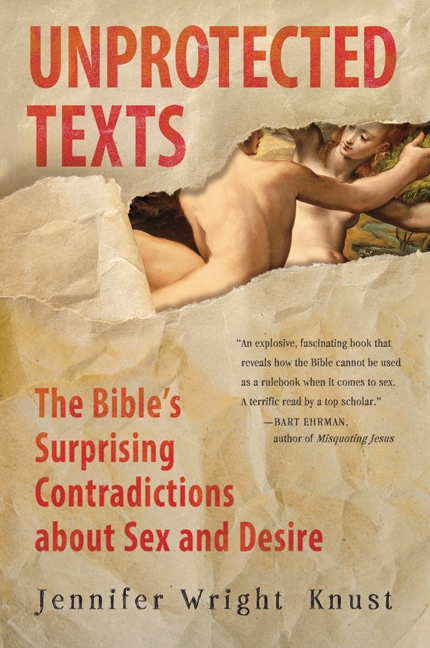
Unprotected Texts -- Review


“Family values” has long been a rallying cry of politically inclined religious conservatives, especially as the sexual mores of the American people have “loosened” since the 1960s. In the face of increasing acceptance of homosexuality, premarital sex, and divorce, “family values” push for the adoption of a “biblically based” sexual morality that includes a definition of marriage limited to one man and one woman along with sexual abstinence outside of marriage. The problem with these proposals is that it’s difficult to nail down a consistent biblically based sexual ethic. First century families, Christian or otherwise, look a lot different from contemporary family structures – even among conservative Christians, not to mention variety of family groupings and guidelines found in the Hebrew Bible/Christian Old Testament. So, whose family values should we embrace? Abraham’s, Jacob’s, David’s, Jesus’, or may be Paul’s? Once you start digging deeper into the biblical text the possibility of finding such a consistent ethic is difficult to find.

Jennifer Wright Knust has taken up the question of the bible and sexuality in her provocatively titled book Unprotected Texts: The Bible’s Surprising Contradictions about Sex and Desire. While the “contradictions” might not be all that surprising to those of us who have read the Scriptures with a critical eye, for many lay readers the questions raised by Knust might prove challenging at the very least. Since this is a book written with the educated but curious general reader in mind, one can imagine the conversations that will take place around the “new books” table at the local bookstore (if such a thing still exists in your community). That the author is not only a biblical scholar (Knust is an assistant professor of religion at Boston University), but an ordained American Baptist minister might be even more provocative to some. How does a person called to serve the church write such a book?

The answer might be found in common concern among religious leaders, including clergy and religious scholars – how do we respond to the questions being asked of us concerning religion and sexuality? For some the answer is simple – stick to “traditional values” – but for others this simply doesn’t work. As we learn more about homosexuality, for instance, it’s much harder to see same-gender relationships as sinful or unnatural. And as young adults postpone marriage, it’s harder to enforce prohibitions against pre-marital sex and living together outside marriage. It is in response to these dilemmas that Knust writes, hoping that by uncovering the complexity of understandings of sexuality in Scripture Christians and Jews might find answers to festering questions. The basic purpose in writing the book, according to the author, is to present “a detailed analysis of biblical attitudes and assumptions while exploring the reception of biblical narratives by later Christian and Jewish interpreters” (p. 16).

In taking up her quest to understand the various ways sexuality is understood in scripture, she makes it clear that in her estimation the Scriptures present conflicting perspectives on sexual morality, even though all of this is done in the name of God. As we take this trip through the Bible’s discussions of sexuality we deal with such issues as whether Jonathan and David’s relationship was homoerotic and whether the Song of Solomon envisions a premarital erotic sexual relationship. The reader will also look at the variety of ways that marriage is envisioned, from the polygamous marriages of David and Solomon, to the rather negative portrayals of marriage offered by Jesus and Paul. Then, of course there are the household codes that we find in Ephesians and Colossians. Sections of the book deal with body parts and fluids – looking into questions of menstruation, circumcision, and masturbation. Another chapter deals with the “evil impulse,” that is the sexual drive, which needed to be controlled. In this particular chapter Knust responds to the suggestion by Southern Baptist megachurch pastor Ed Young that marriages can be strengthened if partners have sex every day. Knust notes that such advice would run quite contrary to the teachings of Paul and his own interpreters, who sought to control their sexuality not free it up – whether within marriage or not.

Knust’s book is an interesting and intriguing read. She covers a lot of territory and does so provocatively. As I noted earlier for many readers much of this won’t be new, though personally I found the discussion in the chapter on “Strange Flesh” illuminating. In this chapter she deals with a number of issues that range from the Sodom Gomorrah story to the suggestion that the giants and “warriors of renown” were the children of unions between angels and human women. The latter isn’t all that new or controversial, but the suggestion that the issue in Sodom centered not on either homosexuality or hospitality, but the Sodomite’s yearning to mate with angels (that is strange flesh) was new to me and intriguing. She also deals with the question of the angels whom Paul is concerned about in 1 Corinthians 11. Paul suggests that women should be veiled “on account of the angels.” Could the issue be that the angels are watching and desiring these women? Remember too that the Corinthians were engaging in angelic speech.  Another topic that many will find intriguing and challenging is her comparison of the Jezebel and Esther stories.  One is condemned for being a foreign woman who leads her husband astray (Jezebel), while the other is a Jewish woman (Esther) who leads her foreign husband to do what is right.  Both play similar roles, but one is commended and the other is not.  It is, therefore, a matter of perspective!

The book is, as noted earlier, intriguing and at times illuminating, but it is also frustrating. At times it seems as if we’re being given only two choices when it comes to reading scripture. You have to choose between either biblical literalism or biblical minimalism. As is often true of the broadsides written by folks like John Spong and Bart Ehrman (his blurb graces the front cover) there doesn’t seem to be any middle ground. Thus, although I find the “strange flesh” explanation for the Sodom story to be intriguing, I’m not sure I’m ready to jettison the idea that the problem is one of breaking the code of hospitality. Another conversation point has to do with Paul’s attitude toward sex (pp. 81ff). Although Paul prefers celibacy, I’m not convinced that this makes him anti-sex or that marriage is the second best option for controlling sexual desire. In addition, while I’m in agreement that there isn’t a consistent sexual ethic present, I wish there was more attention given to how we might make use of the biblical story/stories to construct appropriate sexual ethics in the present age. The author herself affirms that while the Bible is not perfect it is beautiful, “particularly when we do not try to force it to mean just one thing” (p. 247).

My conclusion is that Knust’s book is far from perfect.  First, I'm not always clear who the intended audience is.  There are points at which she gives some rather remedial directives as to the context of a story, while at other points going into rather deep detail in topics that require more background.  While she raises lots of important questions about the role of sexuality and family in the biblical story, often in provocative ways, I wish she had given more guidance as to how we might make sense of this diversity in creating a sexual ethic that is appropriate for this age.  Yes, there is great variety in the text, which seems to offer permission for variety of expressions in the modern age.  But, how does one discern what is appropriate and what is not when it comes to sexuality?  Although, the book is a helpful conversation starter that may serve as necessary antidote to the proof-texting methods of the "family values" crowd, but I was left wanting more. 

Offered as part of the TLC Book Tour.