Showing posts with label Nature of God. Show all posts

Saturday, April 16, 2011

Banned Questions of the Bible -- Review

BANNED QUESTIONS OF THE BIBLE. Banned Questions Series. Christian Piatt, et al. St. Louis: Chalice Press, 2011. 216 pages.


Is it impertinent to ask questions of the Bible? The answer to that question, in the minds of many, who view the Bible as divinely authored or a divinely-given book, is that it would be best to not ask too many questions, especially questions as to whether there are contradictions, errors, or the like. Questions of authorship can also get you in trouble, as are questions concerning whether some parts of the Bible are of greater value or authority than others. Yes, the best thing to do, when it comes to questions about the bible to stick with the tried and true, because to do otherwise will likely lead you down the slippery slope toward apostasy and perhaps even perdition. Because as you have heard, if the Bible is wrong in one place, then the house of cards is likely to fall down upon us. Thus, nothing good can come from asking impertinent questions. Fortunately there are those who are not afraid of testing the waters and poking at shibboleths that others deem sacred. It is fortunate because there are many questions to be asked.

One of those impertinent persons is Christian Piatt, who by his own testimony faced the wrath of a thoroughly frustrated Sunday School teacher. As a youth, Christian writes, the Sunday school teacher became so bedeviled by his incessant questioning of traditional interpretations that the teacher threw a Bible at his head. What he learned from this encounter was that the church isn’t necessarily a safe place to ask questions about the faith. Upon discovering that reality, Christian, like many others, left “organized religion” behind until he found a community that not only tolerated but respected his questions. Having returned to the church, he even ended up married to a Disciples of Christ pastor. Further, Chalice Press even offered him the opportunity to develop a book series that would allow others to wrestle with the same kinds of questions that he had been raising. This book, Banned Questions of the Bible, which Christian edits and facilitates is the inaugural volume of this Banned Questions series.

Since the point of the series is lifting up the kinds of questions that many consider to be taboo, it should not surprise readers to learn that when one reaches the end of the book they may still have questions. The point of the book isn’t to resolve all the questions, but instead to provide a resource so that whether in groups or as individuals people can wrestle with issues that trouble heart and mind. The point, therefore, isn’t the answers, but the conversation. As a result Christian Piatt provides a starting point for creating safe places to discuss important issues, not just relating to faith, but every aspect of life that religion, and in this case, the Bible touch, whether that be sexuality, science, government, and more.

There are, in all, fifty questions that receive attention in this book. Many are provocative and even controversial, but not all. What is important one person, might not be important to another. The whole point of asking questions, is asking questions that matter to you as a seeker after God. The questions range from matters of translation, canonicity, interpretation and authority to specific issues such as human sexuality, politics, and salvation. What makes this particular book somewhat unique is the way that the editor utilizes a group of writers to take up the questions. Not every writer addresses every question, and some questions receive greater attention than others. No rationale is provided as to why this is so, but one can speculate if that seems useful.

Piatt, who is a writer/editor and an active leader in the church his spouse pastors, draws from a group that includes clergy, seminary professors, writers, and lay leaders. There are liberals and evangelicals (mostly moderate and not overly conservative). There is a good balance of males and females, though as far as ethnicity, that is more difficult to gauge as there are no pictures of the writers! Overall, the writers are younger, but even here there appears to be variety. There is humor present in the book, but the authors take their topics seriously and respectfully.

There are differences of perspective here, but the one thing that seems to link them together is their view of God. At the very end of the book one will find the Baylor God Image Survey, which lifts up four different ways in which people envision the nature of God. That is, do they see God as authoritarian, benevolent, critical, or distant. Readers are invited to take the survey and see where they stand in regards to God, and then see where the authors come down. What is interesting is that with just a few exceptions they all show a preference for a Benevolent God. Only one writer doesn’t make benevolence at least tied for the top spot. . So, maybe that embrace of a benevolent God gave these writers the necessary “courage” to deal with questions many Christians would rather not discuss.

The format of the book is quite simple. A question is posed and several possible answers are provided. Some questions receive more responses than others. After the responses are presented, Christian provides selected Scripture references, suggestions for reading, and then questions for further discussion. Standing between the fifty questions/answers and the Baylor God Image survey is a section that allows the writers to define themselves for the reader. You’ll find information about their background, the kinds of books and resources that they find valuable, favorite quotes, and five things that they think would make the world better.

So, why should one pick up this book? We could start with the fact that it provides a place to start for those who have questions and might feel intimidated from asking them. You might have other questions beyond those asked here, but this provides a starting point. For the church it serves as a reminder that the church should be a safe place to ask questions. We shouldn’t have a bible thrown at our heads or our faces slapped because we ask questions or express doubts about long held doctrines. The book is also helpful in that it provides groups with a resource to discuss these kinds of questions – possibly using the answers along with the discussion questions. Because there are fifty questions, groups might decide to pick a few and focus on them.

Being that I was reading this with a review in mind, I tried to read it from cover to cover, but I’m not sure that is the best way to engage the book. I would recommend perusing the table of contents and then pick those questions that seem most pertinent (or perhaps most impertinent) to you the reader. Or you might use it for a “weekly devotional” time, though it would be a most unusual devotional book. Preachers might get some ideas here for a sermon or two. The possibilities are endless, and since this is only the first book in the series, we’ll have other opportunities to wrestle with questions that dog the church! So, by all means, check out this book!

Thursday, March 24, 2011

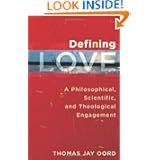
Tom Oord's "Defining Love" and "The Nature of Love" -- A Review

DEFINING LOVE: A Philosophical, Scientific, and Theological Engagement. By Thomas Jay Oord. Grand Rapids: Brazos Press, 2010. Xiii +225 pages. THE NATURE OF LOVE: A Theology. St. Louis: Chalice Press, 2010. Xii +195 pages.

Christians talk a lot about love. We affirm that God is love. We say that God loves the world enough to send into the world his Son. We treasure the words of 1 Corinthians 13, with its suggestion that while faith and hope will abide, the greatest is love. We even sing, perhaps with an uneasy conscience, “They’ll Know We Are Christians by Our Love.” But, what do we mean when we talk about love? What is our definition? How do we know to discern whether someone is acting in love? In fact, where does love come from? All of these questions are raised and addressed in these two similar, but different, books authored by Nazarene theologian Thomas Jay Oord.

Tom Oord, who is Professor of Theology and Philosophy at Northwest Nazarene University and a Ph.D. graduate of Claremont Graduate University, has an agenda. He wants to move beyond simply putting love on the theological discussion table to placing love at the very center of theology. If God not only loves, but is love, then love should be “organizing principle” of theology. Unfortunately, in Oord’s mind, this has not happened. Too often it remains behind Oz’s curtain, but “only when placed at the center can the logic of love explicitly extend to all aspects of Christian theology” (Nature, p. 4).

Oord’s agenda, it would seem, requires too very different but related books. Defining Love is in many ways the foundational text. It provides the broader outlines for placing love at the center of theological reflection, but looking at love from philosophical and scientific angles as well as theological ones. In this challenging and at times dense book Oord lays out a new field of scholarship, what he calls the “love, science, and theology symbiosis” (Defining, p. 5). In this context Oord is advocating a program of “love research,” that has at its core the belief that it is possible for the world and individuals can get better. He wants to find ways in which we can discern the virtues and practices that will enable this to happen. In other words, love just doesn’t’ happen. It requires nurture and promotion and development. This requires research into the nature of love and how it is best expressed. With this in mind, Oord lays out his understandings of science and theology, trying to clearly define where they are different and where they relate to each other.

Essential to this program is to have a firm definition of love, one that can provide a foundation for research and theological reflection. The definition that he formulates provides the basis for discussion in both of these books. That basic definition reads as follows:

To love is to act intentionally, in sympathetic response to others (including God), to promote overall well-being (Defining, p. 15).
With this basic definition in mind, Oord proceeds to explore the diverse forms of love, for not all forms of love are alike, even if they have at their base the same purpose – “promotion of overall well-being.” Thus, he looks at agape, philia, and eros. While making use of theology here, he is more intent on exploring the input of philosophy to the discussion.

Moving from definitions, Oord brings to bear the “qualitative and quantitative” insights of the social sciences, including both psychology and sociology. Key to this discussion are concepts such as altruism and empathy, along with personality types and motives. He concludes that from examining research there is a clear move away from the idea that humans are by nature “inevitably and invariably egoistic” (Defining, p. 96). If the social sciences provide one vantage point, what about biology. Assuming that evolution is true, the question concerns how evolutionary development provides the conditions for love. Again the focus is on altruism, and whether there is evidence from the study of nature of self-sacrificial action. Although the explorations are still at their early stages, the key question, concerns the evidence that nonhuman creatures express love. This may still be speculative, but there is interesting evidence to pursue. Turning from biology to cosmology, with its discussions of the formation of the universe, including the principle of creatio ex nihilo, the issue here in part concerns the possibilities of divine engagement with the universe. This is a key question for we must wrestle with the way in which God might engage us. Does God have either the power or the will to change or affect in dramatic ways nature? Or does God work in a very different fashion? Here Oord, who can be considered part of the Open Theism movement, interacts with a variety of theological and biblical perspectives, including Process Theology, which he respects but doesn’t embrace completely. The point of the chapter isn’t to provide a final understanding but to lay out the parameters and possibilities for study. Finally, he reaches theology, where he expresses his hope for a partnership between the sciences and theology so that love can find its place at the center of theology.

If Defining Love has a scientific/philosophical focus, The Nature of Love focuses on theology itself. Of the two books, this is probably the easier read and may be for many the most appropriate place to start. Although no mention is made of Defining Love many of the ideas and foundations transfer from one book to the other (I’m not sure which book was written first, though from the reader's perspective Defining Love could be considered the foundational book).

In Nature of Love Oord begins with the same definition of love as in the first book, with a focus on intentionality and end result – promotion of well-being. Whereas in the first book his conversation partners are the sciences and philosophy, here they are theologians. He wrestles with Anders Nygren over agape, St. Augustine over eros, and Clark Pinnock over philia. He finds something of value in each of these theologians and their particular definitions and perspectives on love, but he also finds them to be deficient at important points. Of the three foci, I found the engagements with Nygren and Augustine the most pertinent. In both cases, Oord redefines in important ways how we understand love.

In regard to Nygren and Nygren’s claim that agape is the definitive form of Christian love, to the exclusion of other forms, Oord challenges the idea that we are simply conduits of a love that comes from God alone without any human engagement. In his view, agape should be understood as “in spite of love.” That is, agape is that form of love that intentionally seeks to promote the well-being of the other despite the fact that the other means us harm or evil. God is definitely involved, but that doesn’t mean that we have not part to play. With regard to eros, which Augustine saw as a deficient form of love, for Augustine believed that only God could truly love, and that the object of love has no value in and of itself. Oord defines eros as being “because of love,” by which God and we seek to promote overall well-being by affirming and promoting the value that is inherent in the other. This is, I believe an important step, for too often theology starts with the premise that we are some how “totally depraved” and thus having no inherent worth or value. If Oord is correct, then we must think differently, and that means that we act differently with regard to the other. Finally, he deals with philia, and in this regard looks to his late colleague Clark Pinnock with whom he has much in common, but with whom he has what might seem to be minor differences, but which have important implications. Philia is by definition the promotion of well-being by “coming alongside.” It is that friendship, community oriented form of love, which reminds us that we need each other. It speaks of cooperation with God and with one another. Where he differs from Pinnock is in Pinnock’s concern to protect God’s reputation.

In the final chapter of The Nature of Love, Oord offers his own theological program, which he calls “essential kenosis.” This program serves as the context in which love can be brought into the center. There are similarities to Process Theology, though through the use of the idea of kenosis (self-emptying), he hopes to distinguish from his own idea of a self-limiting God with that of an inherently limited divinity, but in this understanding self-limitation isn’t voluntary, it is essential to God’s nature. What he wants the reader to understand is that God’s love is a question of necessity. Whereas in other forms of kenosis theology, God need not love outside the Trinity, in his understanding God of necessity loves the Creation. Love is not contingent. It is part of God’s nature. External forces don’t limit God, but God’s nature does. Therefore, God cannot but love.

So the question is – what does it mean for God to love, and here it’s important that all three forms of love are brought into the equation. The kind of love that forms the center of theology – our understanding of God – must be “full-orbed.” We make a mistake when we think that we can settle on one form of love and define that as Christian or divine love. We must instead bring agape, eros, and philia into our definition. If this is true of God, then it is also true for us, who are called upon as God’s creation to imitate God by expressing this full-orbed love of God in our lives. I should add that in Oord’s understanding love means that God is not coercive in any way. Thus, even creation is not a coercive act, but requires the participation of the other for creation to occur. You can see the similarities to Process Theology. The borders the two are a bit fuzzy, but there is enough of a difference to keep these two as separate understandings of the nature and purpose of God.

I believe that Tom Oord is on to something important. I have found his definitions of love to be not only helpful but have provided a new orientation for understanding the unconditional nature of love, and the full-orbed nature of love. I believe his definitions are far superior to any others I’ve seen. Thus, as a pastor and a preacher, who believes that God not only loves, but is love, these definitions and the research that help sustain these definitions will help the church move forward into the future. It will assist us in moving away from self-centeredness to others-centeredness. It will help us reorient the way we do theology and understand God and God’s relationship to Creation.

Of the two books, The Nature of Love is the easiest to work with and may be the most helpful, but for those who wish to dig deeper into the project, then Defining Love is an important read. Both are well written, but neither of these books are quick reads. They require diligent engagement and reflection. That said, Tom Oord is on to something important that the church needs to hear.