Showing posts with label Process Theology. Show all posts

Thursday, March 24, 2011

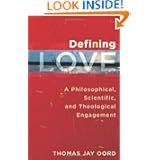
Tom Oord's "Defining Love" and "The Nature of Love" -- A Review

DEFINING LOVE: A Philosophical, Scientific, and Theological Engagement. By Thomas Jay Oord. Grand Rapids: Brazos Press, 2010. Xiii +225 pages. THE NATURE OF LOVE: A Theology. St. Louis: Chalice Press, 2010. Xii +195 pages.

Christians talk a lot about love. We affirm that God is love. We say that God loves the world enough to send into the world his Son. We treasure the words of 1 Corinthians 13, with its suggestion that while faith and hope will abide, the greatest is love. We even sing, perhaps with an uneasy conscience, “They’ll Know We Are Christians by Our Love.” But, what do we mean when we talk about love? What is our definition? How do we know to discern whether someone is acting in love? In fact, where does love come from? All of these questions are raised and addressed in these two similar, but different, books authored by Nazarene theologian Thomas Jay Oord.

Tom Oord, who is Professor of Theology and Philosophy at Northwest Nazarene University and a Ph.D. graduate of Claremont Graduate University, has an agenda. He wants to move beyond simply putting love on the theological discussion table to placing love at the very center of theology. If God not only loves, but is love, then love should be “organizing principle” of theology. Unfortunately, in Oord’s mind, this has not happened. Too often it remains behind Oz’s curtain, but “only when placed at the center can the logic of love explicitly extend to all aspects of Christian theology” (Nature, p. 4).

Oord’s agenda, it would seem, requires too very different but related books. Defining Love is in many ways the foundational text. It provides the broader outlines for placing love at the center of theological reflection, but looking at love from philosophical and scientific angles as well as theological ones. In this challenging and at times dense book Oord lays out a new field of scholarship, what he calls the “love, science, and theology symbiosis” (Defining, p. 5). In this context Oord is advocating a program of “love research,” that has at its core the belief that it is possible for the world and individuals can get better. He wants to find ways in which we can discern the virtues and practices that will enable this to happen. In other words, love just doesn’t’ happen. It requires nurture and promotion and development. This requires research into the nature of love and how it is best expressed. With this in mind, Oord lays out his understandings of science and theology, trying to clearly define where they are different and where they relate to each other.

Essential to this program is to have a firm definition of love, one that can provide a foundation for research and theological reflection. The definition that he formulates provides the basis for discussion in both of these books. That basic definition reads as follows:

To love is to act intentionally, in sympathetic response to others (including God), to promote overall well-being (Defining, p. 15).
With this basic definition in mind, Oord proceeds to explore the diverse forms of love, for not all forms of love are alike, even if they have at their base the same purpose – “promotion of overall well-being.” Thus, he looks at agape, philia, and eros. While making use of theology here, he is more intent on exploring the input of philosophy to the discussion.

Moving from definitions, Oord brings to bear the “qualitative and quantitative” insights of the social sciences, including both psychology and sociology. Key to this discussion are concepts such as altruism and empathy, along with personality types and motives. He concludes that from examining research there is a clear move away from the idea that humans are by nature “inevitably and invariably egoistic” (Defining, p. 96). If the social sciences provide one vantage point, what about biology. Assuming that evolution is true, the question concerns how evolutionary development provides the conditions for love. Again the focus is on altruism, and whether there is evidence from the study of nature of self-sacrificial action. Although the explorations are still at their early stages, the key question, concerns the evidence that nonhuman creatures express love. This may still be speculative, but there is interesting evidence to pursue. Turning from biology to cosmology, with its discussions of the formation of the universe, including the principle of creatio ex nihilo, the issue here in part concerns the possibilities of divine engagement with the universe. This is a key question for we must wrestle with the way in which God might engage us. Does God have either the power or the will to change or affect in dramatic ways nature? Or does God work in a very different fashion? Here Oord, who can be considered part of the Open Theism movement, interacts with a variety of theological and biblical perspectives, including Process Theology, which he respects but doesn’t embrace completely. The point of the chapter isn’t to provide a final understanding but to lay out the parameters and possibilities for study. Finally, he reaches theology, where he expresses his hope for a partnership between the sciences and theology so that love can find its place at the center of theology.

If Defining Love has a scientific/philosophical focus, The Nature of Love focuses on theology itself. Of the two books, this is probably the easier read and may be for many the most appropriate place to start. Although no mention is made of Defining Love many of the ideas and foundations transfer from one book to the other (I’m not sure which book was written first, though from the reader's perspective Defining Love could be considered the foundational book).

In Nature of Love Oord begins with the same definition of love as in the first book, with a focus on intentionality and end result – promotion of well-being. Whereas in the first book his conversation partners are the sciences and philosophy, here they are theologians. He wrestles with Anders Nygren over agape, St. Augustine over eros, and Clark Pinnock over philia. He finds something of value in each of these theologians and their particular definitions and perspectives on love, but he also finds them to be deficient at important points. Of the three foci, I found the engagements with Nygren and Augustine the most pertinent. In both cases, Oord redefines in important ways how we understand love.

In regard to Nygren and Nygren’s claim that agape is the definitive form of Christian love, to the exclusion of other forms, Oord challenges the idea that we are simply conduits of a love that comes from God alone without any human engagement. In his view, agape should be understood as “in spite of love.” That is, agape is that form of love that intentionally seeks to promote the well-being of the other despite the fact that the other means us harm or evil. God is definitely involved, but that doesn’t mean that we have not part to play. With regard to eros, which Augustine saw as a deficient form of love, for Augustine believed that only God could truly love, and that the object of love has no value in and of itself. Oord defines eros as being “because of love,” by which God and we seek to promote overall well-being by affirming and promoting the value that is inherent in the other. This is, I believe an important step, for too often theology starts with the premise that we are some how “totally depraved” and thus having no inherent worth or value. If Oord is correct, then we must think differently, and that means that we act differently with regard to the other. Finally, he deals with philia, and in this regard looks to his late colleague Clark Pinnock with whom he has much in common, but with whom he has what might seem to be minor differences, but which have important implications. Philia is by definition the promotion of well-being by “coming alongside.” It is that friendship, community oriented form of love, which reminds us that we need each other. It speaks of cooperation with God and with one another. Where he differs from Pinnock is in Pinnock’s concern to protect God’s reputation.

In the final chapter of The Nature of Love, Oord offers his own theological program, which he calls “essential kenosis.” This program serves as the context in which love can be brought into the center. There are similarities to Process Theology, though through the use of the idea of kenosis (self-emptying), he hopes to distinguish from his own idea of a self-limiting God with that of an inherently limited divinity, but in this understanding self-limitation isn’t voluntary, it is essential to God’s nature. What he wants the reader to understand is that God’s love is a question of necessity. Whereas in other forms of kenosis theology, God need not love outside the Trinity, in his understanding God of necessity loves the Creation. Love is not contingent. It is part of God’s nature. External forces don’t limit God, but God’s nature does. Therefore, God cannot but love.

So the question is – what does it mean for God to love, and here it’s important that all three forms of love are brought into the equation. The kind of love that forms the center of theology – our understanding of God – must be “full-orbed.” We make a mistake when we think that we can settle on one form of love and define that as Christian or divine love. We must instead bring agape, eros, and philia into our definition. If this is true of God, then it is also true for us, who are called upon as God’s creation to imitate God by expressing this full-orbed love of God in our lives. I should add that in Oord’s understanding love means that God is not coercive in any way. Thus, even creation is not a coercive act, but requires the participation of the other for creation to occur. You can see the similarities to Process Theology. The borders the two are a bit fuzzy, but there is enough of a difference to keep these two as separate understandings of the nature and purpose of God.

I believe that Tom Oord is on to something important. I have found his definitions of love to be not only helpful but have provided a new orientation for understanding the unconditional nature of love, and the full-orbed nature of love. I believe his definitions are far superior to any others I’ve seen. Thus, as a pastor and a preacher, who believes that God not only loves, but is love, these definitions and the research that help sustain these definitions will help the church move forward into the future. It will assist us in moving away from self-centeredness to others-centeredness. It will help us reorient the way we do theology and understand God and God’s relationship to Creation.

Of the two books, The Nature of Love is the easiest to work with and may be the most helpful, but for those who wish to dig deeper into the project, then Defining Love is an important read. Both are well written, but neither of these books are quick reads. They require diligent engagement and reflection. That said, Tom Oord is on to something important that the church needs to hear.

Monday, March 7, 2011

The Adjustment Bureau, Rick Warren, and Process Theology (Bruce Epperly)

Out this past weekend was the latest Matt Damon movie -- The Adjustment Bureau.  I've yet to see it, but Bruce Epperly, a regular contributor to this blog did see it and offers his thoughts from a theological perspective on the movie's message on the fate of humanity, comparing it to Rick Warren's rather deterministic Purpose Driven Life and the more open vision of Process Theology.  I think you'll find this essay intriguing and thought provoking. 


****************************

The Adjustment Bureau, Rick Warren,
and Process Theology
Bruce G. Epperly

The Adjustment Bureau raises issues of God’s plan, destiny, choice, and chance. Rising political star David Norris is destined, yes destined, to become the President of the United States, until a chance encounter with dancer, Elise Sellas. This apparently chance encounter leads to an intricate struggle between the angelic case workers assigned to keep him on the Chairman’s (aka God) pre-established plan and the love struck Norris, who believes that he can choose his own destiny.

The Chairman’s plan takes a page right out of Rick Warren’s Purpose Driven Life. According to the movie, God chooses the important events of our lives, steering us toward the course God has determined that will be best for us and the planet. We think we are free, when are really actors performing the script God has already written for us. The death of Norris’ parents and his brother is not accidental, but the working out of the Chairman’s plan to give Norris the hunger for political greatness, thus fulfilling his father’s dream.

Rick Warren’s image of human destiny takes a similar path in making the following affirmations about the relationship between God’s plan and human decision-making.
  • God plans all the important events (genetics, gender, talents, family of origin) in our lives without our input.
  • Every experience, including traumatic events, such as cancer, abuse, the death of a child, or tsunami, is “father filtered,” or planned by God for our growth.  
  • In every event God is testing our fidelity to God’s sovereign decision-making. 
  • God “smiles” when we follow directions and do as “he” says. 
  • God wants us to “color inside the lines.” Coloring “outside the lines” leads to meaninglessness in this life and alienation from God (hell) in the next. Those who seek to thwart God’s plan will be punished.
Warren’s belief in divine destiny led one of my friends to describe his book as the “puppet driven life.” Both Warren and The Adjustment Bureau’s image of God’s plan assert that when it comes to the most important things, freedom and choice are an illusion. Happiness and fulfillment come from following the pre-established plan.

Now the Adjustment Bureau takes two slight diversions from Warren’s spiritual determinism. Within the Chairman’s plan, chance events occur. Norris meets Sellas and the pre-established plan for his life is jeopardized. Second, the movie suggests that God can scrap certain plans in favor of others, and open the doors to choice in rare circumstances. Although neither Norris nor Sellas is aware of it, the Chairman’s plan had once included them falling in love. That plan, however, was scrapped for greater things for each of them. Nevertheless, the energy of the Chairman’s negation unexpectedly draws them together.

For both theologians and lay people alike, divine choice and human freedom have often been pitted against one another. Either everything reflects divine decision-making or we are entirely free. Perhaps, there is another alternative that joins divine vision and decision-making, human freedom, environmental and genetic conditioning, and chance. This is the multi-faceted approach of process theology.

From the perspective of process theology, every event emerges from the intricate and dynamic interplay of God’s vision, environmental influences, genetics, and creaturely choice. In the dynamic interplay of life, accidents happen – cells reproduce in ways that lead to cancer, bridges collapse, and brakes fail. In this same interplay, human choices can lead to cancer, abuse, faulty construction, and genocide. God has not willed these events, but must, like us, live with these events, seeking to make the most out of difficult situations.

Process theology asserts that God is intimately involved in our lives, providing possibilities, inspirations, and intuitions; working through the interdependence of life to promote synchronous encounters; inviting us to use our limited freedom to create a just and beautiful world; and giving us strength and creativity to respond to personal and communal calamities. God is not in absolute control, nor do we create our own realities.

Still, God is constantly innovating, working within the world as it is to bring forth the right balance of order and novelty. Within the limitations of the many factors of life, humans are also constantly innovating, using our limited freedom moment by moment to choose our pathways. While creaturely freedom may be quite limited, given the influence of the past, environment, genetics, politics, economics, and divine influence, human choices made moment by moment can lead to life-changing expressions of creativity and beauty. Sadly, they can also lead to pain and suffering.

Life is a dynamic interplay of call and response in which God calls and we respond, and God calls again, adjusting God’s vision to our choices rather than forcing us to follow a pre-ordained script. Still, from the perspective of process theology, God provides many possibilities and opens the door to many vocations, or personal destinies. There is God’s vision for a particular moment in time but this vision is part of many broader visions, embodied over a lifetime. Moreover, process theology asserts that God’s vision is neither coercive nor competitive. God creates the context for maximal expressions of freedom and creativity, congruent with the well-being of the global and local communities. Freedom is limited, but it is real.

Like a good parent, God hopes we make the right decisions for ourselves and others. But, God also welcomes surprises. Contrary to Rick Warren and the Chairman’s initial plan, innovation leads to greater and more energetic revelations of God’s presence in our lives. After God has given us the most creative visions to integrate with our freedom and the impact of the environment, like a good parent, who has supplied crayons and paper for our recreation, God whispers in our unconscious, “Surprise me. Bring something new into the world. Do something beautiful and unexpected.”

The Adjustment Bureau provides much food for theological reflection. It invites us to ponder the intricacies of freedom and destiny and God’s role in determining who we are and what we do. It suggests that we may not be puppets of fate after all, and that our calling is to take risks for love, beauty, and healing. These risks rewarded with greater opportunities for freedom and creativity in partnership with the source of all freedom, creativity, and possibility.


Bruce Epperly is a theologian, spiritual guide, healing companion, retreat leader and lecturer, and author of nineteen books, including Holy Adventure: 41 Days of Audacious Living; Process Theology: A Guide for the Perplexed (May 2011); and Tending to the Holy: The Practice of the Presence of God in Ministry. He may be reached at bruceepperly@gmail.com.

Tuesday, February 22, 2011

Circles and Safety -- Process and Parenting #3 (Bruce Epperly)

The third installment of Bruce Epperly's take on parenting from the perspective of Process Theology takes us to a place all parents have been.  He speaks to the question of safety and risk.  How do we protect our children while allowing them freedom to explore and grow.  He mentions a book that I read many evenings to my own son; it's a book that serves to remind the child that no matter where he or she runs, the parent is there.  Runaway Bunny is a favorite of parents and small children for it speaks to the kind of relationship we all envision.  It is, of course, also a relationship that God envisions for us to have with God.  I invite you to reflect and comment on Bruce's essay about drawing circles of safety around our children.

*****************

Circles and Safety
Bruce G. Epperly

In the Celtic tradition, travelers often begin their daily journey with a prayer and the encircling (or “caim”) in which the traveler rotates in a clockwise direction, inscribing a circle with her or his index finger. Whether we do this through movement or in our imagination, the encircling reminds us that wherever we are, we are in God’s circle of protection. In the spirit of Romans 8, we discover that nothing – none of our deepest fears for ourselves or our loved ones – can separate us from the love of God. With the author of Psalm 139, we discover that if we descend to the depths, God is there; if we ascend to the heights, God is also there. Like the story of the Runaway Bunny, even when we run away, or clothe ourselves in darkness, God is there to embrace us.

I have found the practice of encircling to be a spiritual aid, especially when I find myself struggling with stressful situations or caught up in fear and anxiety. When I experience myself in God’s circle of love, I know that despite my fears that all will be well.

Being a parent can be frightening. We fear for our children’s safety and place in the world. We are constantly bombarded by news alerts and commercials that remind us, often unrealistically, that we, and our children, are always at risk. There are no guarantees in life, even for spiritual persons.

While parents can practice many common sense safety practices, the issue of safety is spiritual as well as practical. Parenting is about expanding the circle of our children’s experiences and this always involves risk. At five months, my grandson’s parents have 24/7 awareness of where he is and what he’s up to. They stay in contact with him by: being in the same room and through baby monitors. As he grows older, his circle of experience will grow to closing the door of his own room for privacy to playing alone in the backyard and to going on walks and bike rides with friends or all by himself. Eventually, he will go away to college, making a life of his own.

Parents and children alike need sufficient “primordial” or “basic trust,” enabling us to face uncertainty with confidence in our own abilities and the basic benevolence of the universe. Process theology sees trust as growing out of the dynamic divine-human relationship. God is involved in each moment of experience, providing possibilities and the energy to achieve them. God does not and cannot determine everything or provide an absolute safety net, but in every situation, God is providing resources for our well-being and safety, both in our experiences and by inspiring others toward acts of care and protection. We are always in the circle of God’s love and our calling is to create circles of love that expand to embrace others and that promote others’ creativity and freedom. This applies to parenting as well as to mentoring, marriage and friendship.

Parents need to join order and novelty in their parenting. Order describes the safe circles of life, of responsibility to protect our children with all the resources we can muster in terms of presence, household safety and security, diet, and health promotion. Novelty relates to allowing surprising and serendipitous moments to occur. These always involve a degree of risk. For example, in teaching my son to ride a bicycle 25 years ago, I put him at a small degree of risk as I pushed him forward and then let go so that he could ride on his own. He fell several times and then – voila! – Off he went, having learned to ride on his own without training wheels. The move from crawling to toddling and walking involves pain and failure; and yet it is necessary for growth and maturity. New ideas are threatening – and at times, painful – and yet without new idea, we stagnate intellectually, spiritually, and emotionally.

As a parent and grandparent, I take the Celtic encircling seriously as essential to my intercessions on behalf of my son and grandson. I circle them in God’s care whether I am visiting them in Washington DC or taking a walk in my Lancaster, Pennsylvania neighborhood. The encircling reminds me that we are always connected and that my prayers make a difference. There are no guarantees in life – the sun shines and the rain falls on all of us. But, through the interplay of smart and safe parenting and a constant expanding of the circle of experience, we can balance safety and risk in ways that support our children’s well-being.

A Spiritual Practice for Parents: Regularly inscribe the Celtic circle (or “caim”) around your children and teach them to practice it as well. In your imagination, visualize yourself drawing a circle around your child as you pray for their safety, well-being, and creativity. Invite them to simply draw a circle around themselves by movement or in their imagination.


Bruce Epperly is a theologian, spiritual guide, healing companion, retreat leader and lecturer, and author of nineteen books, including Holy Adventure: 41 Days of Audacious Living; God’s Touch: Faith, Wholeness, and the Healing Miracles of Jesus; and Tending to the Holy: The Practice of the Presence of God in Ministry. He has taught at Georgetown University, Wesley Theological Seminary, Claremont School of Theology, and Lancaster Theological Seminary. He is currently theologian in residence at St. Peter’s United Church of Christ in Lancaster, Pennsylvania. He can be reached at bruceepperly@gmail.com