Showing posts with label Spirituality. Show all posts

Sunday, April 17, 2011

What is Our Spiritual Potentiality?

If God is the giver of every good and perfect gift, then it would be unwise to keep the gifts of God hidden. Having been gifted and called to ministries as diverse as the persons who have received these gifts, it is incumbent upon us to discern the nature and purpose of these gifts in our lives. The place to start, as a community of faith, is to affirm in our own contexts the word that described the experience of the Corinthian church, which, according to Paul, was enriched in every way through gifts of "speech and knowledge of every kind." They didn’t lack any “spiritual gift as [they waited] for the revealing of our Lord Jesus Christ" (1 Cor. 1:4-7). If the church grasps this message, then the next step is for God’s people to discern and discover the nature and use of their own gifts, so that they might join together as one body in service to our God.

Embracing our spiritual potentialities, our giftedness, is to affirm that we are created in God’s likeness, with a mandate to love and serve God. The implications for churches, especially Mainline Protestant churches, of the people of God discovering their spiritual gifts are incredibly significant, for if the people of God will claim the sense of empowerment that comes with this discovery will be transformative.

The reticence that some may have in adopting such a quest is understandable, because it runs counter to the long held belief that ministry is something that ordained clergy do, while the laity benefit from such ministry. But the potential benefits to churches who embrace the possibility of their people discovering their spiritual gifts present are too great to ignore. Not only might the people who inhabit our churches grow spiritually, but churches might grow in their ability to engage in community transforming ministry that brings hope and healing to fragmented and broken world. Jim Wallis made the statement: “Religion is personal, but not private.” Wallis was speaking about the political implications of faith – of religion’s place in the public square. Gifted people are people who engage the world where they find it. Ministry in churches that embrace their gifts will touch not only the people within the church it will touch the world outside. The faith of the gifted will touch political, social, environmental, issues. There is no area of life that the church’s ministry does not touch, for gifted by the Spirit we are one body, with one purpose, to share the love of God with all people.

What are the possibilities? To what ministries might God be calling us to take up? Jürgen Moltmann speaks to the wondrous possibilities that lie before us as people of faith.

The person who believes becomes a person full of possibilities. People like this do not restrict themselves to the social roles laid down for them, and do not allow themselves to be tied to these roles. They believe they are capable of more. And they do not tie other people down to their own preconceived ideas. They do not imprison others in what they are at present. They see them together with their future, and keep their potentialities open for them. [Jürgen Moltmann, The Spirit of Life: A Universal Affirmation, Margaret Kohl, trans., (Minneapolis: Fortress Press, 1992), 187.]
As we trust God, ourselves, and our neighbors, our “charismatic potentialities are awakened” and we begin to join in a ministry that makes a difference.

[Excerpt from Gifts of  Love, unpub. mss.]

Sunday, April 10, 2011

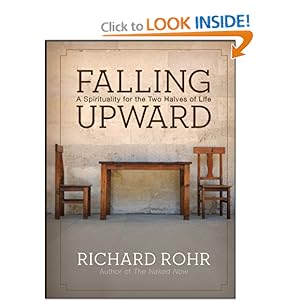
Falling Upward --- Review

FALLING UPWARD: A Spirituality for the Two Halves of Life.  By Richard Rohr.  San Francisco:  Jossey-Bass, 2011.  Xxxix + 183 pp.

In the Book of Hebrews the call is given to “press on to maturity, by moving on from the basics about Christ’s word” (Heb. 6:1 CEB). The reason why this word of wisdom is given to the readers of this sermon/letter is that the author recognized how easy it is to get stuck on the basics and never move on to spiritual maturity. A similar word of wisdom is present in Falling Upward, an exquisitely written book from the pen of Richard Rohr, a Franciscan priest with Emergent Church connections. Rohr offers a gentle but firm reminder that although it’s appropriate to start the spiritual journey by focusing on security and identity, but there comes a time when we must move beyond the protective fences and engage the world in which we live through the Spirit of God.

Rohr uses the image of life’s two halves. In the first half of life, which needn’t be defined purely in terms of age, we focus on the foundations and create a container for life’s questions. From there, after we’ve taken care of these basic elements of the faith journey, then we are ready to fill the container with content. Often, in the first half of life, we live with either/or categories. But, staying put in this first stage of life means that our containers remain largely empty and ill-defined. We live in a sort of perpetual adolescence. It’s fine to be an adolescent for a while, but not forever, but unfortunately the church often does little to challenge this adolescence. As Rohr notes, many of the sermons he has heard over his long life never move beyond this first level. Indeed, if a preacher does challenge these sacred foundations, that person will likely be considered “heretical, dangerous, or ill advised” (p. 7).

If, however, we’re going to experience spiritual maturity, or what Rohr calls the second half of life (something that many people never achieve), then we must be ready to leave the comfort of the black and white and risk living with a both/and dynamic. To move into the second half of life we must be comfortable with change and willing be stretched beyond our comfort zones. Indeed, we need to be aware of the trap of worshiping the status quo. Thus, like Abraham and Sarah, we must be willing and ready to leave home and head out for an undiscovered country.

Whereas the first half of life involves providing a safe context to explore one’s faith and identity, as well as learning the traditions, part of this life process involves having the opportunity to fall. In a word to parents – spiritual and otherwise – Rohr writes:

"We are not helping our children by always preventing them from what might be necessary falling, because you learn how to recover from falling, by falling! . . . People who have never allowed themselves to fall are actually off balance, while not realizing it at all. That is why they are so hard to live with." (p. 28).
Having learned to fall and then get back up in the first half of life, we’re prepared to move outward and face the realities of life beyond the fence. That includes our ability to experience and understand the value of suffering, which is one of the key themes in this book. The point is not that we should pursue suffering, as if we have a martyr’s complex, but that we recognize that enduring suffering enables us to move forward in life. Indeed, the truth is, there must be death, before there is life.

One of the reasons why we get stuck in the first half of life is that we’ve been led to believe that the world operates much like Plato described. It’s a matter of forms and ideas. We expect the world to operate in an orderly fashion, so we find it difficult to deal with reality. He suggests that in many ways Plato is more influential on the way the church thinks than is Jesus – I think he’s right. Consider this word:

"We invariably prefer the universal synthesis, the answer that settles all the dust and resolves every question – even when it is not entirely true – over the mercy and grace of God." (p. 56)
In making this statement, he raises the question of postmodernism, which challenges the possibility of constructing metanarratives that can explain everything. There simply are no such things, but we like simple answers, and so we hold out for these metanarratives, which always fail to deliver.

When we move into the second half of life we are better able to see that Jesus doesn’t offer us a one-size-fits-all gospel. Instead, Rohr suggests that Jesus offers us a vision of reality in which “God adjusts to the vagaries and failures of the moment. The ability to adjust to human disorder and failure is named God’s providence or compassion” (p. 56). As we move beyond the first half understandings where rules come first, we discover in the second half of life that God is less concerned about laws and more about the relationship. Thus, the ability to move forward is to embrace God’s unconditional forgiveness.

The spiritual journey is driven, according to Rohr, by a sense of homesickness. We move on into the second half of life because of spiritual restlessness and dissatisfaction with the status quo. Of course, for many, if not most of us, the fear of the unknown keeps us from moving out into the world to address this restless, which moves us toward union with God. Drawing from St. Augustine, he suggests that “we are created with an inner drive an necessity that sends all of us looking for our True Self, whether we know it or not. This journey is a spiral and never a straight line” (p. 94).

The journey toward the second half of life leads us through complexity and paradox to a new simplicity or unified field, where the painful and excluded parts of parts life brought into a unified picture (but not a metanarrative). The real tragedy in life is that so few can make this journey. The tragedy of so many elderly people never becoming elders may be due to the fact that they themselves had never been eldered or mentored. Thus,

"Such people seem to have missed out on the joy and clarity of the first simplicity, perhaps avoided the interim complexity, and finally lost the great freedom and magnanimity of the second simplicity as well." (p. 114).
This is one of the key elements of this reflection on the movement toward spiritual maturity – age itself is no marker of maturity. Some who are young have been able to move into spiritual maturity, while some who are quite elderly remain spiritually immature.

The journey into maturity requires us to honor the needs of the first half of life – identity formation and security – while providing room to move into the second half. There is a tension here, but if we’re able to keep this tension then there will be an opportunity to grow wisdom. But, as is clear from the book, none of this is easy. It will likely involve endurance of suffering and pain, of overcoming obstacles, and maybe even hitting bottom before climbing back up toward union with God.

The benefits, however, are wonderful. There may be sadness, but there will be less anxiety and fear, and thus openness to others. What you may have avoided in the first half of life, in the second half becomes your friend and teacher. And, this should come as no surprise, considering this perspective, Jesus would have been and is, a “second-half-of-life man,” but as Rohr points out he had the “unenviable task of trying to teach and be understood by a largely first-half-of-life history, church, and culture” (p. 149). Alas, the choice of moving into the second-half-of-life is ours to make or not. Indeed, to be ordinary is not really a choice, but to move on to something extraordinary is a choice. The question is – are we ready to make that choice?

For the most part we Christians are content to live inside the comfortable confines of the institution and the tradition. We’re not too eager to ask questions or wrestle with doubt and despair. So, the numbers of people who take the journey toward maturity, and thus union with God are few in number. The road is narrow, and thus we prefer the wide and smooth highways. But, if we’re willing to follow the path that Rohr sets out, there will be blessings to be found – though may be not the riches that some would promise.

Although this is really first real engagement with Richard Rohr, I found him to be a trustworthy guide to the spiritual life. As I read the book I was forced to examine my own journey and thus wonder whether I had moved beyond the first half and into the second. This is definitely a book to be read and pondered and digested, but if one chooses to do so and truly imbibe its wisdom, there will be spiritual transformation.


Article first published as Book Review: Falling Upward by Richard Rohr on Blogcritics.

Tuesday, March 29, 2011

A View from the Back Pew -- Review

A VIEW FROM THE BACK PEW: God, Religion & Our Personal Quest for Truth. By Tim O’Donnell. Kansas City, MO: Linchpin Publishing, 2011. Xiv + 264 pages.

More and more people are identifying themselves as “spiritual but not religious.” This new category of religious people is comprised mostly of people who believe in God or at least some “higher power,” but are either dissatisfied with institutional religion or have been hurt by it. They like God, just not the institution. This “new” breed of spiritually-inclined people tends to be eclectic, though their understandings of spirituality often reflect aspects of whatever tradition they may have been born into. In this new age of spirituality, where religious observance and institutional membership aren’t required or expected people feel free to strike out on their own, picking and choosing from among the various religious offerings. In this new world of spirituality, there is no central authority, but because of the entrepreneurial spirit that is inherent in this new age, one can either choose to be one’s own spiritual authority or attach oneself to one of the many spiritual guides who have emerged in the age of new media. Ultimately, in this age of spiritual eclecticism the individual is the final arbiter of truth.

Tim O’Donnell’s apparently self-published book A View From the Back Pew offers readers a personal memoir of a spiritual journey that reflects this new spirit. The author is a business entrepreneur, former newspaper publisher, and most importantly is a former Roman Catholic. He writes about the journey he took from a rather traditional Roman Catholic upbringing, which included the requisite run-ins with narrow minded and physically abusive Nuns to the realization that he was free to embrace the God within. In large part this book is a product of what O’Donnell calls “The Deal,” a pact he made with God while a college student studying in Rome. He had a spiritual experience that led him to abandon college and pursue his fortune, which he would then use to serve God. When the Roman Church seemingly didn’t have much use for his gift, once he had made his fortune, he chose to strike out on his own and use his fortune to tell his story.

The book itself alternates between stories from his life that carry him to the point at which he could share his sense of the life in the Spirit, with his reflections on the nature of this life – including sharing his own doctrinal perspectives. In the epilogue O’Donnell provides the window by which the journey can be evaluated. The title of the book comes from a more recent experience in Rome, where he is sitting in the back pew of the chapel where he had worshiped as a college student. At that moment, he realized that “one could come to communion with God from within. In a rush of overwhelming understanding, I knew the Church was a man made institution that could not deliver a man to where God really dwelt” (p. 256).

As you read this book you can’t help but sympathize with his struggles, though as a Protestant I have to be careful not to embrace too eagerly a negative portrayal of the Roman Catholic Church (Protestants have been known to do this). But while I can understand why O’Donnell felt hemmed in by the institutional forces of religion, I also found myself needing to raise questions.

Although I could critique this book on theological and historical grounds that wouldn’t seem to make much sense. That critique might sound defensive, and I’m not sure the author would find my critique all that compelling. So, for the most part I’ll leave those issues alone. What I would like to do is raise some questions about tendencies I see in the “spiritual but not religious” movement, which are exemplified in this book, that do concern me.

I’ll start with O’Donnell’s relationship with Roman Catholicism. It is clear that his understanding of Christian faith is wrapped up tightly with what he learned and experienced growing up in the Catholic Church, especially his education in Catholic schools, including those encounters with rather physically abusive nuns. This schooling introduced Tim O’Donnell to a rather narrow view of faith, one that was rigid and punitive. There were, of course, signs of grace here and there, but these seem to be the exceptions. Although O’Donnell knows that there are other forms of Christianity, including Protestantism, he doesn’t seem interested in them. Like many who emerge from the Catholic context it’s hard to break free of this orbit. As we often hear – once you’re a Catholic always a Catholic, even if you’re a lapsed one. So, much of his argument with institutional Christianity is wrapped up in his experiences of the Catholic Church. Ironically, even though he is disenchanted with traditional Christianity, it is this faith tradition that provides the foundation for his own reflections. This Catholic Faith provides the lenses through which he reinterprets his own experiences.

More problematic in my mind is what I’ll call the “infatuation with Gnosticism” that is so prevalent among many “spiritual but not religious” folks. The idea that the Gnostic texts were excluded from the canon by a narrow minded religious institution seems to give them added authority. Whether it is the recent hullabaloo over the Gospel of Judas or the popularization of gnostic gospels in The Da Vinci Code, the idea that the Church tried to suppress alternative versions of the Jesus story has caught on in the popular mind. In an age that distrusts institutions, this process of canonization, rather than being an example of divine providence, is a sign that the church knows something to be true that they don’t want out. And what is that truth? Well, often the truth is that there is a pathway to God that bypasses the institution. But what we don’t see in this engagement with the Gnostic texts is a recognition that Gnosticism tended to be elitist (after all the Gnostics saw themselves as possessors of secret knowledge), docetic (by and large they denied the value of the physical/material world), and they also tended to be anti-Jewish (Marcion – one of the heroes of Gnosticism – believed that the God of the Old Testament was the creator of the world – which was evil – and not the God of Jesus). The existence of these texts do remind us that the early Christian community was diverse, but I would question the enthusiasm with which their message is being received, without much further examination of them.

The biggest concerns that I have about this movement, which are exemplified by the life of the author, relate to two areas that I think are related. First, there is the issue of a moral/ethical vision, and the second has to do with community.

I’ll deal first with the matter of ethics/moral foundations. Although, the author appears, from his own self-description, to be a man of high moral standards – he exhibits these in his business practices – I’m left wondering about where these standards were derived. My sense is that they were instilled in him by his Catholic upbringing. Despite this, I don’t see much concern for social justice in this understandings of spirituality. He criticizes the Catholic Church for excluding women from the priesthood, but that seems to be part of his overall reaction to the narrowness of the institution. I may have missed something, so I’d be glad to hear from the author about his vision of social justice, but something that did stick out was his rather angry rejection of a statement by a Catholic college professor that wealth was evil. Since the author wants to include Jesus in his own spiritual self-understanding, I’m wondering what he makes of Jesus’ rather regular denunciations of a pursuit of wealth, including his call for the young man to sell all his possessions and give to the poor or his suggestion that one can’t serve God and wealth. So my question is – if I am my own religious authority, who is in the position to challenge my moral/ethical standards?

The final concern that I have about the “spiritual by not religious” movement has to do with the individualism that is prevalent in this movement. O’Donnell, like many in this movement, has essentially created his own religion to fit his own perspectives (yes I know that to some degree we all do this). He is, by his own admission, the author and founder of his faith, which is rooted in the supposition that we are all somehow God incarnate. That is, while he honors Jesus, he believes that we can all be Christs, and he tries to interpret biblical texts in that light. As I read his interpretations of these texts, many of which are filtered through his embrace of the gnostic gospels, I found his interpretations to stretch the meanings beyond what they’re capable of holding, but again my focus isn’t on the doctrinal side of things. My concern is with the individualism that undermines the call to community. O’Donnell doesn’t say this, but there is a sense that if Christ is within us, and that all we need to do to find God is to look within, then why would we need a community? We are essentially spiritually self-sufficient. And if we’re self-sufficient then no one or no institution can challenge my sense of what is true and what is right. In the end, not only is the institution unnecessary (and human-made), but community is unnecessary? But as I read the biblical texts I see in them a call to community. Paul speaks of the church not as institution but as the body of Christ. It is a living being, in which every member is important. I’m wondering what will happen to the spiritual lives of those who have no connection to a community that challenges and supports one as one takes the journey of faith. I struggled with how to respond to this book, because I don’t want to come off as defensive of my tradition or the institution. I must admit that the institution and the tradition needs critique. At the same time, while I found O’Donnell’s book to be a well-written and expressive of his own journey, I believe that there are important questions that need to be posed to those who have embraced this “spiritual but not religious” idea. And these questions need to be asked now while this movement is growing at an increasingly fast pace, so fast that it is in many ways leading to the emptying out of the church that employs folks like me. So, I do have a vested interest in this conversation.

What we on the institutional side of things can learn here is that there is a strong sense of disappointment and frustration among the populace. The traditional institutions aren’t speaking to their hearts or their minds. The question is why? Why do people feel the need to strike out on their own? At the same time, I wonder if this new movement pushes the pendulum of institutionalism too far in the other direction, and what that will mean for people’s journeys as they become less and less connected to traditions once held? These are all questions that I pose to further the conversation, and not cut it off.


This review is offered as part of the TLC Book Tours,
which provided this review copy.

Monday, March 28, 2011

What Do You Worship? (Guest Post)

Alex McCauslin is a young seminarian and ministry intern at Central Woodward Christian Church.  One of Alex's assignments is to work with our young adults to create a YA community.  In a posting at her own blog, Alex writes about her encounter with a young woman who was cutting her hair.  This conversation about God, church, and worship raises some intriguing questions.  We know that an increasing number of young adults are listed as "Nones."  That is, they simply don't identify with any religious community or tradition.  That doesn't mean they don't believe in God or that they're not interested in spiritual things, they just don't have a "place" to put these beliefs.  I'd like to use Alex's reflections as a starting point for an important conversation about faith, worship, and a world that feels disconnected to what happens in religious communities.

**************************


This experience has been rattling around in my head for the last week. I am puzzled by it, still.

I recently had my hair cut. The woman cutting my hair was in her early twenties (around my age.) She asked what I was doing with my life, and, of course, I eventually admitted I was studying at Seminary and working for a church.

“So, what religion are you?” She asked.

“I’m Disciples of Christ, it’s Protestant, like Methodists.”

She stared blankly at me and said, “I had a neighbor who was a Mormon and I went to church with her once.”

“We’re not quite like the Mormons,” I said.

“I don’t know. I mean, I’m a Christian.”

“Oh, yeah? What church did you go to?”

She shrugged. “I’ve never been to church, just youth group with my friends when I was in high school.”

“Cool, what kind of youth group?”

Again, a blank stare. “I don’t know, we just, like, hung out with our friends and talked about stuff. I didn’t really like it that much, so I stopped going.”

I nodded, and, deciding that the conversation was headed nowhere, stopped asking questions about church and started asking questions about her aspirations as a stylist.

Later, after a short lull in our conversation, she returned to the topic of religion. “So you work at a church? What do you do there?”

I told her that I was currently putting together an alternative worship service on Sunday evenings.

She frowned and stopped cutting my hair. “If you don’t mind me asking, what do you worship there?”

I didn’t even know what to say. I’d never been asked such a question before, and certainly never by someone who’d claimed to be a Christian.

I told her that we praised God and prayed to Jesus. That we contemplated our purpose, especially as it related to communities that suffered poverty and other oppression.

“That’s cool,” she said and pressed on asking questions about how we actually tried to help people. Eventually she admitted that she had given up trying to make a difference, as she had realized it wasn’t really possible.

As she was walking me to the front desk to pay for my haircut, she brought up the topic of religion a third time, out of the blue and with urgency. “I think I’m a really spiritual person! I just don’t know much about the church. It’s not really for me, I don’t think.”

I’ve heard this comment before. I don’t know what to do with it. Is the church not doing its job? Or is it becoming obsolete to upper-middle class Americans?

I don’t know what to do with the fact that Christians, perhaps myself included, aren’t prepared to answer the question, “What do you worship?” I’ve been thoroughly prepared to answer questions of why or how. But ‘what’ completely threw me off my game.

What do we worship?

ETA: Just went to lunch with a friend who started a new job as Youth Director at a suburban church. She has been observing their current Youth Group program and has concluded that it centers around gossip and chilling. She is appalled and eager to create change.


Reposted from Alex Discerns a Way.

Tuesday, March 1, 2011

Nurturing Your Child's Spiritual Life (Bruce Epperly)

In the fourth essay in his series on parenting from the persective of process theology, Bruce Epperly speaks to the issue of cultivating trust in a child.  I found this to be an interesting and compelling post, especially after recently being with Martin Marty at the Academy of Parish Clergy annual meeting, where he spoke to the topic of his most recent book:   Building a Culture of Trust.  Bruce reminds us that the process begins as soon as children are born. 

*********************

Nurturing Your Child’s Spiritual Life –
Cultivating Trust
Bruce G. Epperly


The world regularly disappoints us. Things don’t work out as we expected and our best laid plans are often thwarted by unexpected instances of Murphy’s Law. Our trust in the essential goodness of life and humankind is, on occasion, betrayed by institutions, employers, friends, and spouses. Illness strikes and our once predictable world is turned upside down. Beyond that, we know only too well the realities of natural disasters and unexpected accidents. We are never ever fully secure or safe in life on a personal or planetary scale.

Yet, trust, even in a world where death can strike at any moment, is essential for creativity, healthy relationships, and personal and community flourishing. Trust in the world and trust in oneself are intimately related. But, how do we cultivate trust in children in a constantly changing and often insecure world?

Erik Erikson spoke of basic or primordial trust as the most essential need of infants. To grow spiritually and emotionally, infants must answer what Einstein called life’s most important question: “Is the universe friendly?” with a resounding “yes” if they are to find personal and relational fulfillment. But, how do parents cultivate trust that lasts a lifetime in the first months and years of life? Obviously, the infant can’t produce her or his trust. This trust must come from the infant’s experience of the goodness of life, at a deep and unconscious level, through positive and supportive relationships with an infant’s most significant people, most especially mother and father.

Nurturing basic trust in an infant is a matter of parental character and spiritual maturity. Trust is nurtured by faithful and trustworthy persons, who can be relied upon to deliver what they’ve implicitly promised to those who are absolutely dependent and completely vulnerable. In fact, I believe that one of the roles of religious and spiritual traditions is to restore and promote the trust we may not have received in infancy. Healthy religion tells us that we are ultimately safe, cared for, and affirmed regardless of our life situation. The apostle Paul captured the essence of trust when he proclaimed that “nothing can separate us from the love of God” – not even persecution, illness, fear, or death. Centuries earlier, the author of Psalm 139 asserted that if we ascend to the heavens God is there and if we descend to the depths God is there. God is there even when we run away from God and cover ourselves in darkness.

Cultivating trust in infants is grounded in trustworthy and faithful parenting. And, this requires parents to cultivate a sense of consistency in care and love. While an infant can’t intellectually articulate the meaning of love, he or she knows love in action – in an available breast or bottle, in a soothing voice in the night, in the reading of books and massaging of skin, in the tone of our voice, and in the touch of loving arms. The Dalai Lama once said that we are blessed to be born into loving arms and later to die into loving arms.

As a grandparent, I seek to be faithful and trustworthy with my six month old grandson. When I’m visiting him and his parents, I wait till later in the morning to take a walk. My grandson tends to be an early riser, so his mother brings him down to me at 5:00 a.m., so she and my son can get a little more rest before facing the challenges of parenting, householding, and professional life. I place his concerns ahead of my morning rituals - writing or even meditating. I have learned that you can’t give a child too much love, nor can you say “I love you” in too gentle a tone. He learns trust as I securely hold him, come to him when he cries (nowadays after letting him cry a moment or two to begin to learn patience). He discovers trust in loving arms and gentle words.

Cultivating trust invites us to develop our own characters and spiritual growth. As parents, we learn to be trustworthy by taking time out for prayer and meditation, by learning to be patient with ourselves – and this is best learned through prayerfulness and trust in God’s care. We need to remember the flight attendant’s counsel, “put your oxygen mask on first” so we have the resources to be faithful through hours of crying, interruptions at night, and changes in old routines. Our own spiritual nurture reminds us that “it’s not about us” and that peace and well-being involve balancing our own needs with the needs of others.

Cultivating trust also requires a “village” not just to raise a child, but support and nurture parents. We are blessed at this time of our lives to be able to spend a couple days each week with our son, daughter-in-law, and grandson. We hope to do this for years ahead to support his professional parents’ balancing a career with family. And, beyond grandparents, a community of friends and a just and supportive social structure, including the government, contributes to an environment of trust.

Ultimately, we need to cultivate our sense that “all will be well” and that even when we reach our limits, we will have the resources to face life’s challenges with hope, courage, and equanimity.

Trust is a gift; the gift of community, of caring parents, and a trustworthy God. Life is challenging, but trust enables us to live through life’s challenges knowing that we have power to shape our lives and that, when are most vulnerable, nothing can separate us from the love of God.


Bruce Epperly is a theologian, spiritual guide, healing companion, retreat leader and lecturer, and author of nineteen books, including Holy Adventure: 41 Days of Audacious Living; God’s Touch: Faith, Wholeness, and the Healing Miracles of Jesus; and Tending to the Holy: The Practice of the Presence of God in Ministry. He has taught at Georgetown University, Wesley Theological Seminary, Claremont School of Theology, and Lancaster Theological Seminary. He is currently theologian in residence at St. Peter’s United Church of Christ in Lancaster, Pennsylvania. He can be reached at bruceepperly@gmail.com