Showing posts with label Richard Rohr. Show all posts

Sunday, April 10, 2011

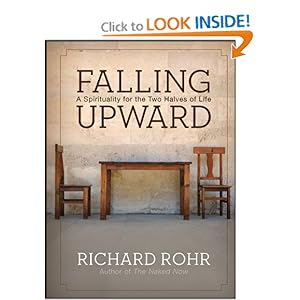
Falling Upward --- Review

FALLING UPWARD: A Spirituality for the Two Halves of Life.  By Richard Rohr.  San Francisco:  Jossey-Bass, 2011.  Xxxix + 183 pp.

In the Book of Hebrews the call is given to “press on to maturity, by moving on from the basics about Christ’s word” (Heb. 6:1 CEB). The reason why this word of wisdom is given to the readers of this sermon/letter is that the author recognized how easy it is to get stuck on the basics and never move on to spiritual maturity. A similar word of wisdom is present in Falling Upward, an exquisitely written book from the pen of Richard Rohr, a Franciscan priest with Emergent Church connections. Rohr offers a gentle but firm reminder that although it’s appropriate to start the spiritual journey by focusing on security and identity, but there comes a time when we must move beyond the protective fences and engage the world in which we live through the Spirit of God.

Rohr uses the image of life’s two halves. In the first half of life, which needn’t be defined purely in terms of age, we focus on the foundations and create a container for life’s questions. From there, after we’ve taken care of these basic elements of the faith journey, then we are ready to fill the container with content. Often, in the first half of life, we live with either/or categories. But, staying put in this first stage of life means that our containers remain largely empty and ill-defined. We live in a sort of perpetual adolescence. It’s fine to be an adolescent for a while, but not forever, but unfortunately the church often does little to challenge this adolescence. As Rohr notes, many of the sermons he has heard over his long life never move beyond this first level. Indeed, if a preacher does challenge these sacred foundations, that person will likely be considered “heretical, dangerous, or ill advised” (p. 7).

If, however, we’re going to experience spiritual maturity, or what Rohr calls the second half of life (something that many people never achieve), then we must be ready to leave the comfort of the black and white and risk living with a both/and dynamic. To move into the second half of life we must be comfortable with change and willing be stretched beyond our comfort zones. Indeed, we need to be aware of the trap of worshiping the status quo. Thus, like Abraham and Sarah, we must be willing and ready to leave home and head out for an undiscovered country.

Whereas the first half of life involves providing a safe context to explore one’s faith and identity, as well as learning the traditions, part of this life process involves having the opportunity to fall. In a word to parents – spiritual and otherwise – Rohr writes:

"We are not helping our children by always preventing them from what might be necessary falling, because you learn how to recover from falling, by falling! . . . People who have never allowed themselves to fall are actually off balance, while not realizing it at all. That is why they are so hard to live with." (p. 28).
Having learned to fall and then get back up in the first half of life, we’re prepared to move outward and face the realities of life beyond the fence. That includes our ability to experience and understand the value of suffering, which is one of the key themes in this book. The point is not that we should pursue suffering, as if we have a martyr’s complex, but that we recognize that enduring suffering enables us to move forward in life. Indeed, the truth is, there must be death, before there is life.

One of the reasons why we get stuck in the first half of life is that we’ve been led to believe that the world operates much like Plato described. It’s a matter of forms and ideas. We expect the world to operate in an orderly fashion, so we find it difficult to deal with reality. He suggests that in many ways Plato is more influential on the way the church thinks than is Jesus – I think he’s right. Consider this word:

"We invariably prefer the universal synthesis, the answer that settles all the dust and resolves every question – even when it is not entirely true – over the mercy and grace of God." (p. 56)
In making this statement, he raises the question of postmodernism, which challenges the possibility of constructing metanarratives that can explain everything. There simply are no such things, but we like simple answers, and so we hold out for these metanarratives, which always fail to deliver.

When we move into the second half of life we are better able to see that Jesus doesn’t offer us a one-size-fits-all gospel. Instead, Rohr suggests that Jesus offers us a vision of reality in which “God adjusts to the vagaries and failures of the moment. The ability to adjust to human disorder and failure is named God’s providence or compassion” (p. 56). As we move beyond the first half understandings where rules come first, we discover in the second half of life that God is less concerned about laws and more about the relationship. Thus, the ability to move forward is to embrace God’s unconditional forgiveness.

The spiritual journey is driven, according to Rohr, by a sense of homesickness. We move on into the second half of life because of spiritual restlessness and dissatisfaction with the status quo. Of course, for many, if not most of us, the fear of the unknown keeps us from moving out into the world to address this restless, which moves us toward union with God. Drawing from St. Augustine, he suggests that “we are created with an inner drive an necessity that sends all of us looking for our True Self, whether we know it or not. This journey is a spiral and never a straight line” (p. 94).

The journey toward the second half of life leads us through complexity and paradox to a new simplicity or unified field, where the painful and excluded parts of parts life brought into a unified picture (but not a metanarrative). The real tragedy in life is that so few can make this journey. The tragedy of so many elderly people never becoming elders may be due to the fact that they themselves had never been eldered or mentored. Thus,

"Such people seem to have missed out on the joy and clarity of the first simplicity, perhaps avoided the interim complexity, and finally lost the great freedom and magnanimity of the second simplicity as well." (p. 114).
This is one of the key elements of this reflection on the movement toward spiritual maturity – age itself is no marker of maturity. Some who are young have been able to move into spiritual maturity, while some who are quite elderly remain spiritually immature.

The journey into maturity requires us to honor the needs of the first half of life – identity formation and security – while providing room to move into the second half. There is a tension here, but if we’re able to keep this tension then there will be an opportunity to grow wisdom. But, as is clear from the book, none of this is easy. It will likely involve endurance of suffering and pain, of overcoming obstacles, and maybe even hitting bottom before climbing back up toward union with God.

The benefits, however, are wonderful. There may be sadness, but there will be less anxiety and fear, and thus openness to others. What you may have avoided in the first half of life, in the second half becomes your friend and teacher. And, this should come as no surprise, considering this perspective, Jesus would have been and is, a “second-half-of-life man,” but as Rohr points out he had the “unenviable task of trying to teach and be understood by a largely first-half-of-life history, church, and culture” (p. 149). Alas, the choice of moving into the second-half-of-life is ours to make or not. Indeed, to be ordinary is not really a choice, but to move on to something extraordinary is a choice. The question is – are we ready to make that choice?

For the most part we Christians are content to live inside the comfortable confines of the institution and the tradition. We’re not too eager to ask questions or wrestle with doubt and despair. So, the numbers of people who take the journey toward maturity, and thus union with God are few in number. The road is narrow, and thus we prefer the wide and smooth highways. But, if we’re willing to follow the path that Rohr sets out, there will be blessings to be found – though may be not the riches that some would promise.

Although this is really first real engagement with Richard Rohr, I found him to be a trustworthy guide to the spiritual life. As I read the book I was forced to examine my own journey and thus wonder whether I had moved beyond the first half and into the second. This is definitely a book to be read and pondered and digested, but if one chooses to do so and truly imbibe its wisdom, there will be spiritual transformation.


Article first published as Book Review: Falling Upward by Richard Rohr on Blogcritics.

Building on Strong Foundations -- Sermon #9 on the Sermon on the Mount

Matthew 7:24-29

Remember back when this sermon began – no, not my sermon, but Jesus’ sermon? Remember how Jesus had decided to get away from the crowds that had been coming from as far away as Syria in the north and Judea in the South to hear him speak and maybe be healed? He took his disciples up on the mountain so he could teach them about God’s realm in peace and quiet. As you remember, he began with the Beatitudes: Blessed are the poor in Spirit, blessed are those who mourn, blessed are those who are meek or are merciful, and so on. At least from the way Matthew seems to tell it, you’d assume that just Jesus and the disciples have gathered on that mountain. But as we come to the end of Jesus’ sermon, the group dynamics have changed. Without so much as a head’s up we hear that “when Jesus had finished saying these things, the crowds were astounded at his teachings . . .” Where did the crowds come from? How did this small group bible study or ministry staff meeting become a convention?

1. Wise and Foolish Builders

Now that the audience has grown from a few dozen into the hundreds, we find Jesus closing out his sermon with a parable about two kinds of builders: wise ones and foolish ones. I don’t know about you, but if I were going to build a house, I’d want to choose the right builder; one who not only had the right credentials, but understood the lay of the land. After all, none of us want to watch as our house gets washed away by the storm.

When it comes to rain, you may have heard the song that claims that “it never rains in Southern California.” In case you’ve never been to California and think that it’s sunny all the time, I can attest to the fact that it does rain, and when it rains in Southern California, it pours. And, when it rains, especially if there have been fires, which are common in Southern California, there likely will be mud slides as well. That means, that if you have live in a house on a hill overlooking the ocean, you had better hope that you’ve hired a wise builder, or your house might end up in the ocean!

So, wisdom is a necessary quality in a builder, and a wise builder will not only know how to build a house, but the builder also will know where to build it, taking into consideration such things as climate, soil, bedrock, and plate tectonics. Then, when the rain comes, that house won’t fall into the ocean.


2. Two Types of Foundations

This parable has two main elements. The first element is the quality of the builder, but the second element has to do with the foundation, and as we think about the foundation upon which we build our own spiritual lives, I’d like to switch the metaphor from floods to earthquakes. Being from the West Coast, I’ve experienced a few earthquakes and I’ve seen the destruction that they can bring.

Although I wasn’t there when that 6.0 earthquake hit my hometown of Klamath Falls in 1993, I think that it illustrates Jesus’ point very well. That quake, which hit just a few days after we returned home from a visit with my Mother, was pretty good-sized, especially when you consider that quakes don’t hit Klamath Falls very often, and so they weren’t all that prepared for it. Quite a number of buildings were damaged, including the venerable Court House, which had sat for many years on reclaimed lake bed. When the quake hit, it essentially liquefied the soil, and that seemingly well-built stone building collapsed. Ironically, just down the street sits the Baldwin Hotel, which is the oldest building in town. I don’t know how well this unreinforced brick building from the late 19th century was built, but it didn’t suffer any damage at all. In fact, not one thing even moved during that very large and destructive quake, not even a picture sitting on the mantle of the fireplace. You see that builder very wisely built the hotel on solid bedrock. This was a very “firm foundation.”

The Court House was well-built, but it was built on sand, while the rickety old hotel was built on bedrock – two very different foundations, with very different outcomes.


3. Acting on the Word of Jesus

The wise builder builds on a firm foundation, and with this word in mind, we hear Jesus say that “everyone then who hears these words of mine and acts on them will be like a wise man who built his house on rock” and not on sand – like the foolish builder.

As I reflected on these words after I returned home from yesterday’s Elders Meeting, where Alex led the Elders in a team building exercise to help us reflect on our call to be a missional church, my thoughts went immediately to the scripture that Alex asked us to reflect on from the Letter of James. In this letter we find the words: “But be doers of the word, and not merely hearers who deceive themselves” (James 1:22ff). According to James, if we simply hear the Word of God, but don’t act upon it, then we’re like the person who looks in a mirror and then goes off and forgets what they look like. When we’re hearers only and not doers, then we fail to practice a religion that is pure and undefiled before God, a religion that involves not just religious acts, but more importantly involves caring for the orphan and widow in their distress.

With this word from James in mind, we hear the word of Jesus who also tells his disciples that if they’re to enter the realm of God, then they must be doers and not just hearers, for that wouldn’t be a wise choice. And, as for what Jesus wants us to not only hear but do, the path forward is revealed throughout his sermon, which we’ve been pondering these past several weeks. And as we’ve been discovering as we’ve been on this journey, this isn’t an easy path to take. There have been many who’ve started out on the journey, only to turn back, but we do have few guides for the journey – people like St. Francis tried and Dietrich Bonhoeffer. And there’s Gandhi who found great inspiration in these words, even if he didn’t find much inspirations from the lives of Jesus’ followers.

The Sermon on the Mount is an invitation to enter the Realm of God. Jesus describes what it means to live under the reign of God, not just in heaven, but on earth as well. But that means living our lives differently, which is what I think James means when he calls on the church to “keep ourselves unstained from the world.” This is also what it means to pray the Lord’s Prayer and ask that God’s will would be done on earth as in heaven. In praying this prayer, we pledge our allegiance to God, so that we might live our lives in such a way that we’ll be salt and light in the world; that we won’t act out of anger or commit adultery; we’ll keep our word without needing to take an oath; and we won’t retaliate against those who hurt us. And, while the Law tells us to love our neighbors as we love ourselves, we will also love our enemies and not make a show of our piety. As for our treasure, we will deposit it in a heavenly bank and not worry about tomorrow, which will take care of itself. If we’re living under the reign of God, we’ll leave the job of judging others to God and not profane that which is holy. To live under the reign of God means doing for others, as we would have them do for us.

The way of the kingdom means taking the narrow path, which is difficult for us to navigate, at least on our own. We could decide, as some have, to simply file this sermon (of Jesus) under the heading – “Not for Earthly Lives – Heaven Only.” I think this would alleviate a lot of guilt, but I wonder if that is what Jesus had in mind. After all, when he contrasted the wise and foolish builders, Jesus seemed to suggest that now is the time to not only hear his words, but to act upon them. This, he says, is to be like the wise builder.

Jesus’ closing words find an echo in a book I mentioned in a sermon a few weeks ago. In his book Falling Upward, Fr. Richard Rohr asks his readers whether they’ve laid a solid foundation for their lives in Jesus Christ, so that the Spirit might help them build upon this foundation and embrace God’s future for their lives, for the church and for the world. This is, he suggests, the path to spiritual maturity, a path that is very much like the one Jesus outlines in the Sermon on the Mount. Like Jesus, Rohr invites us to live a life of wisdom, one that is based on a firm foundation in Jesus Christ, so that we might embrace the mission of God.

It isn’t an easy path, but as our closing hymn declares, having laid a foundation in God’s excellent word, then we can find our strength for the journey in God’s unwavering love, which leads us to declare this word of faith as we sing the final stanza of this great hymn of the faith:

The soul that on Jesus still leans for repose,
I will not, I will not, desert to its foes;
that soul, though all hell should endeavor to shake,
I’ll never, no never, no never forsake. (How Firm a Foundation)

Preached by:
Dr. Robert D. Cornwall
Pastor, Central Woodward Christian Church (Disciples of Christ)
Troy, Michigan
Sixth Sunday of Lent
April 10, 2011

Sunday, March 27, 2011

Judge Not, Lest Ye . . . 7th Sermon on the Sermon on the Mount

Matthew 7:1-14

Although many of us enjoy being judge and jury, few of us want to face judgement. We like the words “judge not, lest ye be judged,” and yet it’s almost part of human nature to judge others. Therefore, we find ourselves saying: “Can you believe the way she dresses? It’s embarrassing.” Or, “Did you hear what he said? Well, I just think that’s totally inappropriate!” Or, “Did you hear that Sam went to the casino last week, and he calls himself a Christian?” In case you believe yourself incapable of such words, Jesus has an unflattering word to describe you (and me).

As we continue our journey through the Sermon on the Mount, we come to an invitation to examine closely our lives. Instead of judging others, we hear Jesus calling on us to judge ourselves. Of course, the task of facing our own inner demons isn’t an easy task, which is why very few of us answer this call. But, if we’re going to seek first the kingdom of God, then this is the road we must take.


1. Logs and Splinters

Jesus is a master of language, and his choices in metaphors cut through the noise that surrounds our lives. In this passage from Matthew’s gospel, we hear words about splinters and logs. Although we enjoy sitting in judgment of others – admit it, you like it – we’re really not in the position to render judgment on the lives of our neighbors. That’s because we have logs in our eyes that keep us from seeing the splinter that lies in the eye of our neighbor. You simply can’t pull something out of the eye of another person, when there’s an impediment so large sitting your eye that you can’t even see the face of the other. So, take care of that impediment, before trying to do surgery on someone else.

As we contemplate these metaphors, we might benefit from hearing another story, this one being from the Gospel of John. If you look at most bibles, the story of the woman caught in adultery will be in the margins or in parentheses. That’s because there are questions about whether or not it is original to this gospel, but whether or not it originally was in John’s gospel, it speaks to an important truth.

According to this story, a group of religious leaders brings this women who had been caught in adultery and challenged Jesus to render judgment. That meant casting the first stone. Jesus puts the onus back on them, and says to the accusers – “let the one who is without sin, cast the first stone.” When no one comes forward, Jesus says to the woman, no one comes to condemn you, neither do I, but go and sin no more. If we take the biblical witness to heart, Jesus is in a position to cast that stone, but he chose not to do so. Since he chooses not to render judgement, then perhaps we shouldn’t either.


2. Proper Gifts

Of course Scripture speaks of judgment, and next Sunday’s sermon carries the title “Judgement Day.” Although there is a place for judgment, it is God and not us, to whom this task is entrusted. When we try to take on the role of judge, we’re assuming the prerogative of God. Now, the reason why we should leave the role of judge to God isn’t because God is important and we’re not, but instead it’s because of the character of God.

This is why the words that follow the word about judgment are so important. Jesus tells us that if we ask, we’ll receive; if we seek, we’ll find; and if we knock the door will be opened. This is because God is faithful to God’s promises. When it comes to the promises of God, there will be no bait and switch.

Of course, we need to understand that the promises of God are related to the kingdom of God. The promise is made to those who seek first the kingdom and place their treasure in heaven. Although, there are those who would say otherwise, Jesus isn’t promising us a Lexus or a mansion, or even a check for a million dollars, not even if you promise to donate 10% to the church. But because God, who is the giver of every good and perfect gift and who will not do evil, then we can trust God. Yes, as Jesus says, God is like a loving parent, who when a child asks for bread doesn’t give a stone instead, or when a child asks for a fish, gives a snake instead. Indeed, if you, who are evil, don’t treat your children that way, then surely God, who is righteous and loving won’t either. The reason why we should leave the task of judgment to God, is that God isn’t just good, but because God’s essence is love in all of love’s dimensions.

God is love, which doesn’t mean that God is a sentimental chap, but rather, to borrow from Tom Oord’s definition of love, God acts “intentionally in sympathetic/empathetic response to others, to promote overall well-being” (Oord, The Nature of Love, p. 17). This definition of love defines the nature of God, and it also provides the context in which God acts in judgment of the world.

3. Do unto others . . .

Instead of rendering judgments that neither you nor I are prepared to offer, “treat people in the same way that you want people to treat you; this is the Law and the Prophets.” (Mt. 7:12 CEB). These words form what we call the Golden Rule, and this rule is simply a paraphrase of the second great commandment – “love our neighbors as you love yourself.” As you consider this golden rule, remember that Jesus defined neighbor to include one’s enemies, and agape love, as Tom Oord suggests, means intentionally promoting the overall well-being of those who mean to do us evil. This is, of course, no easy task, which is why few of us heed the call to love the world as God loves the world.

But, if you love in this way, then you fulfill the Law and the Prophets. You may have thought that Jesus renders the Law and the prophets null and void, but that isn’t true. Jesus never abandons either the Law or the Prophets, because without them we won’t know how to act toward others. As Stanley Hauerwas, who is known to be a rather radical sort of character, puts it: “love is the fulfillment of the Law.” And, having said that, he goes on to say that love is “a radical politics that challenges the world’s misappropriation of God’s good gift.” Indeed, if Christ embodies God’s love, then we can’t “know love apart from loving one’s enemies.” (Mt. 22:37-40). [Stanley Hauerwas, Matthew, Brazos Press, 2006, p. 89].

If we’re going to take the journey that Jesus outlines in the Sermon on the Mount, then we’ll have to give up trying to be judge and jury. Instead, of trying to be judges of others, we can begin loving our friends and our enemies as God loves them. If we’re going to join God in the work of transforming this world in which we live, then we’ll have to take the narrow pathway, which is the road less traveled.

So how do we know which path to take? Dietrich Bonhoeffer writes in his book on discipleship that we’ll know the way if we keep our eyes focused on Jesus, who walks in front of us, leading the way. Bonhoeffer writes:

He is the narrow road and the narrow gate. The only thing that matters is finding him. If we know that, then we will walk the narrow way to life through the narrow gate of the cross of Jesus Christ, then the narrowness of the way will reassure us. [Bonhoeffer, Discipleship, (Fortress, 2001), p. 4:176].

This narrow path doesn’t take the form of legalism, with a lot of senseless rules and regulations that tell us not to do this or do that or we’ll be excluded. It’s not a matter of dress codes and good manners, or even having all the right beliefs. What it does involve is living life in a way that honors God and seeks to promote the well-being of others. That’s not an easy path to take, but this is the path way that leads from what Richard Rohr calls the first half of life to the second half of life.

If we’re going to take this path then we’ll have to “let go of our own smaller kingdoms,” which we’re not always eager to do, and instead choose union with God. That means letting God lead the way. If we choose this path, and let God both guide us and judge us, then we’ll begin to think in a way that leaves plenty of room for others to join us in communion with God. As Fr. Rohr writes: “Everyone is in heaven when he or she has plenty of room for communion and no need for exclusion. The more room you have to include, the bigger your heaven will be” (Richard Rohr, Falling Upward, p. 101).

It is my prayer that each of us will let go of the need to judge others, but instead as we recognize our own need of forgiveness and restoration, that we will commit ourselves to the way of the kingdom, and in doing so, we will promote the well-being of all those who share this world with us. In this we will know the fullness of God’s presence, and that is what it means to be in heaven!
 
Preached by:
Dr. Robert D. Cornwall
Pastor, Central Woodward Christian Church (Disciples of Christ)
Troy, Michigan
3rd Sunday in Lent
March 27, 2011

Wednesday, March 16, 2011

Moving on Up -- a Lectionary Reflection for the Second Sunday of Lent

Genesis 12:1-4a


Romans 4:1-5, 13-17


John 3:1-17


Moving on Up . . .

You can’t see the Kingdom of God without being “born from above.” So says Jesus to Nicodemus (John 3:3). That phrase “born from above” might be a key to understanding the journey of faith. We are by nature physical beings, but by grace we become spiritual beings. By faith we are enabled, as we allow the Spirit, who like the wind, blows where it likes, without us being able to control it. If we’re willing to allow grace to bless us, then our lives might be transformed so that we can participate in God’s work of transforming the world that God loves. If being part of the realm of God means being “born from above,” then most assuredly the path of faith is an upward track. While this path may lead upward, it needs to be said that most often it first goes into the valley.

In approaching these three lectionary texts for the second Sunday of Lent, my thoughts are being pushed in interesting directions from my concurrent readings in Richard Rohr’s Falling Upward: A Spirituality for the Two Halves of Life (Jossey Bass, advanced proof). Rohr speaks of the reality that faces us all – that we will fall before we rise.

So we must stumble and fall, I am sorry to say. And that does not mean reading about falling, as you are doing here. We must actually be out of the driver’s seat for a while, or we’ll never learn how to give up control to the Real Guide. It is the necessary pattern. (P. 66).
The journey we are taking, should we chose the way of the Spirit of God, won’t be an easy one. Consider the journey of Abraham and Sarah, after God calls him. Yes, he receives a promise and a purpose, but it’s not all smooth sailing. God calls Paul on the Damascus Road, he’s blinded and then healed, but it’s not all smooth sailing for him either. As for Jesus, he hears the call and takes up the mantle of God, but his path leads to a cross before it leads to resurrection. Suffering is part of the course of life. We must go down, in order to move up. The cross comes before resurrection. If we’re to experience the fullness of God’s promises we must understand this reality.

Our journey starts with a promise to Abram. God says – go to a new country and I’ll make for you many descendants and you we’ll be blessed so that you might be a blessing to the nations. That’s pretty good news, but it demands a sacrifice. Abram must leave behind his home and his family in order to receive the blessings. But Abram went by faith. But, he doesn’t go alone. In this particular set of verses, we don’t read Sarai’s name, but this is a partnership. There will be no descendants without her. The promise made to Abram and Sarai is really one of the most important statements in scripture, because it sets the context for the rest of the story. Christians come into the story as heirs of the promise to Abraham by grace, for we are not direct descendants of Abraham and Sarah. But then again, as we’ll see, even Abraham and Sarah and their descendants don’t earn this promise, but instead receive it by grace. It is grace that enables them to receive the call of righteousness by faith.

In many ways Romans 4 is a commentary on the Genesis 12 passage. According to Paul, the call of Abraham is not something that has been earned. Abraham is our ancestor, not because of works, but simply because Abraham believed God. Now what does this mean? “Abraham believed God.” Does that mean that God gave Abraham some kind of ordination exam with a set of questions that needed proper answers lest he be rejected? That doesn’t seem to be the case. Abraham isn’t justified – made right before God – because of the Law. Remember the Law doesn’t come until later. No, it’s a matter of faith, and again faith isn’t assent to a set of doctrines, but is simply trust. Abraham heard the call to leave behind family and friends and security so that he could follow God’s lead into Canaan.

It’s important that as we hear Paul place the Law behind Faith, we don’t hear him denigrate the value of Law. For Paul the Law its place, but it’s not the end game. Again, turning to Richard Rohr, who speaks of life’s two halves, the first half has to do with identity formation and security. It’s a question of ordering one’s life, and most assuredly the Law helps with this task. In the second half of life, we can begin to take risks and journeys beyond secure boundaries, but as Rohr suggest, “maybe they cannot answer a second call because they have not yet completed the first task.” He then goes on to write:

Unless you build your first house well, you will never leave it. To build your house well is, ironically, to be nudged beyond its doors (p. 23).
We have to fulfill at least a large part of the first half tasks before we’re ready to move on. Apparently Abraham was ready to take the next step. So was Paul. The point is, that if adherence to the Law is all that is required, then faith is of little value. If Law is the end, then what we have is a rather risk-averse life. The Law has its place, for as Rohr writes, “without law in some form, and also without butting up against the law, we cannot move forward easily and naturally” (p. 25). To live by faith is to take that step outside the doors, to butt up against the walls that try to keep us inside, and being to fly, to test the waters, and live by the Spirit.

This brings us to the gospel lesson from John. The text itself doesn’t speak to the Abraham paradigm that is present in the two texts from Genesis and Romans, but John pushes us to think outside the box. Nicodemus comes to Jesus, seeking wisdom (we would assume), but Jesus throws him for a loop with his talk of being born from above if he should want to see God’s kingdom. Like most of us, Nicodemus is thinking in very material terms. How can I be reborn from my mother’s womb? But, Jesus is speaking in spiritual not material terms. He’s moving beyond the first half concerns of rules and boundaries and identities to the life in the Spirit, where we test boundaries and allow God to move in and through us so we might reach our full potential as God’s children. Jesus first says – if you want to see the realm of God you have to be born from above – that is, born from heaven. Then he ups the ante, and says – if you want to enter the Kingdom then you will have to be “born of water and Spirit.” Traditionally, this phrase has been taken to refer to baptism, but I’m convinced that in context the point isn’t baptism, but rather a contrast between physical birth (water) and spiritual birth. Both are necessary, for we are born of the flesh, but if we’re open then we can also be born of the Spirit as well. To enter the kingdom we must experience this spiritual birth, and when it comes to the Spirit, the wind blows where it will. We don’t control it, and it will push us outside the box.

In this conversation, as John tells the story, Jesus moves onto a discussion of what it means to fall upward. No one has ascended to heaven, he says, except the one who has descended from heaven – the Son of Man. But the one who has descended must be lifted up, even as Moses lifted up the serpent, so that whoever would believe might have eternal life. And what does it mean to believe? Again, I don’t think it means signing on the dotted doctrinal line, but rather trusting in the one who seeks to take us on a journey of faith – the Spirit of God. Our hope lies then in the one sent by God who loves the world, so that whoever trusts in the one God has sent might not perish but have eternal life, which as Richard Beck notes, may have less to do with quantity of time as it does with quality of life in God.

The question that these texts raise concerns whether we’re ready to move on up into the heavenly realm? Are we ready to follow the Spirit and live outside the box? Have we formed/been formed in such a way that our identities are secure enough that we can leave the nest and follow the Spirit into new opportunities to be in partnership with God in loving the world? And we do so by faith, knowing that the wind of the Spirit blows where ever it wills!


Sunday, March 13, 2011

Putting on a Show -- The fifth sermon on the Sermon on the Mount

Matthew 6:1-18

We live in a consumer-driven society. Everything from education to religion is a commodity that can be bought and sold, which means that we can easily become consumers of religious commodities. When this happens we cease being disciples of Jesus, and become customers in search of the best deal. We in the “church business” know this to be true, because we go to seminars and workshops and read books that tell us how to market ourselves and create entertaining “worship services” so we can compete with the brand next door. None of this is new, but the resources available to us today are increasingly sophisticated.

Now, some religious institutions do a better job than others at creating attractive venues. And, although there are lots of media-savvy megachurches out there today, no one has done it with quite the flair for the dramatic as Aimee Semple McPherson. Back in the 1920s and 1930s, Aimee’s illustrated sermons and radio ministry reached millions. Not only was she a preacher, she was a celebrity, who drew huge crowds and lots of media-coverage wherever she went. My mother has told me how my atheist grandfather loved to listen to her sermons on the radio as they drove home from her grandparents’ home on Sunday evenings. Now, Aimee didn’t change my grandfather’s mind about religion, but he was entertained. What made Aimee successful is that she knew how to compete with Hollywood, and many others have learned her lessons as well.

While church needn’t be boring, the message that comes to us in the Sermon on the Mount, which we return to this morning after going with Jesus to the Mount of Transfiguration, seems to challenge this consumerist vision of religion. As we’ve been making our way through the Sermon on the Mount, we’ve seen Jesus challenge our habits and our world views, and he doesn’t let us off the hook in this morning’s gospel reading from Matthew 6.

The Sermon on the Mount challenges us to take the narrow path, the one that leads into the desert where both privation and temptation await (Matt. 4:1-11). The path that Jesus takes is very different from the consumer-driven religion that prevails in our time. Richard Rohr, a Franciscan priest and writer on spirituality, suggests that we live in an “adolescent culture,” and that this culture influences our faith expressions. According to Fr. Rohr, there are two halves to our lives. The first half of life is focused on identity formation and the search for security. That is, the focus of this first stage of life is the self. We all go through this stage, because it’s essential to our development. But, unfortunately, too often we stay put in this first half reality. As the book of Hebrews puts it – we stay with the milk rather than moving onto the meat. In the first half of life, our focus tends to be on the boundaries. We often see the world in either/or categories. We do this because we’re still forming our identities. But, the point of the journey isn’t staying put in this identify formation stage, but rather to move into the second stage of life, where we’re ready to take risks and see the world in more both/and terms. We grow spiritually and intellectually, because we’ve experienced deprivation and suffering, and we’ve not only survived, but we have thrived. Rohr’s point is that death comes before resurrection [Richard Rohr, Falling Upward, Jossey Bass, 2011 – forthcoming, pp. 4ff].

1. Beware the Hypocrites

In a consumer-driven reality, it’s easy to find ourselves “playing church.” That is, we find ourselves putting on a religious show to catch the attention – not of God – but of our neighbor. Worship can be a powerful drama that changes lives if the audience is God. But when we perform our faith to catch the eye of our neighbors, then according to Jesus we have become hypocrites. Jesus says to the disciples, and to us:

Be careful that you don’t practice your religion before people to draw their attention. If you do, you will have no reward from your Father in heaven (Mt. 6:1).
Although consumer-driven religion seems to be thriving, the majority of those people leaving the church or who believe that the church is of no use in their spiritual journeys, point to hypocrisy as the trigger. According to the polls, they like Jesus, but not the institution that claims his name.

Now, it might help us to better understand Jesus’ message if we know that in the first century, a hypocrite was an actor. And in the religious realm, a hypocrite was one who put on a religious mask so that their piety might be seen by others. Jesus says that when you engage in public acts of piety such as giving alms, praying, or fasting, hoping that you’ll be seen by your neighbors, then that’s all the reward you’ll get. That reward may seem attractive, after all, politicians love to invoke God’s support and blessing on their actions. In fact, we expect this of them. We wonder about politicians that don’t wear their religion on their sleeves. As for the rest of us, at least in times past, many people hoped to derive a social benefit from their church membership. In days past if you wanted to get ahead in society you had to be a member of not just any church, but the right church. Not only that, you needed to be seen as a pillar of the church. But, Isaiah’s answer to those who complained that God wasn’t seeing their fast speaks to this view of religion.

Look, you serve your own interest on your fast day, and oppress all your workers. Look, you fast only to quarrel and to fight and to strike with a wicked fist. Such fasting as you do today will not make your voice heard on high (Isa. 58:3-4).
The world is watching us, and they become disillusioned when we say we love God and neighbor, and then support torture or advocate balancing the budget on the backs of the poor.


2. Practicing True Faith

In this selection from the Sermon on the Mount Jesus addresses the issue of public piety, focusing on giving alms, praying in public, and fasting. The message is really clear – if we do these things so that we’ll be noticed by our neighbor, then that’s all the benefit we’ll receive. It appears that what’s at issue here is one’s motivation.

So, Jesus says – when it comes to giving of alms, something we’ve been asked to do this morning in response to the disaster in Japan – offer your alms without making a big deal about it. Don’t announce the amount. Don’t ask for a plaque. Just give from the heart in response to God’s call to love our neighbors as we love ourselves.

And as for prayer, when you pray in public don’t design the prayer to attract words of praise for your eloquence. Now, should someone offer a word of thanks for your words, its okay to receive that word with grace and humility, but Jesus says to us – don’t let that be your motive. In case we need some guidance in this, Jesus offers us a model of prayer. He tells the disciples – pray like this – and offers to them the foundation of the prayer we pray each week. Although there is great beauty to this prayer, it’s also simple and straightforward. It calls on us to pledge our total allegiance to God, whom we are to declare holy. We pledge our service to God’s kingdom, and then make our requests of God – simple requests of food, forgiveness, and deliverance from temptation and evil.

And when it comes to fasting, brush your hair and put on decent clothes, so that no one will know you are depriving yourself of food or pleasure. The point of this act of asceticism, is not to show everyone how “spiritual” we are, but instead, it is designed to put us in a better position to encounter the presence of God.

Church of Christ pastor Jerry Taylor puts it all in perspective:

Spiritual power is not based on the approval rating we receive for the performance of our pious acts of religion. We become spiritually impotent when we allow our righteousness to walk around on the broken crutches of religious showmanship. [Jerry Taylor, “May I have Your Attention,” in Preaching the Sermon on the Mount, (Chalice Press, 2007), Kindle loc. 2012-16.]

3. Secret Blessings

There is a constant theme in this passage. Jesus seems rather insistent that the God who sees in secret, will bless us in secret. If we’re willing and able to move from the first half of life into the second, then we can leave behind matters of identity and security, and begin to move into maturity. The blessings that come from being in the presence of God may not be as apparent to our neighbors, but if we’re willing to take the narrow path, the one Scott Peck called the “road less traveled,” then we’ll begin to see our lives and our relationships transformed.

As Richard Rohr suggests, in the first half of life, we focus on the externals – on the law, correct rituals, and correct beliefs. While these are not bad things – they help us in creating containers that will allow us to share in life changing encounters with God – they shouldn’t be the end of the journey. Instead, as we move into the second half of life, we will find ourselves caught up in the burning presence of God. That is, like Moses’ burning bush, “authentic God experience always ‘burns’ you, yet does not destroy you” (Ex. 3:2-3) [Rohr, p. 13]. Yes, we can be content with the show, but if we are content with the show then we’ll miss out on the secret blessings of mystical union with God.
 
Preached by:
Dr. Robert D. Cornwall
Pastor, Central Woodward Christian Church (Disciples of Christ)
Troy, Michigan
First Sunday of Lent
March 13, 2011

Saturday, March 12, 2011

Foundational Necessity of Law and Tradition

I've been hearing a lot about anarchy and such of late.  I'm not totally sure what this means.  But, I do know that when everything and anything goes there is chaos, and chaos may have its place, but not as the foundation for our existence.  Remember that in Genesis 1, God takes chaos and orders it. 

I am reading an advanced proof of Richard Rohr's latest book Falling Upward: A Spirituality for the Two Halves of Life (Jossey Bass -- out in May 2011).  In it he talks about the foundations that are built in the first half of life (unfortunately we tend to stay put in this half of life and don't move on to the 2nd half).  In this period of life we develop our sense of identity and security, to name a couple of key elements.  As he develops his understanding of the first half of life he speaks of tradition and law as the foundation, the starting point of our journey.  He notes that "we cannot each start at zero, entirely on our own."  The traditions that we inherit not only help keep us from falling, but they help us understand how to fall and how to learn from our falls.  We don't truly help our children if we prevent them from falling and failing.  They have to learn how to recover from falling, but falling.  

This leads me to the piece I'd like to quote at length, for it underlines the value of law and tradition to the spiritual journey.   I should note that when we read Paul, we need to remember that Paul didn't reject Law, he didn't want us to remain so tied to Law that we couldn't move on into God's future.  But consider this:

Law and tradition seem to be necessary in any spiritual system both to reveal and to limit our basic egocentricity, and to make at least some community, family, and marriage possible.   When you watch ten-year-olds intensely defend the rules of their games, you see what a deep need this is early in life.  It structures children's universe and gives them foundational meaning and safety.  We cannot flourish early in life inside a totally open field.  Children need a good degree of order, predictability, and coherence to grow up well, as Maria Montessori, Rudolph Steiner, and many others have taught.  Chaos and chaotic parents will rightly make children cry, withdraw, and rage -- both inside and outside.  (Rohr, pp. 28-29). 
Thus, the Ten Commandments aren't the end of the journey, they're the beginning, the foundation.  Without law and tradition, we experience shapelessness, and that, as Rohr suggests, could lead to the "death of any civilization or any kind of trustworthy or happy world" (p. 30). 

I'll just add something into the mix -- to parents who believe that you shouldn't give your children a foundation in a particular faith, but that you'll just let them choose when the time comes -- you're taking away the foundation upon which they can make that choice when the time comes. 

Law and Tradition -- they are essential foundations.  They cannot, however, be the end of the journey!  As Rohr notes, the second half of the journey involves much greater freedom, but you have to have the security of the first half foundations under your belt so you can take the step of faith to take this journey.