Showing posts with label Suffering. Show all posts

Sunday, April 10, 2011

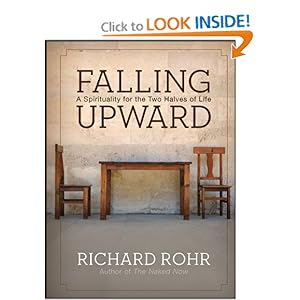
Falling Upward --- Review

FALLING UPWARD: A Spirituality for the Two Halves of Life.  By Richard Rohr.  San Francisco:  Jossey-Bass, 2011.  Xxxix + 183 pp.

In the Book of Hebrews the call is given to “press on to maturity, by moving on from the basics about Christ’s word” (Heb. 6:1 CEB). The reason why this word of wisdom is given to the readers of this sermon/letter is that the author recognized how easy it is to get stuck on the basics and never move on to spiritual maturity. A similar word of wisdom is present in Falling Upward, an exquisitely written book from the pen of Richard Rohr, a Franciscan priest with Emergent Church connections. Rohr offers a gentle but firm reminder that although it’s appropriate to start the spiritual journey by focusing on security and identity, but there comes a time when we must move beyond the protective fences and engage the world in which we live through the Spirit of God.

Rohr uses the image of life’s two halves. In the first half of life, which needn’t be defined purely in terms of age, we focus on the foundations and create a container for life’s questions. From there, after we’ve taken care of these basic elements of the faith journey, then we are ready to fill the container with content. Often, in the first half of life, we live with either/or categories. But, staying put in this first stage of life means that our containers remain largely empty and ill-defined. We live in a sort of perpetual adolescence. It’s fine to be an adolescent for a while, but not forever, but unfortunately the church often does little to challenge this adolescence. As Rohr notes, many of the sermons he has heard over his long life never move beyond this first level. Indeed, if a preacher does challenge these sacred foundations, that person will likely be considered “heretical, dangerous, or ill advised” (p. 7).

If, however, we’re going to experience spiritual maturity, or what Rohr calls the second half of life (something that many people never achieve), then we must be ready to leave the comfort of the black and white and risk living with a both/and dynamic. To move into the second half of life we must be comfortable with change and willing be stretched beyond our comfort zones. Indeed, we need to be aware of the trap of worshiping the status quo. Thus, like Abraham and Sarah, we must be willing and ready to leave home and head out for an undiscovered country.

Whereas the first half of life involves providing a safe context to explore one’s faith and identity, as well as learning the traditions, part of this life process involves having the opportunity to fall. In a word to parents – spiritual and otherwise – Rohr writes:

"We are not helping our children by always preventing them from what might be necessary falling, because you learn how to recover from falling, by falling! . . . People who have never allowed themselves to fall are actually off balance, while not realizing it at all. That is why they are so hard to live with." (p. 28).
Having learned to fall and then get back up in the first half of life, we’re prepared to move outward and face the realities of life beyond the fence. That includes our ability to experience and understand the value of suffering, which is one of the key themes in this book. The point is not that we should pursue suffering, as if we have a martyr’s complex, but that we recognize that enduring suffering enables us to move forward in life. Indeed, the truth is, there must be death, before there is life.

One of the reasons why we get stuck in the first half of life is that we’ve been led to believe that the world operates much like Plato described. It’s a matter of forms and ideas. We expect the world to operate in an orderly fashion, so we find it difficult to deal with reality. He suggests that in many ways Plato is more influential on the way the church thinks than is Jesus – I think he’s right. Consider this word:

"We invariably prefer the universal synthesis, the answer that settles all the dust and resolves every question – even when it is not entirely true – over the mercy and grace of God." (p. 56)
In making this statement, he raises the question of postmodernism, which challenges the possibility of constructing metanarratives that can explain everything. There simply are no such things, but we like simple answers, and so we hold out for these metanarratives, which always fail to deliver.

When we move into the second half of life we are better able to see that Jesus doesn’t offer us a one-size-fits-all gospel. Instead, Rohr suggests that Jesus offers us a vision of reality in which “God adjusts to the vagaries and failures of the moment. The ability to adjust to human disorder and failure is named God’s providence or compassion” (p. 56). As we move beyond the first half understandings where rules come first, we discover in the second half of life that God is less concerned about laws and more about the relationship. Thus, the ability to move forward is to embrace God’s unconditional forgiveness.

The spiritual journey is driven, according to Rohr, by a sense of homesickness. We move on into the second half of life because of spiritual restlessness and dissatisfaction with the status quo. Of course, for many, if not most of us, the fear of the unknown keeps us from moving out into the world to address this restless, which moves us toward union with God. Drawing from St. Augustine, he suggests that “we are created with an inner drive an necessity that sends all of us looking for our True Self, whether we know it or not. This journey is a spiral and never a straight line” (p. 94).

The journey toward the second half of life leads us through complexity and paradox to a new simplicity or unified field, where the painful and excluded parts of parts life brought into a unified picture (but not a metanarrative). The real tragedy in life is that so few can make this journey. The tragedy of so many elderly people never becoming elders may be due to the fact that they themselves had never been eldered or mentored. Thus,

"Such people seem to have missed out on the joy and clarity of the first simplicity, perhaps avoided the interim complexity, and finally lost the great freedom and magnanimity of the second simplicity as well." (p. 114).
This is one of the key elements of this reflection on the movement toward spiritual maturity – age itself is no marker of maturity. Some who are young have been able to move into spiritual maturity, while some who are quite elderly remain spiritually immature.

The journey into maturity requires us to honor the needs of the first half of life – identity formation and security – while providing room to move into the second half. There is a tension here, but if we’re able to keep this tension then there will be an opportunity to grow wisdom. But, as is clear from the book, none of this is easy. It will likely involve endurance of suffering and pain, of overcoming obstacles, and maybe even hitting bottom before climbing back up toward union with God.

The benefits, however, are wonderful. There may be sadness, but there will be less anxiety and fear, and thus openness to others. What you may have avoided in the first half of life, in the second half becomes your friend and teacher. And, this should come as no surprise, considering this perspective, Jesus would have been and is, a “second-half-of-life man,” but as Rohr points out he had the “unenviable task of trying to teach and be understood by a largely first-half-of-life history, church, and culture” (p. 149). Alas, the choice of moving into the second-half-of-life is ours to make or not. Indeed, to be ordinary is not really a choice, but to move on to something extraordinary is a choice. The question is – are we ready to make that choice?

For the most part we Christians are content to live inside the comfortable confines of the institution and the tradition. We’re not too eager to ask questions or wrestle with doubt and despair. So, the numbers of people who take the journey toward maturity, and thus union with God are few in number. The road is narrow, and thus we prefer the wide and smooth highways. But, if we’re willing to follow the path that Rohr sets out, there will be blessings to be found – though may be not the riches that some would promise.

Although this is really first real engagement with Richard Rohr, I found him to be a trustworthy guide to the spiritual life. As I read the book I was forced to examine my own journey and thus wonder whether I had moved beyond the first half and into the second. This is definitely a book to be read and pondered and digested, but if one chooses to do so and truly imbibe its wisdom, there will be spiritual transformation.


Article first published as Book Review: Falling Upward by Richard Rohr on Blogcritics.

Thursday, March 24, 2011

I'm Thirsty -- A Lectionary Meditation

Exodus 17:1-7


Romans 5:1-11


John 4:5-42


I’m Thirsty

Water is essential to life. The human body is somewhere between 55% and 78% water, and water covers about 70% of the earth’s surface. Although we can go a while without water, eventually we’ll die without water. Water and life – they go hand in hand.

Two of the texts for this Third Sunday of Lent focus on water. Moses has to deal with a people who complain vociferously because they don’t have water to drink, while Jesus finds himself tired and thirsty and sitting next to Jacob’s well. He doesn’t complain, but he does ask for water! As we think about water and thirst we might want to look ahead for a moment to Jesus’s cry from the cross – I Thirst (John 19:28). Paul’s not quite ready to get to the water (Baptism appears in Romans 6), but he deals with the issue of suffering and hope, ideas that are present in the other two texts. Each of these scriptures remind us that no matter how difficult the journey, God is present and faithful.

In the Exodus story, the people have again grown cantankerous. Although God provided food for the journey – not that they enjoyed the menu – now they’re thirsty. This leads to quarreling and complaining to Moses – why, they ask, have you led us out here into the wilderness so that we might die of thirst. You would have thought that they preferred slavery in Egypt, and perhaps they did. We often prefer the misery we know to the potential misery that might face us in the unknown. With all the harping and complaining, Moses grows frustrated with this people God had entrusted to his care. They were never satisfied, no matter what God did – whether it was the rescue from the clutches of Pharaoh’s army or the manna from heaven – they weren’t satisfied. Wanting water they begin to quarrel amongst themselves, and Moses cries to God – “What am I to do with this people? They’re ready to stone me.” As I read this, I’m reminded of political leaders, especially Presidents, who find that they can never satisfy the populace, no matter what they do. It’s never enough!

But God is gracious and hears Moses, telling him to gather the Elders and then go out ahead of the people. God tells Moses to meet at the Rock at Horeb, and there in front of the Elders, Moses does as God commanded. He strikes the rock with the staff he had used to strike the Nile, and from that rock sprang water to quench the thirst of the people. God had provided, but in a bit of frustration, Moses calls this place Masseh and Meribah, because the Israelites “quarreled and tested the Lord saying - “is the Lord among us.” I sense that the word we need to hear in this story concerns typical human behavior – even in the church – in spite of our complaining and insolence, God is faithful. So instead of complaining, let us give thanks to God.

Before we turn to story of Jesus’ encounter with the woman at the well, we must heed Paul’s discourse in Romans 5. The chapter begins familiarly – “Since we are justified we have peace with God through the Lord Jesus Christ, through whom we have obtained access to the grace in which we stand.” In Christ we’re justified, saved, and reconciled. I’m afraid it’s easy to read this passage in a very transactional way. We’re sinners who face the wrath of God, and Jesus’ blood substitutes for our blood. For centuries theologians have interpreted the cross in a quid pro quo fashion – the life of Jesus for my life. But why does God need blood to be satisfied? What is it that I have done that requires the death of another, especially one who is innocent of all changes? I struggle with the idea of divine wrath. I don’t have space to delve into this question here in this place, but perhaps there is another way of reading this text. Maybe the issue is one of separation between Jew and Gentile – in the cross a way has been created that brings the two together. I don’t know, but what I do hear in this text is a promise that no matter what happens there is hope. Suffering, which we all experience, produces endurance, and endurance leads to character, and character builds hope, and as Paul says – this hope doesn’t disappoint. That is because God’s love has been poured into our hearts through the Holy Spirit. That is the message we need to hear – not that we’re miserable sinners who need someone to suffer our due punishment so that God will accept us. No the word we should hear in this text is that God’s love will transform our lives in ways that lead to hope. That is a word of salvation.

Finally we come to the story Jesus’ encounter with the Samaritan woman at Jacob’s Well. According to John, Jesus is sitting by the well because he’s tired. He’s on his way to Jerusalem, where he will taste suffering The disciples have gone into town to get some food. It’s about noon when a woman comes to the well to draw water, and so Jesus asks her to draw him some water to drink, because he’s thirsty. This woman is caught off guard because Jesus is a Jew and she’s a Samaritan (and a woman) so why is he asking her for water? My guess is that he’s thirsty and she has the means to get him a cup of water, but that’s too simple an explanation. The point isn’t the physical thirst, but the spiritual thirst that lies within. The request for water leads to a theological discussion, but first Jesus has to overcome the woman’s literalist mind set, just as he had to do in John 3 with regard to Nicodemus. That’s just the way we are – we think literally first and only later are we able to move onto something more spiritual in nature.

Having asked the woman for a cup of water, Jesus in turn offers the woman living water. At first she can’t comprehend what he’s saying. How can Jesus offer her living water when he doesn’t have a bucket to draw water with. But, when Jesus says that once she drinks this living water she’ll never thirst again, she becomes intrigued. How does this happen? But, besides that, this well belonged to Jacob. How could any other water exceed it in value? Still, water that fulfilled thirst eternally, that was worth pursuing. Having such water would eliminate the need to come to the well. As she’s contemplating this reality, Jesus tells her to go and get her husband. Of course, she’s not married, but apparently he already knows this. In fact, although she’s been married five times, the man she’s with whom she now lives isn’t her husband. Not only is she a woman and a Samaritan, but it would appear that she’s also a sinner, but Jesus doesn’t make anything of that. He seems to understand that she has lived a life of suffering – probably at the hands of the men who have been in her life. Perhaps she has become ostracized, which is why she was at the well at the height of the noon day sun. I don’t know any of this for sure, but it does appear that Jesus has pricked her heart. His revelation of her life causes her to move from her focus on getting water to understanding whom Jesus is.

How do you know this about me? You must be a prophet of God, but then there’s this theological problem. We worship here on this mountain, and you worship in Jerusalem. We’re divided, separated from each other by our theologies of worship. We think God is present here in this place, you think God is some place else. And yet he has spoken truth to her and so she’s intrigued. But Jesus has a surprise for her – place doesn’t matter. It doesn’t matter if it’s Sychar or Jerusalem, Wittenberg or Rome, the point is that God is Spirit and those who would worship God must worship in Spirit and truth. What a freeing thing this word must be, though still she’s not ready to receive it. How often do we resist a word of liberation and freedom? We stay locked within the box that we’ve built for ourselves. The box may have its use once, but now its time to move on, to grasp that God is bigger than the box. The woman who is now a theologian says to Jesus, well when the Messiah comes, then we’ll know what to do. Yes, when the prophet comes who we’re expecting, that person will make this all clear. And Jesus says – “I am he.” I’m the one you’ve been waiting for.

As Jesus makes this claim, the Disciples return to find him deep in conversation with this woman. They’re surprised at all of this. I’m not sure whether this is because the conversation partner is a woman or a Samaritan, but they’re not prepared. This interruption gives the woman an opportunity to return to the village, where she spreads the news about the one who revealed her life to her, and her testimony draws out the people to the well. While she’s doing her evangelistic effort, the Disciples talk to Jesus about the food they’ve procured, but Jesus says – “I have food you know nothing about.” Yes, once again it’s a question of literal versus spiritual. And the Disciples are confused – where did he get the food, but the food he has to offer is spiritual food. As they discuss what to eat, the Samaritans gather around Jesus and invite him to stay a few days and teach them. Afterwards they say to the woman: We no longer have to rely on your testimony, we’ve heard enough to know that he is the savior of the world.

Our thirst is physical, even as our hunger is physical. We are physical beings and we need food and water – whether we’re in the desert of Sinai or at Jacob’s Well. But we’re more than physical beings who need food and water. We’re spiritual beings, who need spiritual food and spiritual drink. Each week, at least in my tradition, we gather at the table of the Lord and take bread and cup. It’s not enough to stave off our physical hunger and thirst, but it is a reminder that our hope is found in the one whom we worship in spirit and in truth, the one who is faithful and who provides what we need, so that we might grow into people of hope.