Showing posts with label Worship. Show all posts

Thursday, April 21, 2011

Death and Resurrection! -- A Lectionary Meditation for Easter

Jeremiah 31:1-6


Colossians 3:1-4


Matthew 28:1-10


Death and Resurrection!


As we once again experience Holy Week, we’re reminded that life emerges from death. There is no better analogy of this truth than the transition from winter to spring, which is why it seems appropriate that Easter and the coming of spring coincide. With spring’s coming, the long dormant flowers and trees suddenly come back to life as spring’s warmth replaces winter’s cold darkness. Surely, we can see the parallels between this and Good Friday/Easter.

Now, of course, there are questions to be addressed when it comes to the Resurrection. David Hume has had his way with us, and we must face the fact that people just don’t rise from the dead every day. Therefore, we don’t have analogies that can truly help us grapple with this article of faith. Is it a physical event or a metaphor? The Gospels speak of empty tombs and appearances, and we even have defenses of the event against charges that the disciples stole the body. Of course there are the discrepancies between the various stories as to when and where and how Jesus appeared to his disciples. Did he meet them in Jerusalem or in Galilee (or both?). We can speculate, but that gets us nowhere. Whatever the nature of this reality – and I personally find myself somewhere between Marcus Borg and N.T. Wright – and the nature of the debates, what we hear in these texts of Easter is a call to confess our faith in the risen Lord. It is a reminder that we don’t serve a dead hero, but a living Lord, who shares with us the fullness of God’s everlasting love.

Ultimately we must hear each witness on its own, listening for its voice, and in this case, for this meditation (and for Sunday’s sermon) I will limit my thoughts to Matthew’s testimony – together with that of Jeremiah and the author of Colossians.

Jeremiah doesn’t explicitly speak to Easter -- there’s no promise of resurrection here, but there is a promise here concerning God’s intention to be present with us forever, sharing with us the everlasting love of God. Now this word goes first and foremost to Israel, which must endure the suffering of exile, but here in Jeremiah 31 comes the promise that God hasn’t forgotten them. God promises to be the God of all Israel, even as they have endured the wilderness. The word that comes to Israel (and to us) is that God has loved Israel with “everlasting love,” and therefore God continues to be faithful to Israel. This confession of God’s faithfulness leads Jeremiah to invite the people to pull out their tambourines and begin to dance like merrymakers. Having heard the promise that Israel will continue to be God’s people and that exile is ending, they are invited to celebrate something that is equivalent to life out of death. But not only will they dance, but they will also plant. Yes, merrymaking leads to work. And from there, the call goes out: “Come, let us go up to Zion, to the Lord our God. All of this, however, is but a sign of God’s everlasting love. As I reflect on this truth, my thoughts go to the point made by Rob Bell in his new and controversial book, wherein, he speaks of God’s desire that all be saved–or reconciled. He writes:

History is about the kind of love a parent has for a child, the kind of love that pursues, searches, creates, connects, and bonds. The kind of love that moves toward, embraces, and always works to be reconciled with, regardless of the cost. [Bell, Love Wins, p. 99].

Jeremiah understands this truth – God seeks out and restores the people to the land, and therefore they will rejoice with song and dancing, and also by planting, by taking possession of the land that is promised. This is, after all, an act of love.

We hear the resurrection story from Matthew’s perspective in this lectionary season (unless you decide to go with John’s version). In this version of the story, Mary Magdalene and another Mary go to the tomb, though the reason for their visit isn’t mentioned. As they reach the tomb on this first day of the week, with the Sabbath behind them, they discover that an earthquake has rolled the stone away from the tomb. Now, I know something about earthquakes and generally their not as localized as this report would suggest. Whatever the nature of the quake, the stone is rolled away, and an angel of heaven with a countenance like that of lightening, and the clothes, a dazzling white, sits on the stone – having frightened the guards away. The message of this angel is simple: Don’t be afraid (like the guards?). Instead, hear the message he brings – the one they look for isn’t there, but is instead risen from the dead, just as he had said. Remember, God is faithful! They might not have gotten the message, but God remains faithful, due to God’s everlasting love.

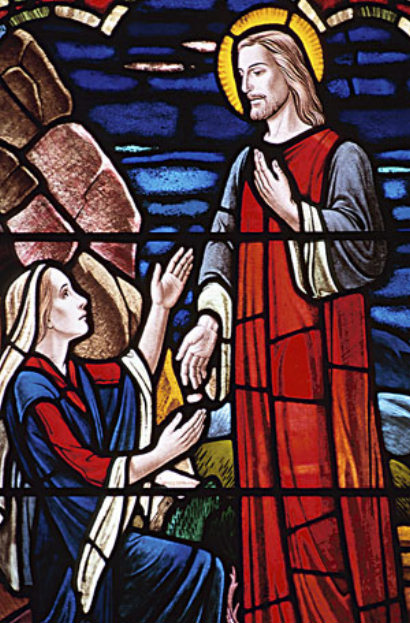
The angel has another message – go tell the disciples to meet Jesus in Galilee. With this command these two women become the first witnesses to the resurrection – at least of the empty tomb. But as they go back to the larger gathering, they receive another visit. This time it’s Jesus himself, and like the angel, he tells them to tell the disciples to meet him in Galilee (where they’ll receive their commissions). It bears repeating here that one of the marks of an apostle is that the apostle is a witness of the resurrection, and thus these two women are to be counted among the apostles of Jesus. Oh, and there’s one other thing about this passage, not only do the women bear witness of the resurrection, but when they meet Jesus they worship him. Matthew says that they grabbed his feet and worshiped him (proskynein). While this could mean an acknowledgment of someone of higher rank, James Dunn notes that in almost every case in the New Testament it’s used in relationship to worship of God or of Jesus (as is the case here) [James Dunn, Did the First Christians Worship Jesus?, p. 10-11].

There’s not enough space here to wrestle with the issue of what it means to say that they worshiped Jesus, but it’s clear that the women are rejoicing at this sign of God’s everlasting love. They can’t help not worshiping this one who was dead and now lives! And is that not the point of Easter – the one who brings God’s everlasting love to us is alive and present with us, so that we need not see ourselves alone in the wilderness?

Finally, our attention goes to this short passage from Colossians 3, where the author (we don’t know if it’s Paul or not), declares that if we’re raised with Christ then we should look for the things that come from above, for that is where Christ is sitting – at the Right Hand of God. The message of resurrection is to consider the things of heaven, rather than the earth. For many of us this command does raise warning flags. We’re all aware of the danger of “being so heavenly minded that we’re of no earthly good.” That is, it sure sounds as if the author of this letter is giving us permission to walk around with our heads in the clouds, but I don’t believe that’s the case. It is, I would suggest a reminder to examine our own sense of allegiance. If you are a follower of Jesus, then you must keep your allegiance with the one who sits at the Right Hand of God. And when he’s revealed then you, having hid your life in Christ, you will be revealed in glory.

Here we are at Easter, being called upon to declare our allegiance to the one whom God has raised to the Right Hand, a God who as Jeremiah reminds us, is faithful to the promise to love with everlasting love. If this is true, if Easter is true, then what is your response? How will you celebrate Easter’s glory?  Will you take out the tambourine and dance for joy?

Monday, March 28, 2011

What Do You Worship? (Guest Post)

Alex McCauslin is a young seminarian and ministry intern at Central Woodward Christian Church.  One of Alex's assignments is to work with our young adults to create a YA community.  In a posting at her own blog, Alex writes about her encounter with a young woman who was cutting her hair.  This conversation about God, church, and worship raises some intriguing questions.  We know that an increasing number of young adults are listed as "Nones."  That is, they simply don't identify with any religious community or tradition.  That doesn't mean they don't believe in God or that they're not interested in spiritual things, they just don't have a "place" to put these beliefs.  I'd like to use Alex's reflections as a starting point for an important conversation about faith, worship, and a world that feels disconnected to what happens in religious communities.

**************************


This experience has been rattling around in my head for the last week. I am puzzled by it, still.

I recently had my hair cut. The woman cutting my hair was in her early twenties (around my age.) She asked what I was doing with my life, and, of course, I eventually admitted I was studying at Seminary and working for a church.

“So, what religion are you?” She asked.

“I’m Disciples of Christ, it’s Protestant, like Methodists.”

She stared blankly at me and said, “I had a neighbor who was a Mormon and I went to church with her once.”

“We’re not quite like the Mormons,” I said.

“I don’t know. I mean, I’m a Christian.”

“Oh, yeah? What church did you go to?”

She shrugged. “I’ve never been to church, just youth group with my friends when I was in high school.”

“Cool, what kind of youth group?”

Again, a blank stare. “I don’t know, we just, like, hung out with our friends and talked about stuff. I didn’t really like it that much, so I stopped going.”

I nodded, and, deciding that the conversation was headed nowhere, stopped asking questions about church and started asking questions about her aspirations as a stylist.

Later, after a short lull in our conversation, she returned to the topic of religion. “So you work at a church? What do you do there?”

I told her that I was currently putting together an alternative worship service on Sunday evenings.

She frowned and stopped cutting my hair. “If you don’t mind me asking, what do you worship there?”

I didn’t even know what to say. I’d never been asked such a question before, and certainly never by someone who’d claimed to be a Christian.

I told her that we praised God and prayed to Jesus. That we contemplated our purpose, especially as it related to communities that suffered poverty and other oppression.

“That’s cool,” she said and pressed on asking questions about how we actually tried to help people. Eventually she admitted that she had given up trying to make a difference, as she had realized it wasn’t really possible.

As she was walking me to the front desk to pay for my haircut, she brought up the topic of religion a third time, out of the blue and with urgency. “I think I’m a really spiritual person! I just don’t know much about the church. It’s not really for me, I don’t think.”

I’ve heard this comment before. I don’t know what to do with it. Is the church not doing its job? Or is it becoming obsolete to upper-middle class Americans?

I don’t know what to do with the fact that Christians, perhaps myself included, aren’t prepared to answer the question, “What do you worship?” I’ve been thoroughly prepared to answer questions of why or how. But ‘what’ completely threw me off my game.

What do we worship?

ETA: Just went to lunch with a friend who started a new job as Youth Director at a suburban church. She has been observing their current Youth Group program and has concluded that it centers around gossip and chilling. She is appalled and eager to create change.


Reposted from Alex Discerns a Way.

Thursday, March 3, 2011

On the Mountain with God -- Lectionary Meditation

Exodus 24:12-18


2 Peter 1:16-21


Matthew 17:1-9


On the Mountain with God

I grew up in the shadow of the Cascade Mountains. From the age of 3 to 9 I lived at the foot of one of the great mountains in America, the majestic Mount Shasta, a 14,160 foot double coned volcano that exudes mystery. I never climbed Mount Shasta, but I have climbed a few other shorter Cascade peaks, and so I understand the draw that mountains can have on people. There is something powerful and awe-inspiring about standing at the top of the mountain and looking out across the landscape. You see the handiwork of God very differently from high up in the mountains, standing above tree-line, where nothing is able to take hold except a few of the hardiest plants. The air is thin, cold, and clear. You feel as if you can touch the sky and even reach through the thin membrane separating heaven and earth and touch the things of God.

From my own experience living among the mountains I can understand why people from time immemorial have gone to the mountains to encounter God. In the biblical story, we see people going to the mountain, from Moses to Elijah to Jesus, and there upon the mountains God is encountered, and lives are changed. In this week’s lectionary texts we go to the mountains to meet God. With Moses we go into the presence of God on Mt. Sinai, and with Jesus we go to the mountain where he is transfigured before our eyes and God speaks to him from the cloud of presence.

We begin with Moses who receives a call from God to go to the mountain and receive the tablets of the law, which God has written for their instruction. And so he takes Joshua, and after leaving Aaron and Hur in charge, heads for the mountain. As Moses climbs the mountain, a cloud begins to envelope it, so that the “Glory of the Lord settled upon Mount Sinai.” They wait, presumably on the edge of the cloud for six days. On the seventh day, with the Glory of the Lord sitting on the mountain having the appearance of a devouring fire, God invites Moses to enter the cloud. As I read this description I have in mind the forest fires I remember seeing coming down the side of Mount Shasta as a child. They were far enough away that I didn’t have to worry, but the flames were large enough to get your attention. You can imagine the feeling of the people down below. Moses and Joshua have gone up the mountain, which is now engulfed in flame. Will they ever return? What will happen to us? Yes, I can only imagine. But then, Moses went up into the cloud and ascended the mountain, and there he spent forty days and forty nights. With this the passage ends – though if you continue reading you discover that it is in this forty day period that God reveals to Moses God’s desires for the people of Israel. All the directions for the creation of the Tabernacle and ordination of priests and more are revealed, as Moses is with God on the mountain.

Most assuredly Moses is transformed by this encounter with God, though we later learn that when Moses emerges from the cloud his face shines so much that he must keep himself veiled. Paul suggests that over time the glow faded, but Moses kept the veil so as to cover up the loss of this sign of God’s presence.

2 Peter is one of those interesting texts. It claims to be written by one of Jesus’ closest friends and colleagues, though most scholars believe that it comes from a much later time, perhaps into the 2nd century. In this letter Peter writes that he was an eyewitness of God’s majesty and that of Jesus. We were there, he says, when God spoke: “This is my son, my beloved, with whom I am well pleased.” Yes, we were with him on the mountain. So, listen to our testimony. Listen to our interpretation – for “no scripture is a matter of one’s own interpretation.” Prophecies come not by human will, but by people moved by the Holy Spirit to speak for God. I think that the author of this letter is pulling something of a power play – I was there when God spoke to Jesus, therefore, listen to my interpretation of Scripture, for Scriptures aren’t the matter of one’s own interpretation. Still, despite this almost unseemly display, we hear in it a word of witness to the encounters the people of God have on the mountain, encounters that can be life changing.

Finally we come to Matthew’s account of the Transfiguration. Note that Jesus goes up the mountain after six days – is this reflective of Moses’ ascent to Mount Sinai? Of course, we need to go back a chapter to see that according to Matthew, it was six days earlier that Peter made the Good Confession, declaring that Jesus is the Christ/Messiah and Son of God (Mt. 16:16). Even as Moses took Joshua with him, Jesus took three of his closest associates – Peter, James, and John – with him up the mountain. There he was “transfigured” or transformed before their eyes so that his face shown like the sun and his clothes became a dazzling white. There is similarity to Moses’ encounter, but here, the transformation seems to be less a reflection of the encounter, but it emerges from within. It is, one could say, an unveiling of the glory of the Lord that is already present in Jesus. Then and only then do Moses and Elijah, representing the Law and the Prophets, appear and are seen talking with Jesus. It has been suggested that Moses and Elijah are seen here as transcendent beings, people who are caught up into heaven without dying.

Peter sees all this and being something of an impulsive sort (the reason we like him so much) decides he has to do something. So, he offers to set up tents for the three conversation partners – or perhaps these are designed to be shrines. He recognizes that something powerful is happening and that Jesus must be someone of transcendent importance if he is standing in the presence of Moses and Elijah.

It is at this moment that a cloud overshadows them – as on the Mountain of Sinai – and from the cloud comes a voice that states: “This is my Son, the Beloved; with him I am well pleased; listen to him!” Words that we the reader have encountered earlier in Matthew at the baptism of Jesus, but now they are repeated to fuller effect. At this the three disciples fall on their faces in fear. Jesus sees them, touches them (I find this to be a most poignant statement) and picks them up and tells them not to be afraid. Jesus does that a lot – telling his followers not to fear. It is at this point that they discover that Jesus is alone. Having had this encounter they head back down the mountain – not with stone tablets, but with a new sense of wonder and awe at the person they are called to accompany. For his part, Jesus tells them not to tell anyone about what happened on the mountain until after the Son of Man had been raised from the dead.

As we reflect on these three texts that depict powerful encounters with God, encounters that are transformative, it is appropriate for us to ask of ourselves – in what way are we transformed by our encounters with the transcendent God? What are our mountain top experiences? From the looks of the rest of Matthew’s narrative, the disciples still don’t understand, even after their mountain top experiences. Are we any different? Does the wonder begin to wear off once we're back into the thick of things?  Do we forget with whom we walk?  May we be thankful for God’s patience!