


Over time the cross has evolved from being a means of torture and execution to a fashionable piece of jewelry. Crosses can come in gold or silver, plain or bejewelled, and if you didn’t know better, you’d never believe that this cross that people wear around their necks or on their ears was once one of the most feared and despised forms of execution devised by humanity. Its message was so powerful that the Romans reserved the cross for rebels and troublemakers.
It’s easy for us to forget the meaning of the cross since it no longer functions as a means of tortuous death, which is why it’s important to observe Good Friday before we celebrate Easter. Before we can appreciate the beauty of Easter, we must take in the ugliness of the cross upon which Jesus died. The cross upon which Jesus hung, reminds us of the ugliness is present in our world – war, segregation, prejudice, self-centeredness, anger, and hatred, to name but a few. As we contemplate the cross, we recognize that as Jesus hung on the cross, he was experiencing all of that ugliness that is present in human culture. And, as the prophet wrote centuries earlier:
But he was wounded for our transgressions, he was bruised for our iniquities: the chastisement of our peace was on him; and with his stripes we are healed. (Is. 53:5 KJV)
This is the truth that is revealed on Good Friday, and which is given voice in the ancient hymn of Bernard of Clairvaux:
O Sacred Head, now wounded, with grief and shame weighed down,now scornfully surrounded with thorns, thine only crown;how pale thou art with anguish, with sore abuse and scorn!How does that visage languish which once was bright as morn!This is the message that gives context to our celebration of Easter.
1. A sign of New Life
With the cross behind us and the empty tomb before us, it’s time to celebrate the triumphant message of Easter. Yes:
The Tomb is empty. Sound the Trumpet.The Lord is risen! Sound the trumpets!
In this declaration, we hear the good news that death has given way to life.
I realize that there are those who believe that Easter is simply a baptized pagan holiday that celebrates the coming of spring. While it’s true that the word Easter may derive from the name of a long forgotten German goddess, whose spring festival involved eggs and bunnies, that doesn’t mean that connecting spring with resurrection isn’t appropriate, maybe even providential. Spring, after all, does remind us that life emerges out of winter’s deathly grasp. Spring flowers, birds chirping, and squirrels scurrying, all remind us that the promise of the gospel is that life triumphs over death. As Paul put it:
Since death came through a human being, the resurrection of the dead came through one too. In the same way that everyone dies in Adam, so everyone will be made alive in Christ. (1 Cor. 15:21-22 CEB).
With these images in mind, we come to Matthew's account of the empty tomb. Going back to Good Friday, we remember that after Jesus gave up the fight on the cross, crying out to God: “My God, My God, why have you forsaken me,” Joseph of Arimathea got permission from Pilate to place Jesus’ body in his tomb. Now, three days later, the story shifts to that tomb. Two women, both named Mary, go out early in the morning to the tomb, but unlike Mark and Luke, Matthew doesn’t tell us why they went to the tomb. The women of Matthew’s gospel don’t have spices to anoint the body, so we’re not sure why they came. Maybe they wanted to pay their last respects or maybe they came to grieve. Or, maybe, these women went hoping that Jesus’ promise of resurrection was true.
Whatever they expected to find when they got to the tomb, they found the stone rolled away and an angel sitting on top of that stone. As Matthew tells it, an earthquake knocked the stone away from the tomb and an angel appeared from the heavens, with a countenance like that of lightning, and clothes as white as snow. So dazzling was the appearance of the angel that the guards, who’d been posted at the tomb to prevent any skulduggery, fainted in fear and then ran away. But the women, although they may have been frightened themselves, remain steadfast and don't run away. What an interesting contrast between fear and faith!
And then the angel brings them a message: "Don't be afraid; I know that you are looking for Jesus who was crucified. He is not here; for he has been raised!" And then the angel says to them, perhaps responding to the kinds of questions that we all have at moments like this: "Come, see where they laid him." Yes, come and see something amazing, something that’s beyond human comprehension! Something grander than the grandest sunset. Come and take in a beautiful sight!
There are many debates about the resurrection. Is it a physical reality or a vision in the hearts of Jesus’ followers? Marcus Borg and N.T. Wright have had a long back and forth about this issue, but however we decide to define this event, the message is clear: something happened that day that transformed a discouraged band of followers into powerful witnesses to God’s grace and love as it’s revealed in the person of Jesus. However you define the nature of the Resurrection, the good news is that life triumphs over death. The question, then, that Easter poses to us is this: What will you make of the resurrection in your life? What difference does it make in the way you look at life itself?
2. THE JOB AHEAD
This encounter with the angel at the empty tomb raises the question – what will you make of life? But that’s not the only point of the story. Not only are we confronted with this message that life triumphs over death, but the angel gave them and us a job. You see, the angel says to them: "Go quickly and tell his disciples, `He has been raised from the dead, and indeed he is going ahead of you to Galilee’." That is, don't just stand there, get busy and spread the news. “Quickly now, go tell the disciples that Jesus Christ is no longer dead, joy to the world, he is risen, alleluia! . . .” At least that’s the way the “Easter Song” puts it, and with this word of guidance, the women head back to the Upper Room, with heads and hearts filled with wonder and grief. They may not totally understand what had happened, but they knew that something truly amazing had just transpired. Yes, mixed in with the fear and the doubt was an overpowering sense of joy. And as they run back toward the Upper Room, with these mixed feelings, they encounter the risen Lord himself.
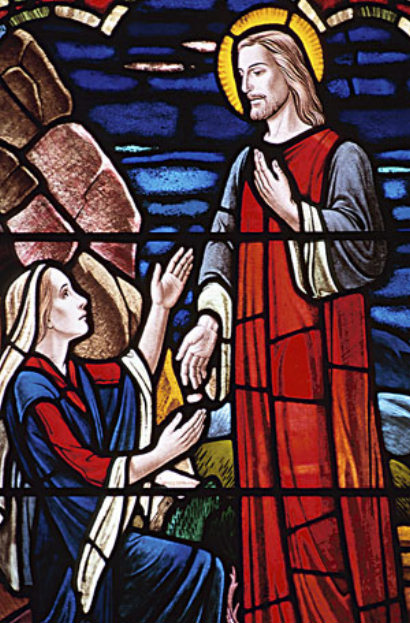
When the women see Jesus, they respond by falling at his feet and worshiping him. What else could they do? He was dead and now he’s alive. In their joy and maybe a little disbelief they grab hold of his legs and give praise and thanks to God, for God’s gift of life. Yes, this was a beautiful sight, grander than the Grand Canyon, more wondrous than Crater Lake, and more majestic than Mount McKinley.
This is the sight that stirs in our hearts the joy that rings out in professions of faith like the one we opened worship with: "Christ the Lord is risen today, Alleluia!" In this great hymn of Easter, we respond to Charles Wesley 's invitation to all creation, that creation might "raise your joys and triumphs high, Alleluia!"
In coming with the women to the tomb of Jesus, not only do we discover its emptiness, but we also encounter the life-giving presence of our Lord, who calls on us to bear witness to God’s reconciling grace. This discovery should lead us to declare our faith in God with these words:
"Love's redeeming work is done, Alleluia!Fought the fight, the battle won, Alleluia!Death in Vain forbids him rise, Alleluia!Christ has opened paradise, Alleluia!"
Yes, let us rejoice that in Jesus Christ, death has lost its sting, so that neither death nor hate will reign supreme in our lives and in our world. Alleluia!
Preached by:
Dr. Robert D. Cornwall
Pastor, Central Woodward Christian Church (Disciples of Christ)
Troy, Michigan
Easter Sunday
April 24, 2011

 , p. 99].
 p. 10-11].

