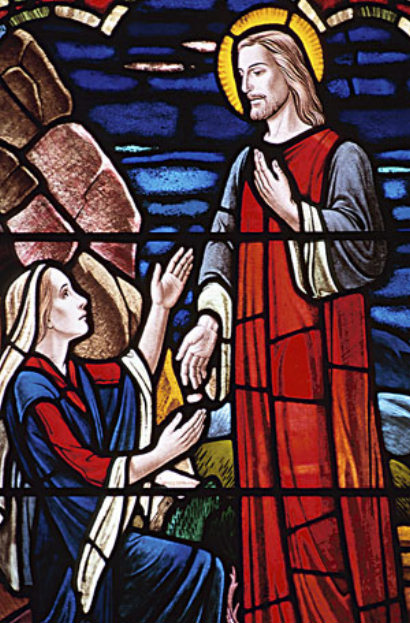
Showing posts with label Easter. Show all posts

Thursday, April 28, 2011

I Believe in the Resurrection -- A Lectionary Meditation

Acts 2:14a, 22-32


1 Peter 1:3-9


John 20:19-31


I Believe in the Resurrection


This may simply be the week that follows Easter. We had our great celebration, but now it’s time to get on with business. The liturgical calendar has, of course, other ideas (as does the lectionary). Therefore, let us continue the celebration we began on the Day of Resurrection by singing the songs of resurrection. With contemporary hymn writer Brian Wren we can sing:

Christ is risen! Shout hosanna! Celebrate this day of days.
Christ is risen! Hush in wonder; all creation is amazed.
In the desert all surrounding, see, a spreading tree has grown.
Healing leaves of grace abounding bring a taste of love unknown        (Chalice Hymnal, 222).

And, with St. John of Damascus (8th century), we can sing:

Let the heavens be joyful! Let earth its song begin!
The world resound in triumph, and all that is therein;
let all things seen and unseen their notes of gladness blend;
for Christ the Lord has risen, our joy that has no end.                         (Chalice Hymnal 228, vs. 3).
Yes, it’s not yet time to let go of the Easter song – indeed, the reason that we gather for worship on the first day of the week is that Jesus rose from the dead on the first day of the week.

I realize that this doctrine of resurrection continues to be controversial, with scholars taking positions along a spectrum from bodily/physical to the metaphorical and everything in between. You can pick your theologian/interpreter and go from there. But, as theologian Clark Williamson reminds us, we can’t get away from its message:

The resurrection explains the New Testament; the New Testament does not explain the resurrection. The resurrection is God’s answer to Pilate’s brutality and to the death dealing ways of all oppressive powers and principalities
.
Thus, God chose to exalt him so that every knee should bow and tongue confess him Lord (Phil. 2:9-11). He goes on to write:

When the church affirms that the Christ who was raised still bears the marks of the crucified Jew who died on a Roman cross, it puts us on notice that the risen Christ will not now do anything out of character with what the Jew Jesus did in relation to his followers. As Jesus then confronted his followers with the promise and command of the God of Israel, so Jesus now confronts his followers with the same promise and command. (Williamson, Way of Blessing, Way of Life, pp. 200-201).

It is this nail scarred but risen Lord whom we meet again in John’s gospel, and through whom we experience the healing presence of God.

On the first Sunday after Easter the lesson from the Hebrew Bible is replaced by a reading from Acts 2, though this passage draws our attention to the words of Psalm 16, the author of which, according to Peter, is David. In this text we hear Peter addressing the gathered crowd on Pentecost, and drawing upon Psalm 16, Peter declares that in this song of the ancient Jewish people, David had declared that the Messiah (the one who would sit on David’s throne) would not be abandoned to Sheol (Hades) or experience corruption, which Peter takes to mean resurrection. David might suffer death and be buried – after all, his tomb remained with them. But the one whom “they” had crucified, God redeemed by raising him from the dead – all of this according to God’s foreknowledge. They may have acted outside the Law, but God had acted to reverse their judgment and restore to the throne of David the chosen one of God. For Peter, David, who died, and whose tomb remained with them, had made it clear that the one who would redeem his throne would be greater than him, for he would be the risen Lord.

If Acts roots the promise of Resurrection in the Psalmist’s prophetic statements, 1 Peter, a letter that claims the great apostle as its author roots the new birth and living hope of the people of God in the resurrection of Jesus. That is, the church doesn’t explain the resurrection – the resurrection explains the church. Therefore, because of this resurrection, the people of God will receive an “inheritance that is imperishable, undefiled, and unfading, kept in heave for you . . .” That promise of the resurrection that the letter speaks of gives hope and strength to those who must suffer trials because of their faith. It enables the follower of Jesus to endure the testing of faith by fire. In the end, strengthened by this promise, they will express their joy in praise and glory and honor. And though you may not have seen him you will be able to love him and believe in him. Yes, because of the resurrection you will experience indescribable joy due to the salvation of your soul.

The text that truly grabs us on this Sunday after Easter is John 20. It comes to us in two episodes, both of which remind us that this resurrection of which we speak was no mere resuscitation, but it also appears to be more than mere metaphor or vision.

In the first episode, the disciples are locked away in the Upper Room, because they’re afraid “of the Jews.” It’s interesting that the Romans executed Jesus, but in John’s view they fear the Jews (even though that too are Jews!). But the point that needs to be grasped here is that they are afraid. This is no jolly band ready to continue the work of their fallen leader, and therefore it would seem to take more than a metaphor to cause them to take on a new calling.

Hiding away behind that heavy door, afraid of their shadows, they experience something unexpected. Jesus suddenly appears – as if he walked through walls. Here’s the piece that fits with Clark’s meditation on the resurrection – he shows them his hands and side and then they rejoice. They are comforted that he’s the one marked by the cross. Because they believe and receive him, Jesus then breathes upon them the Holy Spirit and gives them a commission – forgive or retain sins, for whichever you choose, God will act upon this choice. This is John’s Pentecost, the time in which the Spirit empowers and ordains the disciples to be witnesses. They are given the responsibility to share the word of forgiveness.

But not everyone is there that night. One is missing – Thomas, the Twin. He’s not ready to receive their witness. He’s something of a David Hume. He has to see in order to believe. I’m with him really. I too need evidence to quell my doubts. And so we have the second episode. Again, the group of disciples hunkers down behind locked doors – a reminder that the resurrection message didn’t completely take. They received the Holy Spirit from Jesus, but the Spirit had yet to free them completely from their fears. And once again, Jesus appears – through the door - -and he again says: “Peace be with you.” This time his focus is on the doubter, and he invites Thomas to touch the wounds on his hands and in his side. Touch them so that you might know and believe. Yes, the New Testament doesn’t explain the Resurrection. The Resurrection explains the New Testament! It is the Resurrection that compels the people of God to share the good news. Now, Jesus doesn’t condemn Thomas for his doubts, but he does offer a blessing on those who don’t see and yet believe. We who live after David Hume, should receive this word with joy, for if we’re to take the Resurrection Road, it will require of us great faith and trust.

The Gospel doesn’t tell everything that occurred, but it does tell us enough that we might believe that Jesus is the Messiah, the son of God. If we’re willing to believe this, then there is salvation in his name.

The hope of the church and the world is found in the risen Lord. For as Charles Wesley put it:

Soar we now where Christ has led, Alleluia!
Following our exalted Head, Alleluia!
Raise your joys and triumphs high, Alleluia!
Sing, O Heavens, and earth reply, Alleluia!                                                      (Chalice Hymnal, 216 vs. 4)

Sunday, April 24, 2011

A Beautiful Sight! -- An Easter Sermon

Matthew 28:1-10

Over time the cross has evolved from being a means of torture and execution to a fashionable piece of jewelry. Crosses can come in gold or silver, plain or bejewelled, and if you didn’t know better, you’d never believe that this cross that people wear around their necks or on their ears was once one of the most feared and despised forms of execution devised by humanity. Its message was so powerful that the Romans reserved the cross for rebels and troublemakers.

It’s easy for us to forget the meaning of the cross since it no longer functions as a means of tortuous death, which is why it’s important to observe Good Friday before we celebrate Easter. Before we can appreciate the beauty of Easter, we must take in the ugliness of the cross upon which Jesus died. The cross upon which Jesus hung, reminds us of the ugliness is present in our world – war, segregation, prejudice, self-centeredness, anger, and hatred, to name but a few. As we contemplate the cross, we recognize that as Jesus hung on the cross, he was experiencing all of that ugliness that is present in human culture. And, as the prophet wrote centuries earlier:

But he was wounded for our transgressions, he was bruised for our iniquities: the chastisement of our peace was on him; and with his stripes we are healed. (Is. 53:5 KJV)

This is the truth that is revealed on Good Friday, and which is given voice in the ancient hymn of Bernard of Clairvaux:

O Sacred Head, now wounded, with grief and shame weighed down,
now scornfully surrounded with thorns, thine only crown;
how pale thou art with anguish, with sore abuse and scorn!
How does that visage languish which once was bright as morn!
This is the message that gives context to our celebration of Easter.

1. A sign of New Life

With the cross behind us and the empty tomb before us, it’s time to celebrate the triumphant message of Easter. Yes:

The Tomb is empty. Sound the Trumpet.
The Lord is risen! Sound the trumpets!
In this declaration, we hear the good news that death has given way to life.

I realize that there are those who believe that Easter is simply a baptized pagan holiday that celebrates the coming of spring. While it’s true that the word Easter may derive from the name of a long forgotten German goddess, whose spring festival involved eggs and bunnies, that doesn’t mean that connecting spring with resurrection isn’t appropriate, maybe even providential. Spring, after all, does remind us that life emerges out of winter’s deathly grasp. Spring flowers, birds chirping, and squirrels scurrying, all remind us that the promise of the gospel is that life triumphs over death. As Paul put it:

Since death came through a human being, the resurrection of the dead came through one too. In the same way that everyone dies in Adam, so everyone will be made alive in Christ. (1 Cor. 15:21-22 CEB).
With these images in mind, we come to Matthew's account of the empty tomb. Going back to Good Friday, we remember that after Jesus gave up the fight on the cross, crying out to God: “My God, My God, why have you forsaken me,” Joseph of Arimathea got permission from Pilate to place Jesus’ body in his tomb. Now, three days later, the story shifts to that tomb. Two women, both named Mary, go out early in the morning to the tomb, but unlike Mark and Luke, Matthew doesn’t tell us why they went to the tomb. The women of Matthew’s gospel don’t have spices to anoint the body, so we’re not sure why they came. Maybe they wanted to pay their last respects or maybe they came to grieve. Or, maybe, these women went hoping that Jesus’ promise of resurrection was true.

Whatever they expected to find when they got to the tomb, they found the stone rolled away and an angel sitting on top of that stone. As Matthew tells it, an earthquake knocked the stone away from the tomb and an angel appeared from the heavens, with a countenance like that of lightning, and clothes as white as snow. So dazzling was the appearance of the angel that the guards, who’d been posted at the tomb to prevent any skulduggery, fainted in fear and then ran away. But the women, although they may have been frightened themselves, remain steadfast and don't run away. What an interesting contrast between fear and faith!

And then the angel brings them a message: "Don't be afraid; I know that you are looking for Jesus who was crucified. He is not here; for he has been raised!" And then the angel says to them, perhaps responding to the kinds of questions that we all have at moments like this: "Come, see where they laid him." Yes, come and see something amazing, something that’s beyond human comprehension! Something grander than the grandest sunset. Come and take in a beautiful sight!

There are many debates about the resurrection. Is it a physical reality or a vision in the hearts of Jesus’ followers? Marcus Borg and N.T. Wright have had a long back and forth about this issue, but however we decide to define this event, the message is clear: something happened that day that transformed a discouraged band of followers into powerful witnesses to God’s grace and love as it’s revealed in the person of Jesus. However you define the nature of the Resurrection, the good news is that life triumphs over death. The question, then, that Easter poses to us is this: What will you make of the resurrection in your life? What difference does it make in the way you look at life itself?


2. THE JOB AHEAD

This encounter with the angel at the empty tomb raises the question – what will you make of life? But that’s not the only point of the story. Not only are we confronted with this message that life triumphs over death, but the angel gave them and us a job. You see, the angel says to them: "Go quickly and tell his disciples, `He has been raised from the dead, and indeed he is going ahead of you to Galilee’." That is, don't just stand there, get busy and spread the news. “Quickly now, go tell the disciples that Jesus Christ is no longer dead, joy to the world, he is risen, alleluia! . . .” At least that’s the way the “Easter Song” puts it, and with this word of guidance, the women head back to the Upper Room, with heads and hearts filled with wonder and grief. They may not totally understand what had happened, but they knew that something truly amazing had just transpired. Yes, mixed in with the fear and the doubt was an overpowering sense of joy. And as they run back toward the Upper Room, with these mixed feelings, they encounter the risen Lord himself.

When the women see Jesus, they respond by falling at his feet and worshiping him. What else could they do? He was dead and now he’s alive. In their joy and maybe a little disbelief they grab hold of his legs and give praise and thanks to God, for God’s gift of life. Yes, this was a beautiful sight, grander than the Grand Canyon, more wondrous than Crater Lake, and more majestic than Mount McKinley.

This is the sight that stirs in our hearts the joy that rings out in professions of faith like the one we opened worship with: "Christ the Lord is risen today, Alleluia!" In this great hymn of Easter, we respond to Charles Wesley 's invitation to all creation, that creation might "raise your joys and triumphs high, Alleluia!"

In coming with the women to the tomb of Jesus, not only do we discover its emptiness, but we also encounter the life-giving presence of our Lord, who calls on us to bear witness to God’s reconciling grace. This discovery should lead us to declare our faith in God with these words:

"Love's redeeming work is done, Alleluia!
Fought the fight, the battle won, Alleluia!
Death in Vain forbids him rise, Alleluia!
Christ has opened paradise, Alleluia!"
Yes, let us rejoice that in Jesus Christ, death has lost its sting, so that neither death nor hate will reign supreme in our lives and in our world. Alleluia!

Preached by:
Dr. Robert D. Cornwall
Pastor, Central Woodward Christian Church (Disciples of Christ)
Troy, Michigan
Easter Sunday
April 24, 2011

Friday, April 22, 2011

Are You Sure Easter Is Tomorrow?

No disrespect intended.  It’s a serious question.  I was so anxious for the Easter Bunny to arrive this year that I wrote an Easter piece a few weeks back and realized in the course of writing it just how divergent were the views on the process of the calculation.  This year Christians in the West and the East celebrate it together on the same date, but that is not always the case.  And each year’s date is different from the last, which is why it’s called a moveable feast, unlike Christmas…at least for most.

So, why is there such uncertainty over determining the date of this seminal holiday so significant to so much of the world?

First Council of Nicaea (325)

I understand that officially the First Ecumenical Synod ruled in 325 that Easter Sunday should fall on the Sunday that follows the first full moon after the vernal equinox (the point at which the ecliptic intersects the celestial equator, the sun having a northerly motion) and the invariable date of the vernal equinox is March 21.  If the full moon happens to fall on a Sunday, Easter is observed the following Sunday.

Before the year 325 the determination of the date for Easter (or Pascha) seemed relatively easy.  Just ask the Jews in your community when they celebrated Passover according to the lunar-based Hebrew Calendar (now into its 5771st year), because the Jewish Holiday of Passover (or Pesach) was the occasion for the Last Supper.  The only dispute appeared to be over whether Easter should be celebrated on the Hebrew calendar’s date of Nisan 14 or the following Sunday.

Original mural by Leonardo Da Vinci between 1495-1498

The First Ecumenical Synod changed all that by calculating the exact date of Easter from the more modern, cycles of the sun-based Julian calendar.  And even though some in the Church did not agree with that determination, it became Christianity’s generally accepted method for calculating the date of Easter and continued to be so for more than five hundred years after the Great Schism of 1052 separated the Church of the West to Rome and the Church of the East to Constantinople (Istanbul).

Pope Gregory XIII (1502-1585)
But in 1582 Pope Gregory XIII introduced what is known as the Gregorian calendar for the express purpose of correctly calculating Easter, something the Julian calendar was not believed to have achieved.  Today, the Gregorian calendar is the world’s officially accepted civil calendar (except in Greece’s 1500 year-old monastic community of Mount Athos—see Prey on Patmos), but there still is not agreement among the Christian world over whether it correctly fixes the date of Easter.

Indeed, as recently as 1997 the World Council of Churches proposed a method of using modern scientific knowledge for precisely calculating Easter and replacing divergent practices.  It was not adopted.

All of which means that (based upon our everyday calendar), Easter for Western Christianity always falls on a Sunday between March 22 and April 25, and for most of Eastern Orthodoxy on a Sunday between April 4 and May 8—at least during the 21st Century.

A White House Passover Seder
As for how Passover fits into all this, Julian calendar Easter always falls on a Sunday after the first day of the eight-day Passover holiday (and generally within those eight days), but Gregorian calendar observers who might think of tempting their Jewish friends with offers of treasured chocolate bunnies forbidden to their friends during that observant period should keep in mind that on the Gregorian calendar Passover will fall around a month after Easter three times in every nineteen year period.  My buddies in the old neighborhood learned that lesson the hard way.

But no matter what calendar you follow, with all my heart I wish you Happy Easter, Kalo Paska, and Zissen Pesach.  And a special message of love to my grandson, who turns four today.

Jeff—Saturday

Thursday, April 21, 2011

Death and Resurrection! -- A Lectionary Meditation for Easter

Jeremiah 31:1-6


Colossians 3:1-4


Matthew 28:1-10


Death and Resurrection!


As we once again experience Holy Week, we’re reminded that life emerges from death. There is no better analogy of this truth than the transition from winter to spring, which is why it seems appropriate that Easter and the coming of spring coincide. With spring’s coming, the long dormant flowers and trees suddenly come back to life as spring’s warmth replaces winter’s cold darkness. Surely, we can see the parallels between this and Good Friday/Easter.

Now, of course, there are questions to be addressed when it comes to the Resurrection. David Hume has had his way with us, and we must face the fact that people just don’t rise from the dead every day. Therefore, we don’t have analogies that can truly help us grapple with this article of faith. Is it a physical event or a metaphor? The Gospels speak of empty tombs and appearances, and we even have defenses of the event against charges that the disciples stole the body. Of course there are the discrepancies between the various stories as to when and where and how Jesus appeared to his disciples. Did he meet them in Jerusalem or in Galilee (or both?). We can speculate, but that gets us nowhere. Whatever the nature of this reality – and I personally find myself somewhere between Marcus Borg and N.T. Wright – and the nature of the debates, what we hear in these texts of Easter is a call to confess our faith in the risen Lord. It is a reminder that we don’t serve a dead hero, but a living Lord, who shares with us the fullness of God’s everlasting love.

Ultimately we must hear each witness on its own, listening for its voice, and in this case, for this meditation (and for Sunday’s sermon) I will limit my thoughts to Matthew’s testimony – together with that of Jeremiah and the author of Colossians.

Jeremiah doesn’t explicitly speak to Easter -- there’s no promise of resurrection here, but there is a promise here concerning God’s intention to be present with us forever, sharing with us the everlasting love of God. Now this word goes first and foremost to Israel, which must endure the suffering of exile, but here in Jeremiah 31 comes the promise that God hasn’t forgotten them. God promises to be the God of all Israel, even as they have endured the wilderness. The word that comes to Israel (and to us) is that God has loved Israel with “everlasting love,” and therefore God continues to be faithful to Israel. This confession of God’s faithfulness leads Jeremiah to invite the people to pull out their tambourines and begin to dance like merrymakers. Having heard the promise that Israel will continue to be God’s people and that exile is ending, they are invited to celebrate something that is equivalent to life out of death. But not only will they dance, but they will also plant. Yes, merrymaking leads to work. And from there, the call goes out: “Come, let us go up to Zion, to the Lord our God. All of this, however, is but a sign of God’s everlasting love. As I reflect on this truth, my thoughts go to the point made by Rob Bell in his new and controversial book, wherein, he speaks of God’s desire that all be saved–or reconciled. He writes:

History is about the kind of love a parent has for a child, the kind of love that pursues, searches, creates, connects, and bonds. The kind of love that moves toward, embraces, and always works to be reconciled with, regardless of the cost. [Bell, Love Wins, p. 99].

Jeremiah understands this truth – God seeks out and restores the people to the land, and therefore they will rejoice with song and dancing, and also by planting, by taking possession of the land that is promised. This is, after all, an act of love.

We hear the resurrection story from Matthew’s perspective in this lectionary season (unless you decide to go with John’s version). In this version of the story, Mary Magdalene and another Mary go to the tomb, though the reason for their visit isn’t mentioned. As they reach the tomb on this first day of the week, with the Sabbath behind them, they discover that an earthquake has rolled the stone away from the tomb. Now, I know something about earthquakes and generally their not as localized as this report would suggest. Whatever the nature of the quake, the stone is rolled away, and an angel of heaven with a countenance like that of lightening, and the clothes, a dazzling white, sits on the stone – having frightened the guards away. The message of this angel is simple: Don’t be afraid (like the guards?). Instead, hear the message he brings – the one they look for isn’t there, but is instead risen from the dead, just as he had said. Remember, God is faithful! They might not have gotten the message, but God remains faithful, due to God’s everlasting love.

The angel has another message – go tell the disciples to meet Jesus in Galilee. With this command these two women become the first witnesses to the resurrection – at least of the empty tomb. But as they go back to the larger gathering, they receive another visit. This time it’s Jesus himself, and like the angel, he tells them to tell the disciples to meet him in Galilee (where they’ll receive their commissions). It bears repeating here that one of the marks of an apostle is that the apostle is a witness of the resurrection, and thus these two women are to be counted among the apostles of Jesus. Oh, and there’s one other thing about this passage, not only do the women bear witness of the resurrection, but when they meet Jesus they worship him. Matthew says that they grabbed his feet and worshiped him (proskynein). While this could mean an acknowledgment of someone of higher rank, James Dunn notes that in almost every case in the New Testament it’s used in relationship to worship of God or of Jesus (as is the case here) [James Dunn, Did the First Christians Worship Jesus?, p. 10-11].

There’s not enough space here to wrestle with the issue of what it means to say that they worshiped Jesus, but it’s clear that the women are rejoicing at this sign of God’s everlasting love. They can’t help not worshiping this one who was dead and now lives! And is that not the point of Easter – the one who brings God’s everlasting love to us is alive and present with us, so that we need not see ourselves alone in the wilderness?

Finally, our attention goes to this short passage from Colossians 3, where the author (we don’t know if it’s Paul or not), declares that if we’re raised with Christ then we should look for the things that come from above, for that is where Christ is sitting – at the Right Hand of God. The message of resurrection is to consider the things of heaven, rather than the earth. For many of us this command does raise warning flags. We’re all aware of the danger of “being so heavenly minded that we’re of no earthly good.” That is, it sure sounds as if the author of this letter is giving us permission to walk around with our heads in the clouds, but I don’t believe that’s the case. It is, I would suggest a reminder to examine our own sense of allegiance. If you are a follower of Jesus, then you must keep your allegiance with the one who sits at the Right Hand of God. And when he’s revealed then you, having hid your life in Christ, you will be revealed in glory.

Here we are at Easter, being called upon to declare our allegiance to the one whom God has raised to the Right Hand, a God who as Jeremiah reminds us, is faithful to the promise to love with everlasting love. If this is true, if Easter is true, then what is your response? How will you celebrate Easter’s glory?  Will you take out the tambourine and dance for joy?

Friday, April 15, 2011

It May Not Be What It Seems -- A Lectionary Meditation for Palm Sunday

Psalm 118:1-2, 19-29

Matthew 21:1-11


It May Not Be What It Seems


Palm Sunday is a rather odd feast day in the life of the church. We come to church ready to celebrate. We get to wave palms and celebrate with Jesus as he enters the city of Jerusalem in triumph. We get to join with the people who gathered that day for the festal parade and hail Jesus as king of kings and son of David. We sing hymns like “All Glory, Laud and Honor” and “Ride on, Ride on in Majesty.” We wave palm branches as the choir and clergy enter into the sanctuary. We join the crowds of old in shouting Hosanna to the King of Kings. It’s a grand and glorious parade, and yet this grand and glorious hour quickly fades into something else much less triumphant. This is in many ways the picture of an aborted revolution. The powers that be see their foe and crush it before the spark can grow into a fire.

I’m not sure how other preachers feel about Palm Sunday, but I’m rather ambivalent about the day’s events. I enjoy the pageantry, but I don’t want to get caught up in it, because I know that tragedy must come before triumph. If we skip from Palm Sunday to Easter, without stopping to ponder the day of the cross then we will have misunderstood the whole thing. We’ll be lulled into believing that the Christian life is just one triumph after another; not realizing that with triumph often comes suffering and death. But maybe that’s the point of Palm Sunday; if we look at it as only the opening act of the Holy Week story, then we’re reminded of the ease with which we misinterpret the signs, often jumping the gun and failing to see the underlying currents.

Although the lectionary readings for Palm Sunday, at least in this cycle, only provide us with two texts, one from the Psalms and the other from the Gospel, these texts are sufficient. One text, the Gospel of Matthew tells the story of the day, but it’s Psalm 118 that provides us with the lens through which we can truly understand that all might not be as it seems. The Psalmist seems to have caught sight of this undercurrent and names it for us, while at the same time providing us with a word of promise.

We begin with the story of Palm Sunday as it is told in Matthew 21. It’s a well-known, oft-told story. Jesus approaches Jerusalem, and when he comes near the Mount of Olives, he sends two disciples into the village of Bethpage to get a donkey, and with it a colt, and they are to bring these to Jesus. If anyone should ask why they are doing this, they’re to tell them that the Lord sent them. This interchange has led to lots of speculation. Did Jesus have this set up ahead of time? Or did Jesus foresee this happening (after all he is the Son of God and therefore knows all things). And the speculations go on and on, without any real resolution. All of this, however takes place because it fulfills the words of the prophet (Zechariah 9:9), who foresees Jerusalem’s king riding into the city riding on a colt, the foal of a donkey. The gospel writer misses the poetic parallelisms and envisions two animals at interprets Zechariah 9. The other gospels have only one animal.

In any case, this donkey will be the sign of a royal entrance, which Jesus reenacts. Those who see him riding into Jerusalem understand the sign and dutifully hail him king and Messiah (Son of David). They put their cloaks and palm branches out in front of him as a sign of their allegiance, all the while shouting “Hosanna to the Son of David.” And “Blessed is the one who comes in the name of the Lord. As he makes his entrance the city is said to be in turmoil with everyone asking who he was? Those in the know respond: “This is the prophet Jesus from Nazareth in Galilee.”

An act such as this had to be seen as provocative by the authorities. It would have made the Temple authorities, to whom general governance was given by the Romans, nervous, and it would have made the Romans nervous. As the Gospels tell it, this entrance takes place on the eve of the Passover celebration, when the city was filled with pilgrims. And, as Marcus Borg and John Dominic Crossan suggest, Jesus’ “peasant procession” likely was being paralleled by an imperial procession into the city. They envision Pilate entering the city accompanied by his troops who normally were stationed in Caesarea Maritima. As they put it:

Pilate’s procession displayed not only imperial power, but also Roman imperial theology. According to this theology, the emperor was not simply ruler of Rome, but the Son of God. (Borg and Crossan, The Last Week, p. 3).
Two processions each representing rival theologies – one imperial and the other representing the Kingdom of God. Thus, we have a clash of ideologies and theologies, which means that what appears to be a scene of triumph on the surface will likely lead to dangerous encounters as the week progresses. But that is not the story that Matthew is ready to tell just yet. In the meantime we bask in the glory of the day.

The Psalmist helps us put this scene in context. This selection from Psalm 118 begins with a profession of faith in the Lord, who is not only good, but whose “steadfast love endures forever.” From this confession we move down to the Psalmist’s description of a festal parade through the “gates of righteousness.” It is through this gate that the righteous enter so that they might give thanks to the Lord for the salvation that the Lord has brought to them. But salvation has come at a cost, for “the stone that the builders rejected has become the chief cornerstone.” There will be triumph, but there will also be tragedy. This verse stands as a reminder to us that we shouldn’t put too much stock in the exuberant welcome offered to Jesus. Things have a way of souring. People can be fickle.

But in the meantime, let us rejoice and beseech God to “give us success!” With this prayer upon our lips, we join in the parade, crying out: “Blessed is the one who comes in the name of the Lord.” The Lord gives us light so that we can enter the festal parade with branches, and make our way to the “horns of the altar.” There we will offer our sacrifice of praise, giving thanks for God’s provisions. Indeed, we give thanks that God’s “steadfast love endures forever.” Even as the initial triumph is fleeting, so will be our fall. In the end, we can trust in this Love that is God’s. We can take our hope in this promise, because as Tom Oord points out in his book The Nature of Love, when the scriptures speak of God’s everlasting love, it is rooted in the premise that God loves of necessity. That is, when we give thanks this Palm Sunday for God’s chesed (steadfast love) we are talking about God’s essential being that evidences itself in love of God’s creatures (Oord, The Nature of Love, p. 130).

Palm Sunday provides great difficulties for us, because it tempts us to believe that the Christian life runs from one triumph to another. Jesus enters the gates of the city and then jumps to heaven the next Sunday. But that’s not the way it works. We must continue the journey, which leads through betrayal, torture, and death. In Tom Troeger’s hymn for Palm Sunday, “A Cheering, Chanting, Dizzy Crowd,” after speaking of the parade, he offers us these two final stanzas:

Lest we be fooled because our hearts have surged with passing praise,
remind us, God, as this week starts where Christ has fixed his gaze.

Instead of palms a winding sheet will have to be unrolled,
a carpet much more fit to greet the king across will hold. (Chalice Hymnal 193)
The parade of palms will stir our hearts, but it’s not yet time to celebrate the final triumph. Palm Sunday is in many ways a false start. Jesus goes into the city, checks it out, and leaves. No revolution yet! But as the hymn reminds us, the journey has just begun. The triumph that we will celebrate on Easter, must go through Good Friday, and it is in this journey that we see God’s steadfast love truly revealed. In this journey from this triumphant gate to Easter, we discover that God is not only present in the moments of glory, but even more powerfully in our moments of suffering and despair.

Friday, April 8, 2011

Some Easter Reading


The Easter Holidays are finally here. Nonsuch HP will go a little quiet over the next few weeks, but will add a few links to this post if there are any political and historical stories that may be of interest.

Here are a few to get us started:

Malcolm X - A new biography has been published about him. This article explores the man behind the myth.

Who was Britain's greatest ever general? The National Army Museum has conducted a poll and came up with this shortlist: Oliver Cromwell, Douglas Haig, Bill Slim, the Duke of Marlborough and the Duke of Wellington. Read more about them in this article for the Today programme.

Is the British Empire to blame for many of the world's problems? David Cameron seemed to suggest so in his recent speech in Pakistan, but not everyone would agree. Here are two historians' opposing views.

LOL! The famous internet acronym has been added to the Oxford Dictionary, but did you know it is nearly 30 years old, and the French version is "mdr"? (mort de rir - died of laughing - the Thai version is 555, because 5 in Thai is pronounced ha!) More stuff like this here.

That's enough to get you going. If you spot anything else that's interesting, please add a comment below. Happy Easter everyone