Showing posts with label Gospel of Matthew. Show all posts

Sunday, April 24, 2011

A Beautiful Sight! -- An Easter Sermon

Matthew 28:1-10

Over time the cross has evolved from being a means of torture and execution to a fashionable piece of jewelry. Crosses can come in gold or silver, plain or bejewelled, and if you didn’t know better, you’d never believe that this cross that people wear around their necks or on their ears was once one of the most feared and despised forms of execution devised by humanity. Its message was so powerful that the Romans reserved the cross for rebels and troublemakers.

It’s easy for us to forget the meaning of the cross since it no longer functions as a means of tortuous death, which is why it’s important to observe Good Friday before we celebrate Easter. Before we can appreciate the beauty of Easter, we must take in the ugliness of the cross upon which Jesus died. The cross upon which Jesus hung, reminds us of the ugliness is present in our world – war, segregation, prejudice, self-centeredness, anger, and hatred, to name but a few. As we contemplate the cross, we recognize that as Jesus hung on the cross, he was experiencing all of that ugliness that is present in human culture. And, as the prophet wrote centuries earlier:

But he was wounded for our transgressions, he was bruised for our iniquities: the chastisement of our peace was on him; and with his stripes we are healed. (Is. 53:5 KJV)

This is the truth that is revealed on Good Friday, and which is given voice in the ancient hymn of Bernard of Clairvaux:

O Sacred Head, now wounded, with grief and shame weighed down,
now scornfully surrounded with thorns, thine only crown;
how pale thou art with anguish, with sore abuse and scorn!
How does that visage languish which once was bright as morn!
This is the message that gives context to our celebration of Easter.

1. A sign of New Life

With the cross behind us and the empty tomb before us, it’s time to celebrate the triumphant message of Easter. Yes:

The Tomb is empty. Sound the Trumpet.
The Lord is risen! Sound the trumpets!
In this declaration, we hear the good news that death has given way to life.

I realize that there are those who believe that Easter is simply a baptized pagan holiday that celebrates the coming of spring. While it’s true that the word Easter may derive from the name of a long forgotten German goddess, whose spring festival involved eggs and bunnies, that doesn’t mean that connecting spring with resurrection isn’t appropriate, maybe even providential. Spring, after all, does remind us that life emerges out of winter’s deathly grasp. Spring flowers, birds chirping, and squirrels scurrying, all remind us that the promise of the gospel is that life triumphs over death. As Paul put it:

Since death came through a human being, the resurrection of the dead came through one too. In the same way that everyone dies in Adam, so everyone will be made alive in Christ. (1 Cor. 15:21-22 CEB).
With these images in mind, we come to Matthew's account of the empty tomb. Going back to Good Friday, we remember that after Jesus gave up the fight on the cross, crying out to God: “My God, My God, why have you forsaken me,” Joseph of Arimathea got permission from Pilate to place Jesus’ body in his tomb. Now, three days later, the story shifts to that tomb. Two women, both named Mary, go out early in the morning to the tomb, but unlike Mark and Luke, Matthew doesn’t tell us why they went to the tomb. The women of Matthew’s gospel don’t have spices to anoint the body, so we’re not sure why they came. Maybe they wanted to pay their last respects or maybe they came to grieve. Or, maybe, these women went hoping that Jesus’ promise of resurrection was true.

Whatever they expected to find when they got to the tomb, they found the stone rolled away and an angel sitting on top of that stone. As Matthew tells it, an earthquake knocked the stone away from the tomb and an angel appeared from the heavens, with a countenance like that of lightning, and clothes as white as snow. So dazzling was the appearance of the angel that the guards, who’d been posted at the tomb to prevent any skulduggery, fainted in fear and then ran away. But the women, although they may have been frightened themselves, remain steadfast and don't run away. What an interesting contrast between fear and faith!

And then the angel brings them a message: "Don't be afraid; I know that you are looking for Jesus who was crucified. He is not here; for he has been raised!" And then the angel says to them, perhaps responding to the kinds of questions that we all have at moments like this: "Come, see where they laid him." Yes, come and see something amazing, something that’s beyond human comprehension! Something grander than the grandest sunset. Come and take in a beautiful sight!

There are many debates about the resurrection. Is it a physical reality or a vision in the hearts of Jesus’ followers? Marcus Borg and N.T. Wright have had a long back and forth about this issue, but however we decide to define this event, the message is clear: something happened that day that transformed a discouraged band of followers into powerful witnesses to God’s grace and love as it’s revealed in the person of Jesus. However you define the nature of the Resurrection, the good news is that life triumphs over death. The question, then, that Easter poses to us is this: What will you make of the resurrection in your life? What difference does it make in the way you look at life itself?


2. THE JOB AHEAD

This encounter with the angel at the empty tomb raises the question – what will you make of life? But that’s not the only point of the story. Not only are we confronted with this message that life triumphs over death, but the angel gave them and us a job. You see, the angel says to them: "Go quickly and tell his disciples, `He has been raised from the dead, and indeed he is going ahead of you to Galilee’." That is, don't just stand there, get busy and spread the news. “Quickly now, go tell the disciples that Jesus Christ is no longer dead, joy to the world, he is risen, alleluia! . . .” At least that’s the way the “Easter Song” puts it, and with this word of guidance, the women head back to the Upper Room, with heads and hearts filled with wonder and grief. They may not totally understand what had happened, but they knew that something truly amazing had just transpired. Yes, mixed in with the fear and the doubt was an overpowering sense of joy. And as they run back toward the Upper Room, with these mixed feelings, they encounter the risen Lord himself.

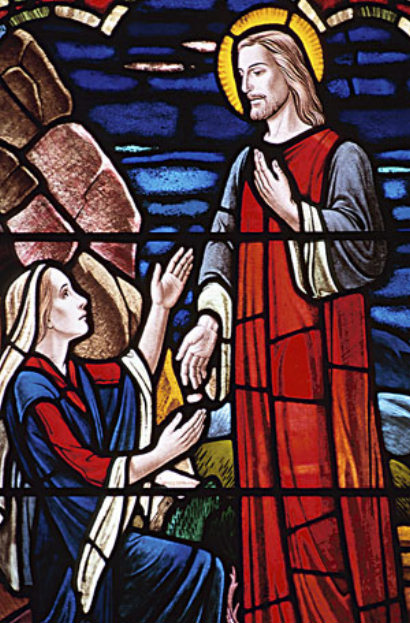
When the women see Jesus, they respond by falling at his feet and worshiping him. What else could they do? He was dead and now he’s alive. In their joy and maybe a little disbelief they grab hold of his legs and give praise and thanks to God, for God’s gift of life. Yes, this was a beautiful sight, grander than the Grand Canyon, more wondrous than Crater Lake, and more majestic than Mount McKinley.

This is the sight that stirs in our hearts the joy that rings out in professions of faith like the one we opened worship with: "Christ the Lord is risen today, Alleluia!" In this great hymn of Easter, we respond to Charles Wesley 's invitation to all creation, that creation might "raise your joys and triumphs high, Alleluia!"

In coming with the women to the tomb of Jesus, not only do we discover its emptiness, but we also encounter the life-giving presence of our Lord, who calls on us to bear witness to God’s reconciling grace. This discovery should lead us to declare our faith in God with these words:

"Love's redeeming work is done, Alleluia!
Fought the fight, the battle won, Alleluia!
Death in Vain forbids him rise, Alleluia!
Christ has opened paradise, Alleluia!"
Yes, let us rejoice that in Jesus Christ, death has lost its sting, so that neither death nor hate will reign supreme in our lives and in our world. Alleluia!

Preached by:
Dr. Robert D. Cornwall
Pastor, Central Woodward Christian Church (Disciples of Christ)
Troy, Michigan
Easter Sunday
April 24, 2011

Thursday, April 21, 2011

Death and Resurrection! -- A Lectionary Meditation for Easter

Jeremiah 31:1-6


Colossians 3:1-4


Matthew 28:1-10


Death and Resurrection!


As we once again experience Holy Week, we’re reminded that life emerges from death. There is no better analogy of this truth than the transition from winter to spring, which is why it seems appropriate that Easter and the coming of spring coincide. With spring’s coming, the long dormant flowers and trees suddenly come back to life as spring’s warmth replaces winter’s cold darkness. Surely, we can see the parallels between this and Good Friday/Easter.

Now, of course, there are questions to be addressed when it comes to the Resurrection. David Hume has had his way with us, and we must face the fact that people just don’t rise from the dead every day. Therefore, we don’t have analogies that can truly help us grapple with this article of faith. Is it a physical event or a metaphor? The Gospels speak of empty tombs and appearances, and we even have defenses of the event against charges that the disciples stole the body. Of course there are the discrepancies between the various stories as to when and where and how Jesus appeared to his disciples. Did he meet them in Jerusalem or in Galilee (or both?). We can speculate, but that gets us nowhere. Whatever the nature of this reality – and I personally find myself somewhere between Marcus Borg and N.T. Wright – and the nature of the debates, what we hear in these texts of Easter is a call to confess our faith in the risen Lord. It is a reminder that we don’t serve a dead hero, but a living Lord, who shares with us the fullness of God’s everlasting love.

Ultimately we must hear each witness on its own, listening for its voice, and in this case, for this meditation (and for Sunday’s sermon) I will limit my thoughts to Matthew’s testimony – together with that of Jeremiah and the author of Colossians.

Jeremiah doesn’t explicitly speak to Easter -- there’s no promise of resurrection here, but there is a promise here concerning God’s intention to be present with us forever, sharing with us the everlasting love of God. Now this word goes first and foremost to Israel, which must endure the suffering of exile, but here in Jeremiah 31 comes the promise that God hasn’t forgotten them. God promises to be the God of all Israel, even as they have endured the wilderness. The word that comes to Israel (and to us) is that God has loved Israel with “everlasting love,” and therefore God continues to be faithful to Israel. This confession of God’s faithfulness leads Jeremiah to invite the people to pull out their tambourines and begin to dance like merrymakers. Having heard the promise that Israel will continue to be God’s people and that exile is ending, they are invited to celebrate something that is equivalent to life out of death. But not only will they dance, but they will also plant. Yes, merrymaking leads to work. And from there, the call goes out: “Come, let us go up to Zion, to the Lord our God. All of this, however, is but a sign of God’s everlasting love. As I reflect on this truth, my thoughts go to the point made by Rob Bell in his new and controversial book, wherein, he speaks of God’s desire that all be saved–or reconciled. He writes:

History is about the kind of love a parent has for a child, the kind of love that pursues, searches, creates, connects, and bonds. The kind of love that moves toward, embraces, and always works to be reconciled with, regardless of the cost. [Bell, Love Wins, p. 99].

Jeremiah understands this truth – God seeks out and restores the people to the land, and therefore they will rejoice with song and dancing, and also by planting, by taking possession of the land that is promised. This is, after all, an act of love.

We hear the resurrection story from Matthew’s perspective in this lectionary season (unless you decide to go with John’s version). In this version of the story, Mary Magdalene and another Mary go to the tomb, though the reason for their visit isn’t mentioned. As they reach the tomb on this first day of the week, with the Sabbath behind them, they discover that an earthquake has rolled the stone away from the tomb. Now, I know something about earthquakes and generally their not as localized as this report would suggest. Whatever the nature of the quake, the stone is rolled away, and an angel of heaven with a countenance like that of lightening, and the clothes, a dazzling white, sits on the stone – having frightened the guards away. The message of this angel is simple: Don’t be afraid (like the guards?). Instead, hear the message he brings – the one they look for isn’t there, but is instead risen from the dead, just as he had said. Remember, God is faithful! They might not have gotten the message, but God remains faithful, due to God’s everlasting love.

The angel has another message – go tell the disciples to meet Jesus in Galilee. With this command these two women become the first witnesses to the resurrection – at least of the empty tomb. But as they go back to the larger gathering, they receive another visit. This time it’s Jesus himself, and like the angel, he tells them to tell the disciples to meet him in Galilee (where they’ll receive their commissions). It bears repeating here that one of the marks of an apostle is that the apostle is a witness of the resurrection, and thus these two women are to be counted among the apostles of Jesus. Oh, and there’s one other thing about this passage, not only do the women bear witness of the resurrection, but when they meet Jesus they worship him. Matthew says that they grabbed his feet and worshiped him (proskynein). While this could mean an acknowledgment of someone of higher rank, James Dunn notes that in almost every case in the New Testament it’s used in relationship to worship of God or of Jesus (as is the case here) [James Dunn, Did the First Christians Worship Jesus?, p. 10-11].

There’s not enough space here to wrestle with the issue of what it means to say that they worshiped Jesus, but it’s clear that the women are rejoicing at this sign of God’s everlasting love. They can’t help not worshiping this one who was dead and now lives! And is that not the point of Easter – the one who brings God’s everlasting love to us is alive and present with us, so that we need not see ourselves alone in the wilderness?

Finally, our attention goes to this short passage from Colossians 3, where the author (we don’t know if it’s Paul or not), declares that if we’re raised with Christ then we should look for the things that come from above, for that is where Christ is sitting – at the Right Hand of God. The message of resurrection is to consider the things of heaven, rather than the earth. For many of us this command does raise warning flags. We’re all aware of the danger of “being so heavenly minded that we’re of no earthly good.” That is, it sure sounds as if the author of this letter is giving us permission to walk around with our heads in the clouds, but I don’t believe that’s the case. It is, I would suggest a reminder to examine our own sense of allegiance. If you are a follower of Jesus, then you must keep your allegiance with the one who sits at the Right Hand of God. And when he’s revealed then you, having hid your life in Christ, you will be revealed in glory.

Here we are at Easter, being called upon to declare our allegiance to the one whom God has raised to the Right Hand, a God who as Jeremiah reminds us, is faithful to the promise to love with everlasting love. If this is true, if Easter is true, then what is your response? How will you celebrate Easter’s glory?  Will you take out the tambourine and dance for joy?

Friday, April 15, 2011

It May Not Be What It Seems -- A Lectionary Meditation for Palm Sunday

Psalm 118:1-2, 19-29

Matthew 21:1-11


It May Not Be What It Seems


Palm Sunday is a rather odd feast day in the life of the church. We come to church ready to celebrate. We get to wave palms and celebrate with Jesus as he enters the city of Jerusalem in triumph. We get to join with the people who gathered that day for the festal parade and hail Jesus as king of kings and son of David. We sing hymns like “All Glory, Laud and Honor” and “Ride on, Ride on in Majesty.” We wave palm branches as the choir and clergy enter into the sanctuary. We join the crowds of old in shouting Hosanna to the King of Kings. It’s a grand and glorious parade, and yet this grand and glorious hour quickly fades into something else much less triumphant. This is in many ways the picture of an aborted revolution. The powers that be see their foe and crush it before the spark can grow into a fire.

I’m not sure how other preachers feel about Palm Sunday, but I’m rather ambivalent about the day’s events. I enjoy the pageantry, but I don’t want to get caught up in it, because I know that tragedy must come before triumph. If we skip from Palm Sunday to Easter, without stopping to ponder the day of the cross then we will have misunderstood the whole thing. We’ll be lulled into believing that the Christian life is just one triumph after another; not realizing that with triumph often comes suffering and death. But maybe that’s the point of Palm Sunday; if we look at it as only the opening act of the Holy Week story, then we’re reminded of the ease with which we misinterpret the signs, often jumping the gun and failing to see the underlying currents.

Although the lectionary readings for Palm Sunday, at least in this cycle, only provide us with two texts, one from the Psalms and the other from the Gospel, these texts are sufficient. One text, the Gospel of Matthew tells the story of the day, but it’s Psalm 118 that provides us with the lens through which we can truly understand that all might not be as it seems. The Psalmist seems to have caught sight of this undercurrent and names it for us, while at the same time providing us with a word of promise.

We begin with the story of Palm Sunday as it is told in Matthew 21. It’s a well-known, oft-told story. Jesus approaches Jerusalem, and when he comes near the Mount of Olives, he sends two disciples into the village of Bethpage to get a donkey, and with it a colt, and they are to bring these to Jesus. If anyone should ask why they are doing this, they’re to tell them that the Lord sent them. This interchange has led to lots of speculation. Did Jesus have this set up ahead of time? Or did Jesus foresee this happening (after all he is the Son of God and therefore knows all things). And the speculations go on and on, without any real resolution. All of this, however takes place because it fulfills the words of the prophet (Zechariah 9:9), who foresees Jerusalem’s king riding into the city riding on a colt, the foal of a donkey. The gospel writer misses the poetic parallelisms and envisions two animals at interprets Zechariah 9. The other gospels have only one animal.

In any case, this donkey will be the sign of a royal entrance, which Jesus reenacts. Those who see him riding into Jerusalem understand the sign and dutifully hail him king and Messiah (Son of David). They put their cloaks and palm branches out in front of him as a sign of their allegiance, all the while shouting “Hosanna to the Son of David.” And “Blessed is the one who comes in the name of the Lord. As he makes his entrance the city is said to be in turmoil with everyone asking who he was? Those in the know respond: “This is the prophet Jesus from Nazareth in Galilee.”

An act such as this had to be seen as provocative by the authorities. It would have made the Temple authorities, to whom general governance was given by the Romans, nervous, and it would have made the Romans nervous. As the Gospels tell it, this entrance takes place on the eve of the Passover celebration, when the city was filled with pilgrims. And, as Marcus Borg and John Dominic Crossan suggest, Jesus’ “peasant procession” likely was being paralleled by an imperial procession into the city. They envision Pilate entering the city accompanied by his troops who normally were stationed in Caesarea Maritima. As they put it:

Pilate’s procession displayed not only imperial power, but also Roman imperial theology. According to this theology, the emperor was not simply ruler of Rome, but the Son of God. (Borg and Crossan, The Last Week, p. 3).
Two processions each representing rival theologies – one imperial and the other representing the Kingdom of God. Thus, we have a clash of ideologies and theologies, which means that what appears to be a scene of triumph on the surface will likely lead to dangerous encounters as the week progresses. But that is not the story that Matthew is ready to tell just yet. In the meantime we bask in the glory of the day.

The Psalmist helps us put this scene in context. This selection from Psalm 118 begins with a profession of faith in the Lord, who is not only good, but whose “steadfast love endures forever.” From this confession we move down to the Psalmist’s description of a festal parade through the “gates of righteousness.” It is through this gate that the righteous enter so that they might give thanks to the Lord for the salvation that the Lord has brought to them. But salvation has come at a cost, for “the stone that the builders rejected has become the chief cornerstone.” There will be triumph, but there will also be tragedy. This verse stands as a reminder to us that we shouldn’t put too much stock in the exuberant welcome offered to Jesus. Things have a way of souring. People can be fickle.

But in the meantime, let us rejoice and beseech God to “give us success!” With this prayer upon our lips, we join in the parade, crying out: “Blessed is the one who comes in the name of the Lord.” The Lord gives us light so that we can enter the festal parade with branches, and make our way to the “horns of the altar.” There we will offer our sacrifice of praise, giving thanks for God’s provisions. Indeed, we give thanks that God’s “steadfast love endures forever.” Even as the initial triumph is fleeting, so will be our fall. In the end, we can trust in this Love that is God’s. We can take our hope in this promise, because as Tom Oord points out in his book The Nature of Love, when the scriptures speak of God’s everlasting love, it is rooted in the premise that God loves of necessity. That is, when we give thanks this Palm Sunday for God’s chesed (steadfast love) we are talking about God’s essential being that evidences itself in love of God’s creatures (Oord, The Nature of Love, p. 130).

Palm Sunday provides great difficulties for us, because it tempts us to believe that the Christian life runs from one triumph to another. Jesus enters the gates of the city and then jumps to heaven the next Sunday. But that’s not the way it works. We must continue the journey, which leads through betrayal, torture, and death. In Tom Troeger’s hymn for Palm Sunday, “A Cheering, Chanting, Dizzy Crowd,” after speaking of the parade, he offers us these two final stanzas:

Lest we be fooled because our hearts have surged with passing praise,
remind us, God, as this week starts where Christ has fixed his gaze.

Instead of palms a winding sheet will have to be unrolled,
a carpet much more fit to greet the king across will hold. (Chalice Hymnal 193)
The parade of palms will stir our hearts, but it’s not yet time to celebrate the final triumph. Palm Sunday is in many ways a false start. Jesus goes into the city, checks it out, and leaves. No revolution yet! But as the hymn reminds us, the journey has just begun. The triumph that we will celebrate on Easter, must go through Good Friday, and it is in this journey that we see God’s steadfast love truly revealed. In this journey from this triumphant gate to Easter, we discover that God is not only present in the moments of glory, but even more powerfully in our moments of suffering and despair.

Sunday, April 10, 2011

Building on Strong Foundations -- Sermon #9 on the Sermon on the Mount

Matthew 7:24-29

Remember back when this sermon began – no, not my sermon, but Jesus’ sermon? Remember how Jesus had decided to get away from the crowds that had been coming from as far away as Syria in the north and Judea in the South to hear him speak and maybe be healed? He took his disciples up on the mountain so he could teach them about God’s realm in peace and quiet. As you remember, he began with the Beatitudes: Blessed are the poor in Spirit, blessed are those who mourn, blessed are those who are meek or are merciful, and so on. At least from the way Matthew seems to tell it, you’d assume that just Jesus and the disciples have gathered on that mountain. But as we come to the end of Jesus’ sermon, the group dynamics have changed. Without so much as a head’s up we hear that “when Jesus had finished saying these things, the crowds were astounded at his teachings . . .” Where did the crowds come from? How did this small group bible study or ministry staff meeting become a convention?

1. Wise and Foolish Builders

Now that the audience has grown from a few dozen into the hundreds, we find Jesus closing out his sermon with a parable about two kinds of builders: wise ones and foolish ones. I don’t know about you, but if I were going to build a house, I’d want to choose the right builder; one who not only had the right credentials, but understood the lay of the land. After all, none of us want to watch as our house gets washed away by the storm.

When it comes to rain, you may have heard the song that claims that “it never rains in Southern California.” In case you’ve never been to California and think that it’s sunny all the time, I can attest to the fact that it does rain, and when it rains in Southern California, it pours. And, when it rains, especially if there have been fires, which are common in Southern California, there likely will be mud slides as well. That means, that if you have live in a house on a hill overlooking the ocean, you had better hope that you’ve hired a wise builder, or your house might end up in the ocean!

So, wisdom is a necessary quality in a builder, and a wise builder will not only know how to build a house, but the builder also will know where to build it, taking into consideration such things as climate, soil, bedrock, and plate tectonics. Then, when the rain comes, that house won’t fall into the ocean.


2. Two Types of Foundations

This parable has two main elements. The first element is the quality of the builder, but the second element has to do with the foundation, and as we think about the foundation upon which we build our own spiritual lives, I’d like to switch the metaphor from floods to earthquakes. Being from the West Coast, I’ve experienced a few earthquakes and I’ve seen the destruction that they can bring.

Although I wasn’t there when that 6.0 earthquake hit my hometown of Klamath Falls in 1993, I think that it illustrates Jesus’ point very well. That quake, which hit just a few days after we returned home from a visit with my Mother, was pretty good-sized, especially when you consider that quakes don’t hit Klamath Falls very often, and so they weren’t all that prepared for it. Quite a number of buildings were damaged, including the venerable Court House, which had sat for many years on reclaimed lake bed. When the quake hit, it essentially liquefied the soil, and that seemingly well-built stone building collapsed. Ironically, just down the street sits the Baldwin Hotel, which is the oldest building in town. I don’t know how well this unreinforced brick building from the late 19th century was built, but it didn’t suffer any damage at all. In fact, not one thing even moved during that very large and destructive quake, not even a picture sitting on the mantle of the fireplace. You see that builder very wisely built the hotel on solid bedrock. This was a very “firm foundation.”

The Court House was well-built, but it was built on sand, while the rickety old hotel was built on bedrock – two very different foundations, with very different outcomes.


3. Acting on the Word of Jesus

The wise builder builds on a firm foundation, and with this word in mind, we hear Jesus say that “everyone then who hears these words of mine and acts on them will be like a wise man who built his house on rock” and not on sand – like the foolish builder.

As I reflected on these words after I returned home from yesterday’s Elders Meeting, where Alex led the Elders in a team building exercise to help us reflect on our call to be a missional church, my thoughts went immediately to the scripture that Alex asked us to reflect on from the Letter of James. In this letter we find the words: “But be doers of the word, and not merely hearers who deceive themselves” (James 1:22ff). According to James, if we simply hear the Word of God, but don’t act upon it, then we’re like the person who looks in a mirror and then goes off and forgets what they look like. When we’re hearers only and not doers, then we fail to practice a religion that is pure and undefiled before God, a religion that involves not just religious acts, but more importantly involves caring for the orphan and widow in their distress.

With this word from James in mind, we hear the word of Jesus who also tells his disciples that if they’re to enter the realm of God, then they must be doers and not just hearers, for that wouldn’t be a wise choice. And, as for what Jesus wants us to not only hear but do, the path forward is revealed throughout his sermon, which we’ve been pondering these past several weeks. And as we’ve been discovering as we’ve been on this journey, this isn’t an easy path to take. There have been many who’ve started out on the journey, only to turn back, but we do have few guides for the journey – people like St. Francis tried and Dietrich Bonhoeffer. And there’s Gandhi who found great inspiration in these words, even if he didn’t find much inspirations from the lives of Jesus’ followers.

The Sermon on the Mount is an invitation to enter the Realm of God. Jesus describes what it means to live under the reign of God, not just in heaven, but on earth as well. But that means living our lives differently, which is what I think James means when he calls on the church to “keep ourselves unstained from the world.” This is also what it means to pray the Lord’s Prayer and ask that God’s will would be done on earth as in heaven. In praying this prayer, we pledge our allegiance to God, so that we might live our lives in such a way that we’ll be salt and light in the world; that we won’t act out of anger or commit adultery; we’ll keep our word without needing to take an oath; and we won’t retaliate against those who hurt us. And, while the Law tells us to love our neighbors as we love ourselves, we will also love our enemies and not make a show of our piety. As for our treasure, we will deposit it in a heavenly bank and not worry about tomorrow, which will take care of itself. If we’re living under the reign of God, we’ll leave the job of judging others to God and not profane that which is holy. To live under the reign of God means doing for others, as we would have them do for us.

The way of the kingdom means taking the narrow path, which is difficult for us to navigate, at least on our own. We could decide, as some have, to simply file this sermon (of Jesus) under the heading – “Not for Earthly Lives – Heaven Only.” I think this would alleviate a lot of guilt, but I wonder if that is what Jesus had in mind. After all, when he contrasted the wise and foolish builders, Jesus seemed to suggest that now is the time to not only hear his words, but to act upon them. This, he says, is to be like the wise builder.

Jesus’ closing words find an echo in a book I mentioned in a sermon a few weeks ago. In his book Falling Upward, Fr. Richard Rohr asks his readers whether they’ve laid a solid foundation for their lives in Jesus Christ, so that the Spirit might help them build upon this foundation and embrace God’s future for their lives, for the church and for the world. This is, he suggests, the path to spiritual maturity, a path that is very much like the one Jesus outlines in the Sermon on the Mount. Like Jesus, Rohr invites us to live a life of wisdom, one that is based on a firm foundation in Jesus Christ, so that we might embrace the mission of God.

It isn’t an easy path, but as our closing hymn declares, having laid a foundation in God’s excellent word, then we can find our strength for the journey in God’s unwavering love, which leads us to declare this word of faith as we sing the final stanza of this great hymn of the faith:

The soul that on Jesus still leans for repose,
I will not, I will not, desert to its foes;
that soul, though all hell should endeavor to shake,
I’ll never, no never, no never forsake. (How Firm a Foundation)

Preached by:
Dr. Robert D. Cornwall
Pastor, Central Woodward Christian Church (Disciples of Christ)
Troy, Michigan
Sixth Sunday of Lent
April 10, 2011

Sunday, March 27, 2011

Judge Not, Lest Ye . . . 7th Sermon on the Sermon on the Mount

Matthew 7:1-14

Although many of us enjoy being judge and jury, few of us want to face judgement. We like the words “judge not, lest ye be judged,” and yet it’s almost part of human nature to judge others. Therefore, we find ourselves saying: “Can you believe the way she dresses? It’s embarrassing.” Or, “Did you hear what he said? Well, I just think that’s totally inappropriate!” Or, “Did you hear that Sam went to the casino last week, and he calls himself a Christian?” In case you believe yourself incapable of such words, Jesus has an unflattering word to describe you (and me).

As we continue our journey through the Sermon on the Mount, we come to an invitation to examine closely our lives. Instead of judging others, we hear Jesus calling on us to judge ourselves. Of course, the task of facing our own inner demons isn’t an easy task, which is why very few of us answer this call. But, if we’re going to seek first the kingdom of God, then this is the road we must take.


1. Logs and Splinters

Jesus is a master of language, and his choices in metaphors cut through the noise that surrounds our lives. In this passage from Matthew’s gospel, we hear words about splinters and logs. Although we enjoy sitting in judgment of others – admit it, you like it – we’re really not in the position to render judgment on the lives of our neighbors. That’s because we have logs in our eyes that keep us from seeing the splinter that lies in the eye of our neighbor. You simply can’t pull something out of the eye of another person, when there’s an impediment so large sitting your eye that you can’t even see the face of the other. So, take care of that impediment, before trying to do surgery on someone else.

As we contemplate these metaphors, we might benefit from hearing another story, this one being from the Gospel of John. If you look at most bibles, the story of the woman caught in adultery will be in the margins or in parentheses. That’s because there are questions about whether or not it is original to this gospel, but whether or not it originally was in John’s gospel, it speaks to an important truth.

According to this story, a group of religious leaders brings this women who had been caught in adultery and challenged Jesus to render judgment. That meant casting the first stone. Jesus puts the onus back on them, and says to the accusers – “let the one who is without sin, cast the first stone.” When no one comes forward, Jesus says to the woman, no one comes to condemn you, neither do I, but go and sin no more. If we take the biblical witness to heart, Jesus is in a position to cast that stone, but he chose not to do so. Since he chooses not to render judgement, then perhaps we shouldn’t either.


2. Proper Gifts

Of course Scripture speaks of judgment, and next Sunday’s sermon carries the title “Judgement Day.” Although there is a place for judgment, it is God and not us, to whom this task is entrusted. When we try to take on the role of judge, we’re assuming the prerogative of God. Now, the reason why we should leave the role of judge to God isn’t because God is important and we’re not, but instead it’s because of the character of God.

This is why the words that follow the word about judgment are so important. Jesus tells us that if we ask, we’ll receive; if we seek, we’ll find; and if we knock the door will be opened. This is because God is faithful to God’s promises. When it comes to the promises of God, there will be no bait and switch.

Of course, we need to understand that the promises of God are related to the kingdom of God. The promise is made to those who seek first the kingdom and place their treasure in heaven. Although, there are those who would say otherwise, Jesus isn’t promising us a Lexus or a mansion, or even a check for a million dollars, not even if you promise to donate 10% to the church. But because God, who is the giver of every good and perfect gift and who will not do evil, then we can trust God. Yes, as Jesus says, God is like a loving parent, who when a child asks for bread doesn’t give a stone instead, or when a child asks for a fish, gives a snake instead. Indeed, if you, who are evil, don’t treat your children that way, then surely God, who is righteous and loving won’t either. The reason why we should leave the task of judgment to God, is that God isn’t just good, but because God’s essence is love in all of love’s dimensions.

God is love, which doesn’t mean that God is a sentimental chap, but rather, to borrow from Tom Oord’s definition of love, God acts “intentionally in sympathetic/empathetic response to others, to promote overall well-being” (Oord, The Nature of Love, p. 17). This definition of love defines the nature of God, and it also provides the context in which God acts in judgment of the world.

3. Do unto others . . .

Instead of rendering judgments that neither you nor I are prepared to offer, “treat people in the same way that you want people to treat you; this is the Law and the Prophets.” (Mt. 7:12 CEB). These words form what we call the Golden Rule, and this rule is simply a paraphrase of the second great commandment – “love our neighbors as you love yourself.” As you consider this golden rule, remember that Jesus defined neighbor to include one’s enemies, and agape love, as Tom Oord suggests, means intentionally promoting the overall well-being of those who mean to do us evil. This is, of course, no easy task, which is why few of us heed the call to love the world as God loves the world.

But, if you love in this way, then you fulfill the Law and the Prophets. You may have thought that Jesus renders the Law and the prophets null and void, but that isn’t true. Jesus never abandons either the Law or the Prophets, because without them we won’t know how to act toward others. As Stanley Hauerwas, who is known to be a rather radical sort of character, puts it: “love is the fulfillment of the Law.” And, having said that, he goes on to say that love is “a radical politics that challenges the world’s misappropriation of God’s good gift.” Indeed, if Christ embodies God’s love, then we can’t “know love apart from loving one’s enemies.” (Mt. 22:37-40). [Stanley Hauerwas, Matthew, Brazos Press, 2006, p. 89].

If we’re going to take the journey that Jesus outlines in the Sermon on the Mount, then we’ll have to give up trying to be judge and jury. Instead, of trying to be judges of others, we can begin loving our friends and our enemies as God loves them. If we’re going to join God in the work of transforming this world in which we live, then we’ll have to take the narrow pathway, which is the road less traveled.

So how do we know which path to take? Dietrich Bonhoeffer writes in his book on discipleship that we’ll know the way if we keep our eyes focused on Jesus, who walks in front of us, leading the way. Bonhoeffer writes:

He is the narrow road and the narrow gate. The only thing that matters is finding him. If we know that, then we will walk the narrow way to life through the narrow gate of the cross of Jesus Christ, then the narrowness of the way will reassure us. [Bonhoeffer, Discipleship, (Fortress, 2001), p. 4:176].

This narrow path doesn’t take the form of legalism, with a lot of senseless rules and regulations that tell us not to do this or do that or we’ll be excluded. It’s not a matter of dress codes and good manners, or even having all the right beliefs. What it does involve is living life in a way that honors God and seeks to promote the well-being of others. That’s not an easy path to take, but this is the path way that leads from what Richard Rohr calls the first half of life to the second half of life.

If we’re going to take this path then we’ll have to “let go of our own smaller kingdoms,” which we’re not always eager to do, and instead choose union with God. That means letting God lead the way. If we choose this path, and let God both guide us and judge us, then we’ll begin to think in a way that leaves plenty of room for others to join us in communion with God. As Fr. Rohr writes: “Everyone is in heaven when he or she has plenty of room for communion and no need for exclusion. The more room you have to include, the bigger your heaven will be” (Richard Rohr, Falling Upward, p. 101).

It is my prayer that each of us will let go of the need to judge others, but instead as we recognize our own need of forgiveness and restoration, that we will commit ourselves to the way of the kingdom, and in doing so, we will promote the well-being of all those who share this world with us. In this we will know the fullness of God’s presence, and that is what it means to be in heaven!
 
Preached by:
Dr. Robert D. Cornwall
Pastor, Central Woodward Christian Church (Disciples of Christ)
Troy, Michigan
3rd Sunday in Lent
March 27, 2011

Friday, March 11, 2011

Temptation -- a Lectionary Meditation

Genesis 2:15-17, 3:1-7


Romans 5:12-19


Matthew 4:1-11


Temptation

“There are several good protections against temptation, but the surest is cowardice.” (Mark Twain)
Two stories of temptation lead off the Lenten journey, reminding us that temptation is an ever present challenge. Though, as Mark Twain notes, there are ways of dealing with temptation, the most effective being – run for the hills! Or better yet, never take risks, and you’ll not have to deal with problems such as this. But if we want to live fully and put ourselves in a position to grow and mature in our faith, then we must face the prospect of falling prey to temptation. It is, in fact, the central theme of the biblical story. Richard Rohr writes:

It is not that suffering or failure might happen, or that it will only happen to you if you are bad (which is what religious people often think), or that it will happen to the unfortunate, or to a few in other places, or that you can somehow by cleverness or righteousness avoid it. No, it will happen, and to you! Losing, failing, falling, sin, and the suffering that comes those experiences – all of this is a necessary and even good part of the human journey. [Richard Rohr, Falling Upward, (Jossey Bass, proof copy), p. xxii]
It is important that as we take in these stories that we not forget that falling down is part of the journey, but growth comes as we get up and move forward in the presence of God. In this week’s lectionary readings there are two stories of temptation – one referring to Adam and Eve and the other to Jesus. In the middle we come across Paul’s meditation on sin and redemption – through one man sin comes into the world, through the second man its effects are overcome. In Genesis God puts a tree into the middle of the garden and says – don’t eat or you’ll die. In Matthew, Jesus is baptized by John and then is immediately driven into the Wilderness by the Spirit so that he might be tested. Are we ready to be tested? That is the question.

In the first story God puts a man in the garden and tells him to till it and tend to it. He can eat of all the trees in the garden, except one, and if he eats of this Tree of Knowledge he’ll most assuredly die – though Genesis doesn’t tell us how this will occur (Gen. 2:15-17). But, as you read this warning, you have to know that something untoward is going to happen. You can’t put a tree in the middle of the garden that has really good looking fruit on it and then say – don’t eat. You know he’ll eventually bite into the fruit. With this warning in place, the lectionary guides have us skip over the section where God creates the woman as the man’s companion, and takes us to the encounter between the woman and the Serpent, who according to the writer of this text is the craftiest of God’s creations. Note here that the reference isn’t to the devil, though later interpretive tradition will make this connection. The Serpent says to the woman: “Did God say, ‘You shall not eat from any tree in the garden?” Of course, God didn’t say anything of the sort. God said you have all that you need, so stay away from that tree in the middle of the garden. If you eat it, you will die. The woman knows the truth and responds accordingly. But the key to the discussion is the suggestion by the Serpent that the reason God doesn’t want them to eat of the fruit is that upon eating it they will be like God, knowing both good and evil. The Serpent promised wisdom, but God asked for trust, trust that was quickly broken. And upon eating the fruit, the eyes of both are opened and they discover that they are naked, and so they cover themselves with fig leaves. Yes, shame enters the picture and the two whom God created to be companions are now alienated from each other. And as the story goes on, they hide even from God, suggesting that alienation from God had also crept into the picture. While we talk about sin here, the real issue is one of broken trust. But, as Rohr points out – that is part of life. The question is – how will we respond to the realities. Will we get back up and seek reconciliation? Will we allow that original trust to be restored?

Before we turn to Matthew’s temptation story, we turn to Romans 5, where Paul talks about the consequences of the man’s transgressions. Although the woman is often blamed for the Fall, Paul is of the mind (maybe it’s his chauvinism) that the man is responsible. Of course, Paul is also concerned about creating a parallel situation. Adam is seen as the one who breaks trust with God, and therefore allows for sin and death to enter the picture. The passage opens with one of the most pregnant verses in the New Testament. Taken literally it seems to give support to the doctrine of original sin. Paul writes that it was through a man (Adam) that death came into the world because of sin, and death spread to all humanity because all sinned. Paul is reaching back to Genesis 2-3, and offers his explanation as to why sin is so prevalent and why death is experienced by all. Because of Adam we all die, and the culprit has traditionally been seen as original sin. We sin because of Adam and we die because of him. It seems so genetic, but not so fast. Note that Paul says that death spread to all because all sinned, not because the man sinned. Sin was present since the beginning of human history – that is the implication of the text, and it has had devastating effects. It is also clear that sin is not simply disobedience of the Law, because sin and death existed prior to Moses.

The key point in all of this is the role that Adam (the man) plays in the story. Paul says that Adam is the type of the one to come. And while sin and death was introduced into the world through the actions of the first man, through the work of the second Adam (Christ) comes grace. Thus, if many die because of the first man’s sin (setting the world in motion toward disobedience), so in the second Adam’s obedience this is turned around. In a statement that almost sounds universalist in intent, Paul says that “because of the one man’s trespass, death exercised dominion through that one, much more surely will those who receive the abundance of grace and the free gift of righteousness exercise dominion in life through one man, Jesus Christ (Rom. 5:17). We must face the reality of sin – however it may have come into the world – but the good news is that in Christ its effects have been overturned. Forgiveness is ours.

When we read Matthew’s Temptation story, it’s easy for us to discount the threat to Jesus’ identity. We just assume, or at least many assume, that Jesus is divine and therefore there’s really nothing to be concerned about. It’s all just a test, to which all the answers have already been given. There’s really no chance that Jesus would actually have failed or fallen. But if we take such a view. If there’s nothing really at risk in the incarnation, then what’s the point? Is it a mere exercise for our enjoyment? Is the devil too stupid to know that Jesus couldn’t fall, so God was having a good laugh? If these tests are real and God’s purpose could have been thwarted, then Jesus is – in Paul’s terms – the Second Adam. In his obedience he shows us the way to rebuild trust; how to walk in righteousness. But as the story goes, the devil gave it his best shot, but it wasn’t good enough. The temptations were truly seductive. Bread to end hunger; a spectacle to draw followers; rule over the world in exchange for a small bow. And yet in each case, Jesus stood strong in the Spirit. Jesus chooses to live by the words that come from the mouth of God; chooses not to put God to the test; and Jesus chose to worship God and not the devil. In the end the devil goes away, and the famished savior is tended to by the angels. It is in the obedience of the Second Adam that the disobedience of the First Adam is reversed. But obedience is more than playing it safe. Obedience involves taking necessary risks so that one might grow in faith and practice.

Temptation is part of life. We will fall, lest we believe that perfection is something to be guarded to such an extent that we’re not willing to live life in the presence of God. That is not, I believe, what God calls for us to do. It is in reality the way of death and not life. Let us then pursue God’s purpose for our lives, by living boldly in the world.

Sunday, March 6, 2011

Transfigured and Transformed! -- A Sermon

Matthew 17:1-9

For the past several weeks we’ve been with Jesus on a mountain being instructed in the ways of God’s realm. This morning we’re taking a brief detour to another mountain, where Jesus’ identity is more fully revealed to us. In this scene from Matthew’s gospel we watch as Jesus is transfigured and transformed, so that we might see more fully the presence of God in him. As we attend to this story, it becomes clear that understanding the gospels requires a bit of an imagination. Without imagination you might end up doing what Jefferson did and start cutting out the parts of the gospel that don’t seem to make sense to the rational mind. Now, I’m a rather analytical, rationalist type, and so this takes some doing on my part. Since I’m not much into poetry (though I do love music) and I don’t read a lot of novels (though I do like movies), I struggle with poet W.H. Auden’s suggestion that Christians need to be poets. Although I struggle with this word of wisdom, I believe he’s right – If we’re going to understand and appreciate the story of the Transfiguration, we must trust our imaginations.

1. THE REVEALING OF AN IDENTITY

The story of the Transfiguration takes us to one of those “thin places” where the membrane separating heaven and earth becomes transparent and we can see the things of God more fully and clearly. In this story, we see Jesus unveiled. His full identity shines through, even if for only a moment.

If we go back a chapter, we’ll find the Disciples trying to answer the question of Jesus’ identity. Jesus asks them “Who do you say that I am?” Peter answers the question with the “Confession” that we make when we join with this assembly and are baptized into Christ: “You are the Christ, the Son of the Living God.” Peter makes this “Good Confession,” but we quickly learn that he doesn’t quite understand the meaning of his words.

Now, six days later, Jesus takes Peter, James, and John up on a mountain where the question of identity is again raised, and to understand the meaning of this event we’ll need to look at reality a bit differently so that we can comprehend the glory and majesty of God who is present to us in Jesus. Writer Madeleine L'Engle, offers this poetic vision of the Transfiguration:

Suddenly they saw him the way he was,
the way he really was all the time,
although they had never seen it before,
the glory which blinds the everyday eye
and so becomes invisible. This is how
he was, radiant, brilliant, carrying joy
like a flaming sun in his hands.
This is the way he was -- is -- from the beginning,
and we cannot bear it. So he manned himself,
came manifest to us; and there on the mountain
they saw him, really saw him, saw his light.
We all know that if we really see him we die.
But isn't that what is required of us?
Then Perhaps, we will see each other, too.
[Madeleine L'Engle, Glimpses of Grace, (San Francisco: Harper-Collins, 1996), 64.

2. A TRIP TO ANOTHER MOUNTAIN

As we try to imagine the scene on the Mount of Transfiguration, it might be helpful to view a parallel scene in the Exodus story. As I read this passage consider the similarities and the differences in these two encounters with God.

The Lord said to Moses, “Come up to me on the mountain, and wait there; and I will give you the tablets of stone, with the law and the commandment, which I have written for their instruction.” So Moses set out with his assistant Joshua, and Moses went up into the mountain of God. To the elders he had said, “Wait here for us, until we come to you again; for Aaron and Hur are with you; whoever has a dispute may go to them.” Then Moses went up on the mountain, and the cloud covered the mountain. The glory of the Lord settled on Mount Sinai, and the cloud covered it for six days; on the seventh day he called to Moses out of the cloud. Now the appearance of the glory of the Lord was like a devouring fire on the top of the mountain in the sight of the people of Israel. Moses entered the cloud, and went up on the mountain. Moses was on the mountain for forty days and forty nights. (Ex. 24:12-18 NRSV).

Later on in the Exodus story we learn that after Moses returned from the mountain with the Tablets of the Law, his face was so radiant from being in God’s presence that the Israelites were afraid to look at him, and so he veiled himself so that he could enter the community (Ex. 34: 29-35).

As I read these two stories together, what seems apparent is that Moses’ radiance is a reflection of encountering God’s presence in the cloud, but Jesus’ radiance comes before the appearance of the heavenly Cloud of Presence. Therefore, it’s not so much a reflection as an unveiling. Therefore, in that moment the Disciples catch a glimpse of Jesus’ full identity. Only then, do Moses and Elijah appear to Jesus, and in their appearance we envision representatives of the Law and the Prophets, who bear witness to Jesus’ mission.

3. PETER'S RESPONSE

At first Peter doesn’t know what to make of all of this. He reacts like many of us do when we’re around famous people or people we admire. He sort of makes a fool of himself. In trying to make sense of Peter’s response, an occasion comes to mind. While waiting with a family at a surgical waiting room in Santa Barbara, we discovered that actor John Cleese – of Monty Python and James Bond fame – was also present in the waiting room. You see, his wife was in surgery, and while our group recognized him, we didn’t bother him, but as always happens, somebody broke the rules. One woman just couldn’t help herself, and so she asked him for an autograph, which he of course refused. Our group lent a nod of understanding and support to his action, but I can understand how easy it is to get caught up in the moment when you’re around someone famous.

Peter was a bit like that autograph seeker when he realized that Moses and Elijah were present, and he just couldn’t contain himself. Overwhelmed, he blurts out:

"Lord this is wonderful! If you want me to, I'll make three shrines, one for you, one for Moses, and one for Elijah. (Matt. 17:4 NLT).
Although it’s not really clear what Peter intended by this offer, because the Greek word can be translated as both tent and shrine, it seems as if Peter had a shrine in mind. Moses and Elijah surely were worthy of a shrine, but now it seemed as if Jesus might be worthy of one as well.

But there is another side to this story. Thomas Keating, a Cistercian monk and writer, suggests that maybe Peter wanted to prolong the experience, and so he offered to build tents for the three men, whom he now recognizes as being transcendent beings.

If we perceive the divine presence in some facsimile of this clarity, we are fascinated, absorbed, and delighted. Peter's response was to want to stay there forever. The more profound the experience of union, the more one cannot help but wish to prolong it. [Thomas Keating, Reawakenings, (NY: Crossroads, 1992), 117.]
Like anyone who has experienced something as profound as an encounter with God, Peter lost all interest in the world below, and wanted to stay put. This is, of course, often true of our mountain top experiences. It’s hard to come down from the mountain. Moses experienced it, so did Peter.

4. THE VOICE OF GOD

Although Peter got caught up in the transformation of Jesus’ appearance and then Jesus’ conversation with Moses and Elijah, what happened next transcended even these two earlier events. Even as Peter made his offer to Jesus, a cloud descends on the mountain, and a voice from the cloud speaks words that readers of the Gospel first heard at the baptism of Jesus:

This is my beloved Son, and I am fully pleased with him. Listen to him (vs. 5 NLT).
As this voice echoes from the skies, Peter and his companions discover that Moses and Elijah have disappeared, leaving Jesus alone with them. This voice demanded that they listen to Jesus, because he is the one who will speak for God in this new age. He is the new law giver and the new prophet. As we ponder this scene, Thomas Keating again offers a helpful interpretation:

Listen not just to his words to which they had been listening when they were on the plain, but "listen to him," the divine person who is speaking to you. Listen to the divine presence that is incarnate in this human being. Listen to the infinite Silence out of which the incarnate Word emerges and to which it returns. (p. 118)
Having heard the voice of God, they fall on their faces in fear, but Jesus gently touches them and invites them to get up and not be afraid.

Having encountered the divine presence the three disciples follow Jesus down the mountain. They’ve experienced something too profound for word; something that they really can’t understand until after the resurrection. With that in mind, Jesus tells them not to talk about their experiences until after the resurrection. As Keating puts it: “There would be no point of talking about it because no one on the plain would understand unless they had climbed a similar mountain." (p. 119).

In Matthew’s story of the transfiguration, we receive an invitation to climb the mountain so that we too might be transformed by our encounter with God. In a moment we will gather at the Table, and we as break bread together we will encounter this presence, even as the disciples experienced it on the road to Emmaus – as Luke’s Gospel tells the story of the post-Resurrection unveiling of Jesus (Lk 24:13ff).

As we hear this story, may we let loose our imaginations, those precious gifts that allow us to see beyond what is rational, so that we might join Peter, James, and John, in seeing the fullness of God’s splendor revealed in the person of Jesus. Then we too will be transformed, as Paul puts it, by the renewing of our minds, so that we might discern the will and purpose of God (Rom. 12:2).
 
Preached by:
Dr. Robert D. Cornwall
Pastor, Central Woodward Christian Church (Disciples of Christ)
Troy, MI
Transfiguration Sunday
March 6, 2011